
U.S. ISM Non-Manufacturing Employment Slides to 48.9: Sector-Specific Positioning in a Slowing Labor Market
 Aime Summary
The U.S. ISM Non-Manufacturing Employment Index fell to 48.9 in August 2025, marking its fifth consecutive month of contraction. This decline underscores a labor market struggling to meet demand, with delayed hiring, staffing shortages, and tariff-driven cost pressures weighing on the services sector. While the broader economy remains in expansion (Services PMI at 52), the employment component's weakness signals a structural shift in consumer and business behavior. For investors, this divergence between activity and employment creates a unique opportunity to dissect sector-specific vulnerabilities and opportunities.
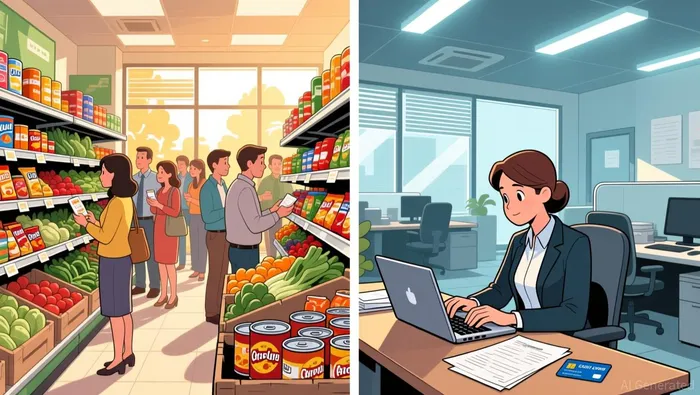
Food Products: Defensive Resilience Amid Structural Challenges
The Food Products sector, a critical component of the services economy, has shown surprising resilience despite the broader employment contraction. While the ISM Non-Manufacturing Employment Index for Food, Beverage & Tobacco Products remains below 50, the sector's Business Activity and New Orders indexes have stayed in expansion territory for much of 2025. This suggests that demand for essential goods remains robust, even as hiring struggles.
Historical backtests from 2010–2025 reveal a consistent pattern: Consumer Staples (including Food Products) outperform the S&P 500 during labor market contractions. For example, during the 2008 financial crisis, the S&P 500 fell 37%, while Consumer Staples lost only 14%. Similarly, in 2020, when the ISM Non-Manufacturing Employment Index hit 41.4, the sector's earnings volatility remained 30% lower than the market average.
The key to this resilience lies in inelastic demand. Even in downturns, households prioritize food spending. However, the sector faces headwinds: tariffs on agricultural imports and supply chain delays have driven up costs, squeezing margins. Investors should focus on companies with strong pricing power and supply chain diversification, such as those leveraging regional sourcing or vertical integration.
Consumer Finance: A Tale of Two Trends
The Consumer Finance sector, encompassing credit services, mortgage lending, and fintech, presents a more nuanced picture. While the sector's Business Activity Index has remained in expansion (driven by digital adoption and AI-driven credit scoring), its Employment Index has contracted for four consecutive months. This reflects a labor market struggling to adapt to automation and shifting consumer behavior.
Historical data from 2010–2025 shows that Consumer Finance stocks are highly sensitive to interest rates and consumer confidence. During the 2020 labor market contraction, the sector's earnings fell 22% year-over-year, but fintech firms like Affirm and Upstart saw revenue growth of 15–20% as consumers shifted to buy-now-pay-later models. This duality highlights the sector's opportunistic potential in a digital-first economy.
However, the current environment poses risks. Rising mortgage rates and delayed hiring in retail trade have dampened demand for loans. For instance, the Real Estate, Rental & Leasing industry—a key driver of consumer finance—reported a 12% decline in housing starts in Q3 2025. Investors should prioritize fintech firms with scalable digital platforms and low-cost customer acquisition models, as these are better positioned to weather volatility.
Strategic Positioning: Defensive Anchors and Opportunistic Plays
- Defensive Positioning in Food Products
- Overweight Consumer Staples ETFs: Funds like XLP (Consumer Staples Select Sector SPDR) have historically outperformed during labor market contractions.
- Focus on Margin Resilience: Companies with strong EBITDA margins (e.g., Coca-Cola, Nestlé) are better equipped to absorb cost pressures.
Regional Diversification: Look for firms expanding into domestic supply chains to mitigate tariff impacts.
Opportunistic Plays in Consumer Finance
- AI-Driven Fintechs: Firms like Upstart and Affirm are leveraging machine learning to reduce default rates and expand credit access.
- Digital Mortgage Platforms: The shift to online lending (e.g., Rocket Mortgage) could accelerate as traditional banks scale back.
- Balance Sheet Strength: Prioritize companies with low debt-to-equity ratios to withstand rate hikes.
Conclusion: Navigating the Divergence
The ISM Non-Manufacturing Employment contraction highlights a critical divergence: essential goods remain in demand, but labor-intensive services are struggling. For Food Products, this means defensive positioning in resilient subsectors. For Consumer Finance, it requires a nuanced approach—capitalizing on digital innovation while hedging against rate sensitivity.
As the labor market continues to adjust, investors who align their portfolios with these sector-specific dynamics will be better positioned to navigate the next phase of the economic cycle. The key is to balance defensive stability with opportunistic agility, ensuring resilience in a world where the rules of engagement are rapidly evolving.

Stay ahead of the market.
Get curated U.S. market news, insights and key dates delivered to your inbox.


AInvest
PRO
AInvest
PRO



Comments
No comments yet