
Ishiba's Uncertain Leadership and Its Implications for Japanese Equities
 Aime Summary
Japan's political landscape has entered a period of unprecedented fragility, with Prime Minister Shigeru Ishiba's leadership under intense scrutiny. The recent upper house election, which saw the ruling Liberal Democratic Party (LDP) and its coalition partner Komeito lose their majority, has left Ishiba governing with a minority in both chambers of the Diet for the first time since 1955. This seismic shift has not only destabilized domestic governance but has also sent ripples through global financial markets, particularly in Asia. For investors, the question is no longer whether Ishiba will remain in power but how his weakened position will reshape Japan's economic trajectory and regional influence.
Political Uncertainty and Its Impact on Governance
Ishiba's decision to cling to office amid calls for his resignation has created a precarious balancing act. His primary justification—managing U.S. trade negotiations and the looming 25% tariff on Japanese goods—has not quelled concerns about policy paralysis. With a minority government, Ishiba now relies on cooperation with opposition parties to pass legislation, a scenario that risks diluting his policy agenda. The rise of populist parties like Sanseito, which secured 22 seats in the upper house, further complicates matters. Sanseito's anti-immigration and anti-globalist rhetoric has polarized public opinion, while its potential to influence fiscal policy threatens to deepen economic divides.
The LDP's internal fractures are equally troubling. Prominent figures like former Prime Minister Taro Aso have openly questioned Ishiba's leadership, signaling a possible leadership challenge within the party. Meanwhile, the opposition Constitutional Democratic Party of Japan (CDPJ) is weighing a no-confidence motion, which could force a snap election or a government reshuffle. Such volatility raises the specter of prolonged uncertainty, with investors bracing for erratic policy shifts and delayed decision-making.
Market Reactions: Nikkei Volatility and Investor Sentiment
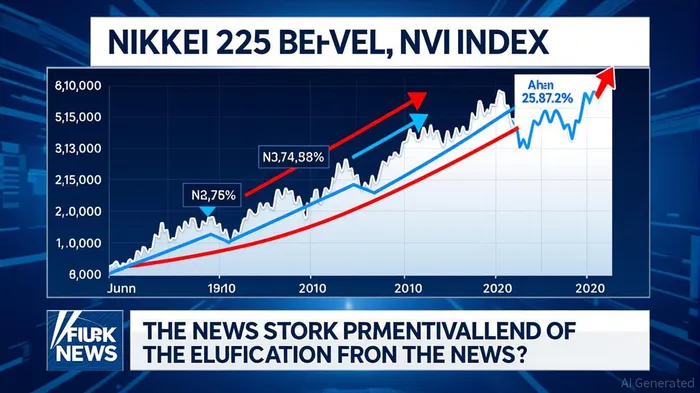
The Nikkei 225, Japan's benchmark index, has mirrored the political turbulence. On July 18, 2025, the index closed at 39,819 points, down 0.21% from the previous session, reflecting cautious sentiment. Over the past month, however, the index has gained 3.46%, buoyed by hopes of fiscal stimulus and a potential softening of U.S. trade demands. Yet, this modest recovery masks deeper fragility. The Nikkei Stock Average Volatility Index (NKVI) has surged to 22.92, indicating heightened investor anxiety.
Sectoral performance highlights the market's fragmented outlook. Electronic tech stocks, including Sony GroupSONY-- (-1.9%) and Keyence Corp (-0.6%), have lagged due to fears of trade disruptions and reduced corporate spending. Conversely, utilities and consumer staples have shown resilience, as investors seek defensive plays amid inflationary pressures. The yen, meanwhile, has swung between strength and weakness, with a post-election rally to 148.29 per dollar giving way to renewed depreciation as trade tensions with the U.S. linger.
Regional Implications and Geopolitical Risk
Japan's political instability has amplified regional geopolitical risks. The U.S. has already signaled frustration over stalled trade negotiations, with the August 1 tariff deadline looming as a critical test of Ishiba's ability to navigate his weakened position. A breakdown in talks could trigger a trade war with global ramifications, particularly for supply chains in the Asia-Pacific.
The rise of Sanseito and its “Japanese First” agenda also introduces new risks. Its anti-immigration policies and anti-globalist rhetoric could alienate foreign investors and disrupt Japan's postwar economic model of integration. This shift may accelerate capital outflows from Japanese equities, particularly in sectors reliant on international demand, such as automotive and electronics.
Strategic Entry Points and Risk-Mitigation Tactics
For investors, the current environment presents both challenges and opportunities. Here's how to navigate the uncertainty:
Hedge Against Volatility: Given the NKVI's elevated levels, consider volatility-linked instruments like Nikkei 225 index options or volatility futures. These can provide downside protection if political instability triggers a sharper sell-off.
Sector Rotation: Shift toward defensive sectors (utilities, healthcare) and away from cyclical ones (tech, automotive) until clarity emerges on trade negotiations. Defensive plays offer stability in a fragmented market.
Diversify Exposure: While Japan's equity market remains volatile, regional markets like South Korea and Singapore offer more stable alternatives. Consider a 30% allocation to Asian equities to balance risk.
Monitor Fiscal Policy: Keep a close eye on Ishiba's fiscal maneuvering. A potential tax cut or increased public spending could boost the Nikkei in the short term but risk long-term inflationary pressures.
Leverage Currency Movements: A weaker yen may benefit Japanese exporters but hurt import-dependent sectors. Use currency hedging tools to mitigate forex risk, especially in multinational portfolios.
Conclusion
Ishiba's uncertain leadership has created a high-stakes environment for Japanese equities. While the Nikkei 225 shows resilience, the interplay of political instability, trade tensions, and populist sentiment ensures a volatile path ahead. Investors must adopt a cautious, adaptive approach, prioritizing liquidity and flexibility. For those willing to take measured risks, strategic entry points may emerge as the market grapples with Ishiba's ability to stabilize governance—and as regional dynamics evolve in response to Japan's shifting political landscape.

Stay ahead of the market.
Get curated U.S. market news, insights and key dates delivered to your inbox.






Comments
No comments yet