
Is NVIDIA Retracing Cisco's Path?
Starting from last year, NVIDIA, which has consistently been the supporting pillar of the U.S. stock market, appears to have finally hit the brakes last week.
Last Friday, NVIDIA's stock recorded its largest single-day drop in nine months - its share price fell by 5.6% in a single day, not only ending its previous bullish rally but also wiping out approximately $130 billion in market value.
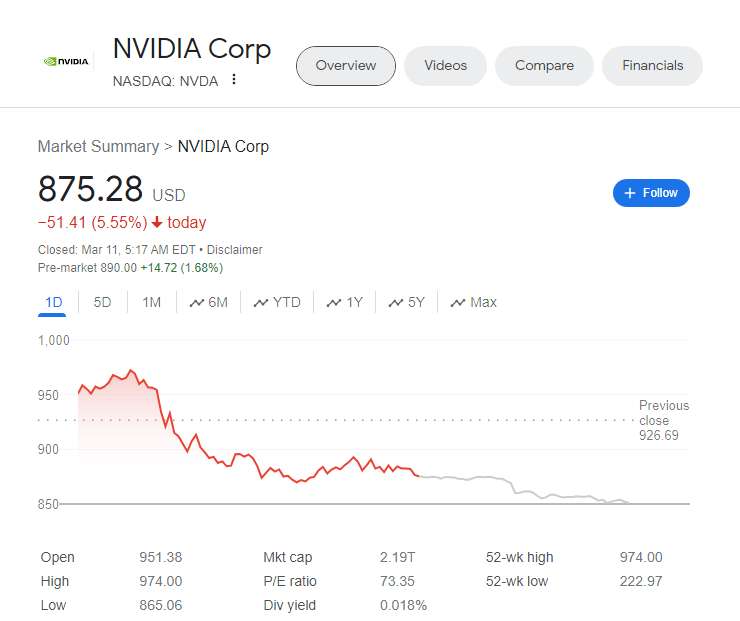
This fluctuation certainly stirred up some kinds of chaos: on one hand, on the same day, the Philadelphia Semiconductor Index also fell from a record high, down more than 4%. And peers in the semiconductor industry like ARM experienced declines close to 10% - ARM fell over 6.6% in one day, Broadcom fell about 7.0%, Navi Semiconductor fell more than 9.8%, and Maxwell Technologies fell well into the double digits.
On the other hand, this has also sparked vigorous discussions around the topic in the market: for example, some industry insiders have stated that NVIDIA's hefty drop is due to adjustments on a technical level.
After the stock price broke through $900, NVIDIA's Relative Strength Index (RSI), a stock momentum indicator, climbed above 85, the highest since November 2021, indicating that the time for the stock to correct has matured.
However, there are also interpretations from a macro-economic perspective: Cathie Wood warned that NVIDIA is likely retracing the old path of Cisco at the turn of the century - at that time, buoyed by the dot com concept, Cisco was once favored by the market and boasted a PE ratio of up to 100 times, but with the bubble burst, Cisco's valuation ultimately lost 90% of its value from its peak.
This is a similar technology moment in time, Wood wrote to shareholders.
Well before the burst in the early 2000s, based on excessive profits brought by soaring network hardware demand during the Internet boom, Cisco's stock surged 31 times in the 3.5 years prior to March 1994.

Although its stock price fell 51% in the subsequent four months due to recession fears and decreased orders due to competition, at the peak of the Internet bubble in March 2000, Cisco's stock gave a staggering return of 71 times, which closely resembles NVIDIA's growth trajectory.
Since February 2015, NVIDIA's stock has surged 117 times over the next nine years, but the ensuing cryptocurrency chill clearly hit chip sales and caused Nvidia's stock to fall 56% within three months. And from last year, buoyed by the headwind of artificial intelligence, NVIDIA's stock price once again got on the fast lane of growth.
Therefore, in Wood's view, today, NVIDIA is that company.
Greg Bassuk, chief investment officer at AXS Investments, also pointed out that now, considering the potential sell-off under the surface of NVIDIA's stock price fluctuations, investors should be more cautious about the risk of profit-taking, and timely hedge against NVIDIA's downside risk.
Charles Schwab also wrote in its market outlook that although there are currently no mid-term sell signals for NVIDIA, the volatility indicates that investors are seeking protection, so short-term volatility will be higher. And once NVIDIA's dive further shakes investor confidence, the market may become more volatile in the next week.
At the same time, the institution also mentioned in its report that if the tech sector pulls back in the next few weeks, say, a drop of 5% to 10%, the departing funds will enter other areas of the market, thus intensifying the pressure for the US stock market to hit a short-term peak.

Expert analysis on U.S. markets and macro trends, delivering clear perspectives behind major market moves.
Latest Articles
Stay ahead of the market.
Get curated U.S. market news, insights and key dates delivered to your inbox.




Comments
No comments yet