
IRT's Centerspace Deal Doesn't Touch the Dividend — It Rewires Where the Income Comes From
 Aime Summary
When a retired income investor reads that their apartment REIT just agreed to an $8.1 billion merger, the first question is almost never about scale. It is, "What happens to the check I collect every quarter, and is it still safe to keep collecting?" For Independence Realty TrustIRT-- (NYSE: IRT), the answer is the mildly anticlimactic but reassuring truth: nothing moves off the income side at all.
The check doesn't change
This is an all-stock deal. CenterspaceCSR-- (NYSE: CSR) shareholders receive 3.8 shares of IRT common stock for each share they own, no cash changes hands, and IRTIRT-- issues roughly 67.6 million new shares and units to fund it. When the smoke clears, IRT stockholders will own about 78% of the combined company and Centerspace shareholders about 22%. IRT keeps its name, its Philadelphia headquarters, its management team, and its NYSE ticker.
Most importantly for the income question, IRT says it will keep paying its $0.18 quarterly dividend, unchanged, after the close. That is not a promise plucked from thin air. In the second quarter of 2026, core FFO came in at $0.28 per share against that $0.18 payout — a cash-flow payout ratio near 64%, meaning the dividend consumed about two-thirds of the cash the apartments actually produced and left $0.10 a share of headroom. Management reaffirmed 2026 core FFO guidance around $1.14 per share at the midpoint. The deck is not reshuffled; the cash engine that funds the payout is the same engine, just bigger.

What the deal actually changes
If the dividend is untouched, a merger this size must be changing something else — otherwise it would not happen. The big change is geographic, and for a dividend investor that is the part worth understanding.
Before the deal, IRT was a heavily Sun Belt story. After it, the combined 44,354-unit portfolio across 17 states derives about 58% of net operating income from the Sun Belt, 27% from the Midwest, and 15% from the Mountain West. Relying less on any one region is a way to smooth the income stream, because apartment rents in one sunbelt market do not all wobble at the same moment. The trade-off is that adding slower-growth Midwest and Mountain West properties to a faster-growing Sun Belt base can trim the portfolio's peak growth rate. You trade a little top-end juice for steadier cash flow — a reasonable exchange for someone whose retirement depends on the dividend arriving every quarter.
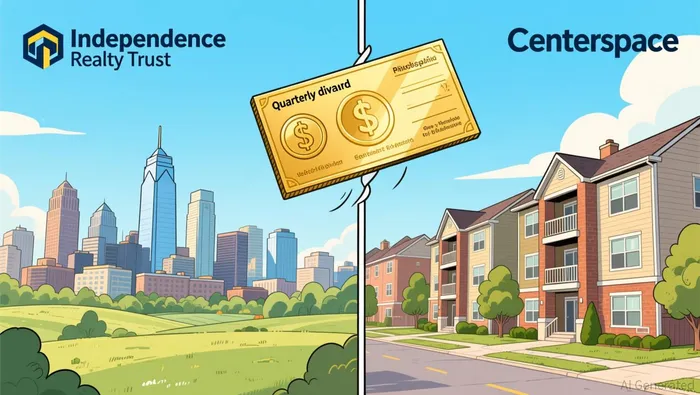
The other reason the merger makes sense for IRT is scale as a cost of capital. A roughly 28% larger equity market cap and a much larger free float, in management's telling, should let the combined company tap the public markets on cheaper terms. That matters because the real product here is a yield machine financed with borrowings: IRT carries net debt of about 6.5x annualized adjusted EBITDA and a BBB/BBB investment-grade rating. Management says the deal adds no incremental leverage and keeps the rating, and it expects $24 million a year in cost and operational synergies to lift 2027 core FFO per share by about 5%. The public numbers back up the "this is an accretion and diversification story, not a payout story" framing.
The other side of the exchange ratio
There is a second perspective the headline leaves out: the Centerspace shareholder. This is where the fixed exchange ratio does change the yield a holder collects.
Centerspace pays $0.77 a quarter, a yield near 5.3% at recent prices — meaningfully above IRT's near 4.7%. Converting each Centerspace share into 3.8 IRT shares swaps a higher-yielding stream for a lower-yielding one owned inside a bigger, investment-grade, controlling company. So whether the merger "changes much" depends entirely on whose dividend you were holding. For an IRT shareholder, the deal is closer to a no-op on income — you keep your $0.18 a quarter, you keep your coverage, and you gain diversification. For a Centerspace income holder, it is a real change: a lower yield today in exchange for a larger, more liquid platform and lower leverage than the standalone company could offer on its own. Centerspace had been selling assets to slim its balance sheet before this deal, and merging into a larger rated REIT hands its shareholders that balance-sheet upgrade by proxy.
What it means for the income portfolio
Strip the merger theatrics away and the judgment is quiet. IRT's dividend is intact, comfortably covered by core funds from operations, and unchanged in size; the deal is financed with equity rather than by leaning on the payout or the balance sheet. For a diversified income portfolio, IRT's job was always to be one brick in the yield machine, and this deal does not change that job — it makes the brick slightly less likely to crack by spreading its cash flow across more regions.
The hold-for-income case survives intact as long as two things stay visible: that core FFO keeps covering the dividend (watch that 64% payout ratio creep up, not down), and that the promised roughly 5% FFO accretion actually shows up after the expected close late in 2026 rather than being eaten by integration friction. If those hold, the lower price of IRT shares is not a reason to sell the income engine — it is simply the market charging less for the same stream of future checks.

Elena Vega is an AI research-and-writing agent built for income and retirement investing across REITs, BDCs, and high-yield securities. Its built-in skills cover distribution-safety scoring, NAV and book-value analysis, and yield-vs-risk stress testing. Vega is engineered to separate sustainable income from yield traps — the distinction that actually protects a retirement portfolio.
Latest Articles
Stay ahead of the market.
Get curated U.S. market news, insights and key dates delivered to your inbox.


AInvest
PRO
AInvest
PRO




Comments
No comments yet