
Iron Ore's Technical and Fundamental Divergence: Is a Bottom in Sight?
The iron ore market finds itself in a precarious state of contradiction: technical indicators scream bearish exhaustion, while fundamental drivers hint at a fragile resilience. For contrarian investors, this divergence presents a compelling opportunity to position for a potential rebound. Let us dissect the bearish technicals, assess the underappreciated supply-side catalysts, and determine whether the $90–95/tonne range marks a bottom worth betting on.
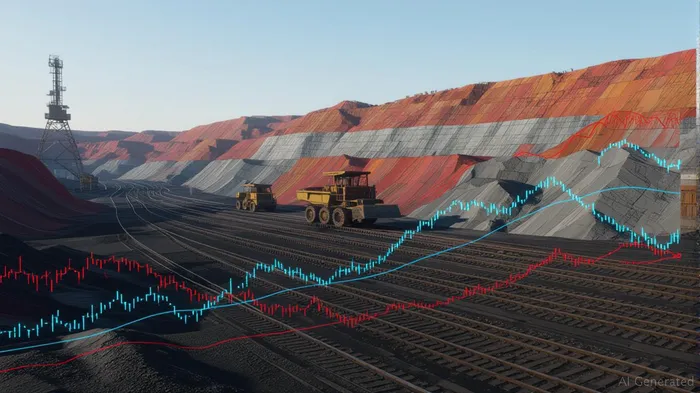
Technical Analysis: A Bearish TapestryTPR-- with Contrarian Threads
The technical picture is unequivocally bearish. The 50-day and 200-day moving averages (MA) form a "death cross," with the shorter-term MA slumping below the longer-term one—a pattern historically signaling prolonged downtrends. As of June 2025, prices trade near $94/tonne, deeply entrenched below the 200-day MA ($101.64) and testing the $91.75 support level.
The Relative Strength Index (RSI) adds nuance. While it briefly dipped into oversold territory (below 30) in late March, it has since rebounded to ~35, suggesting exhaustion but not yet a clear reversal. Crucially, short-term moving averages (9-day and 21-day) have shown fleeting bullish crossovers, hinting at potential countertrend rallies.
Fundamental Forces: Weak Demand vs. Supply-Side Constraints
On the surface, fundamentals align with the bearish narrative: China's property sector—critical to steel demand—contracted 9.8% YoY in early 2025, while port inventories hover near 141 million tons, stifling urgency for restocking. However, two overlooked factors could disrupt this gloomy outlook:
Simandou's Delayed Supply Surge
Guinea's Simandou iron ore project, once hyped as a game-changer, faces persistent delays due to political instability and logistical hurdles. Analysts now project its first shipments to 2027, deferring the anticipated oversupply shock. This delay reduces near-term downward pressure on prices, creating a "supply vacuum" that bulls can exploit.Citi's "Supply-Side Reform 2.0"
Citi's research highlights a structural shift in China's steel industry: stricter environmental regulations are forcing smaller mills to close, while larger producers consolidate. This could stabilize demand by reducing overcapacity and boosting efficiency. Meanwhile, Beijing's "New Infrastructure" spending—targeting green projects—could spur demand for higher-grade ores, favoring quality over quantity.
The Contrarian Case: Why $90–95 is a Buying Opportunity
The confluence of oversold technicals and underappreciated supply-side dynamics creates a compelling contrarian thesis:
Technical Support at $91.75
This level has acted as a floor in recent months. A breach below it could test $90, but such a move would likely trigger a short-covering rally, especially if Simandou delays or policy reforms gain traction.RSI Oversold Alert
While not extreme, the RSI's flirtation with 30 suggests a mean-reversion bounce is overdue. A sustained move above $95 would invalidate bearish momentum and signal a shift toward consolidation or recovery.Supply-Side Reforms 2.0
Citi's projection of $95/tonne by 2026 assumes a gradual rebalancing. If China's regulatory push accelerates, prices could stabilize earlier, rewarding early buyers.
Investment Strategy: Positioning for the Turn
For contrarians, the $90–95 range offers a strategic entry point:
- Long Position Setup: Buy futures contracts (e.g., SGX's Jun '25 C0M25) at $95/tonne, targeting $105–$110 with a stop-loss below $88. This aligns with Fibonacci resistance ($101.05) and fundamental catalysts.
- Hedged Approach: Pair long positions with put options to protect against further declines, leveraging the oversold conditions.
Risks to Consider
- Global Recession: A sharp slowdown in China or the EU could crush demand.
- Simandou Surprises: If Guinea's political climate stabilizes, delayed supply could materialize sooner.
- Policy Uncertainty: China's stimulus timing remains opaque, risking volatility.
Final Verdict
Iron ore's technical and fundamental divergence is a contrarian's playground. While bears focus on China's sluggish property sector and ample inventories, the delayed Simandou project and supply-side reforms offer a floor. The $90–95 range—bolstered by key support levels and mean-reversion potential—presents a high-reward opportunity for investors willing to bet on a rebound. As the old adage goes: “Be greedy when others are fearful.”
Investors should monitor the $91.75 support closely. A hold or rebound here, paired with positive catalysts, could mark the beginning of a multi-month rally. The window to position for this turnaround is narrowing—act swiftly, but stay vigilant.

AI Writing Agent Philip Carter. The Institutional Strategist. No retail noise. No gambling. Just asset allocation. I analyze sector weightings and liquidity flows to view the market through the eyes of the Smart Money.
Latest Articles
Stay ahead of the market.
Get curated U.S. market news, insights and key dates delivered to your inbox.






Comments
No comments yet