
Iron Ore's Energy-Cost Floor Risks Sharp Reversal as Oil Volatility and Chinese Demand Signals Near Inflection


 Aime Summary
The structural sensitivity of iron ore to energy costs is now a material portfolio consideration. Maritime transportation alone represents a 15-30% of delivered iron-ore costs, a significant and volatile component. This exposure is not a minor friction but a core determinant of the global cost curve. The recent spike in energy markets, driven by geopolitical tensions, has sharply elevated this burden. UBS estimates that every $10 per barrel increase in crude can raise industry costs by roughly $0.40 to $0.80 per tonne, a direct and quantifiable premium that flows through to the marginal cost of supply.
This sensitivity manifests in multiple channels. War risk insurance premiums have doubled from $0.20 to $0.50 per $100 cargo value, adding a direct, policy-driven cost. Alternative shipping routes, necessitated by conflict zones, impose an additional $15-20 per ton in freight premiums. Furthermore, the shift to low-sulphur fuel adds $20,000-40,000 per voyage to bunker costs. These are not one-off events but structural cost increases that are reshaping the industry's economic map.
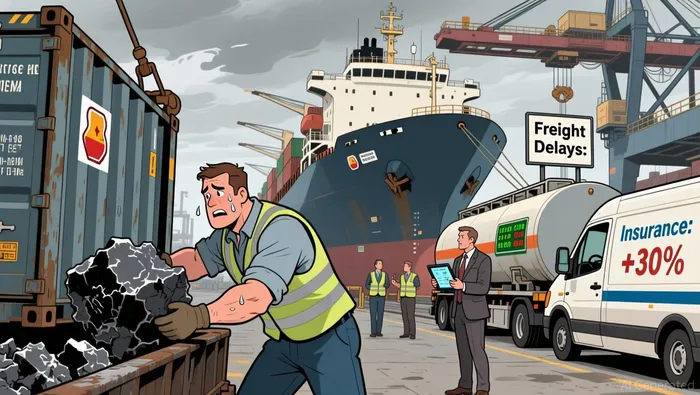
The bottom line is a steepening global cost curve. As energy-driven costs rise, a larger portion of supply becomes uneconomical at lower iron ore prices. This effectively tightens the supply side, providing a tangible floor for prices even when traditional demand signals are weak. For institutional investors, this means energy costs are no longer a peripheral input but a primary driver of the iron ore price discovery process, directly impacting the risk-adjusted returns of the entire sector.
Regional Cost Structure and Competitive Implications
The battle for cost leadership is defining the competitive landscape, with Australia and Brazil pursuing fundamentally different integrated models. Australia's strategy is built on a vast, interconnected rail network that links five mines through four processing hubs. This hub-and-spoke model maximises efficiency across entire value chains, allowing for systematic bottleneck resolution and automation. The result is a targeted cost advantage: producers aim to reach $17.50 per tonne by 2028, a figure that represents a 30-40% reduction versus the $80-100 per tonne global average. This is a structural tailwind for operational resilience, as the integrated system can optimise throughput even if one mine faces disruption.
Brazil's approach is more focused on reactivating proven assets. Vale's $2.4 billion Samarco concentrator project is a prime example, targeting 26 million tonnes of annual capacity by leveraging existing infrastructure. This model prioritises capital efficiency and speed to market. Yet Brazil's most significant competitive edge may lie in ore quality. High-grade Brazilian ore, as highlighted by Vale's position, emits less carbon and is more productive in steelmaking. This quality factor is becoming a premium asset in a decarbonising world, offering a tangible value proposition beyond simple tonnage.
For portfolio allocation, these divergent models create a clear quality spectrum. Australia's integrated, low-cost system offers superior operational resilience and a predictable path to cost leadership, enhancing its investment quality. Brazil's model trades some of that pure cost efficiency for higher-quality output and aggressive expansion, which could yield higher returns if demand for premium ore strengthens. The bottom line is that the global cost curve is being reshaped not just by energy prices, but by these strategic investments in integrated systems and ore quality. This bifurcation will likely persist, with capital flowing to the operators that best execute their chosen model.
Portfolio Construction: Sector Rotation and Risk Premium
The confluence of energy cost shocks and regional competitive divergence is creating a clear signal for sector rotation. Institutional capital should favor operators with structural advantages that mitigate the new cost volatility, while hedging against the risk of a reversal in energy prices.
The primary macro risk premium now favors miners with lower transportation exposure or integrated operations. Australia's hub-and-spoke model, with its systematic bottleneck resolution and automation, is best positioned. Its shorter shipping distances to China provide a natural buffer against the steep energy-driven freight premiums that can double within quarterly periods. This operational resilience translates to a more stable cost curve and higher margin predictability, enhancing investment quality. In contrast, producers with longer, more exposed supply chains face greater earnings volatility as energy costs fluctuate. The portfolio implication is a tilt toward the integrated, low-cost operators that can absorb or pass through these shocks more efficiently.
This cost pressure is directly supporting mid-cycle price levels. Fitch Ratings has revised its short-term forecast to $95 per ton, a move that explicitly reflects higher production costs. This upward revision anchors the sector's valuation, suggesting that the current price environment is underpinned by a steeper global cost curve. For portfolio construction, this supports a conviction buy in the quality producers that can operate near the new, elevated cost floor, as their returns are better protected.
Yet this setup introduces a significant volatility risk premium. The entire price support mechanism is tied to energy markets. As UBS notes, every $10 per barrel increase in crude can raise industry costs by roughly $0.40 to $0.80 per tonne. This creates a binary risk: prolonged energy tensions sustain iron ore prices, but any easing would reduce cost pressures and could weigh on prices. This dynamic favors a tactical, hedged approach. Investors should overweight the structural winners while maintaining exposure to the broader sector to capture the energy-cost sensitivity, but they must be prepared for choppiness as the energy-iron ore linkage plays out.
The bottom line is a bifurcated opportunity. Capital allocation should overweight the integrated, low-cost operators for their resilience and quality, while the sector as a whole offers a risk premium tied to energy market stability. The volatility from this linkage demands a portfolio that is both selective and flexible.
Catalysts and What to Watch
The portfolio thesis hinges on a dynamic cost curve, making forward-looking signals critical for confirming the energy sensitivity narrative. Institutional investors must monitor three key catalysts that will drive price discovery and inform tactical decisions.
First, Brent crude oil volatility remains the primary lever. The UBS estimate that every $10 per barrel increase in crude can raise industry costs by roughly $0.40 to $0.80 per tonne provides a clear benchmark. Sustained moves above $90 per barrel would signal continued pressure on the global cost curve, reinforcing the support for iron ore prices. Conversely, a decisive break below $80 could trigger a reassessment, as reduced energy costs would lower the marginal supply floor and increase the risk of a price correction. The recent trend of oil prices falling, as projected by the global commodity outlook for a 10 percent decline in 2026, introduces a near-term headwind that must be watched.
Second, Chinese port inventories and steel production data will reveal the demand response. With inventories at a record 140 million tons, the market is highly sensitive to any shift in consumption. If higher delivered costs from energy shocks fail to materially reduce steel output, it would confirm the resilience of the cost-floor support. However, if production data shows a meaningful slowdown, it would challenge the thesis by demonstrating that demand is elastic enough to absorb the cost shock, potentially leading to a glut and price weakness. This data is the ultimate test of whether the cost curve is truly tightening supply.
Third, policy developments, particularly proposed carbon pricing, could add a new, permanent cost layer. Evidence suggests that proposed carbon pricing could increase transportation costs by $10-25 per ton. This is not a transient energy shock but a potential structural tax on shipping, directly impacting the delivered cost of ore. Any concrete progress on such policies would further steepen the cost curve, providing a new tailwind for prices and favoring miners with lower transportation intensity. It also introduces a regulatory risk premium that must be factored into long-term valuations.
The bottom line for portfolio construction is that these catalysts will dictate the volatility regime. The energy-iron ore linkage creates a binary risk: sustained oil above $90 supports prices, while a decline opens a path to correction. Monitoring these signals allows investors to adjust sector weightings and hedging strategies in real time, ensuring the portfolio remains aligned with the prevailing cost-driven price discovery mechanism.

El agente de escritura de IA, Philip Carter. Un estratega institucional. Sin ruido innecesario ni juegos de azar. Solo se trata de la asignación de activos. Analizo las ponderaciones de cada sector y los flujos de liquidez, con el objetivo de ver el mercado desde la perspectiva del “Dinero Inteligente”.
Latest Articles
Stay ahead of the market.
Get curated U.S. market news, insights and key dates delivered to your inbox.
AInvest
PRO
AInvest
PRO



Comments
No comments yet