
Irobot's Strategic Resurgence: Navigating the Robotics and Home Automation Landscape in 2025


 Aime Summary
The post-pandemic world has reshaped consumer expectations, accelerating demand for automation in the home. Nowhere is this shift more evident than in the robotics sector, where iRobotIRBT--, the pioneer of the robotic vacuum, is attempting to reclaim its footing amid a rapidly evolving market. For investors, the question is whether iRobot's recent strategic moves-ranging from product innovation to a dramatic restructuring-can position it as a durable player in a space now dominated by agile competitors.
A Rocky 2025: Financial Struggles and Market Share Erosion
iRobot's 2025 has been defined by turbulence. The company
reported a 25% year-over-year revenue decline in Q3 2025, with U.S. . These challenges stem from a confluence of factors: production delays, shipping disruptions, and a shift in consumer demand toward mid-tier and premium products. Meanwhile, , down from a peak of over 60%, as Chinese rivals like Roborock and Ecovacs have
-based navigation and AI-driven obstacle avoidance.
Yet, iRobot's struggles are not unique to its industry. The broader robotics and home automation market is grappling with post-pandemic normalization. While the sector is projected to grow at a CAGR of 15.5% through 2030, , this expansion is being driven by price-sensitive markets and emerging technologies, not the premium segment where iRobot has traditionally thrived
according to market analysis.
Strategic Reinvention: From "Elevate" to Asset-Light Manufacturing
To counter these headwinds, iRobot has embarked on a dual strategy: innovation and operational efficiency. The "iRobot Elevate" plan, launched in 2025, prioritizes cost-cutting, R&D investment, and AI integration. 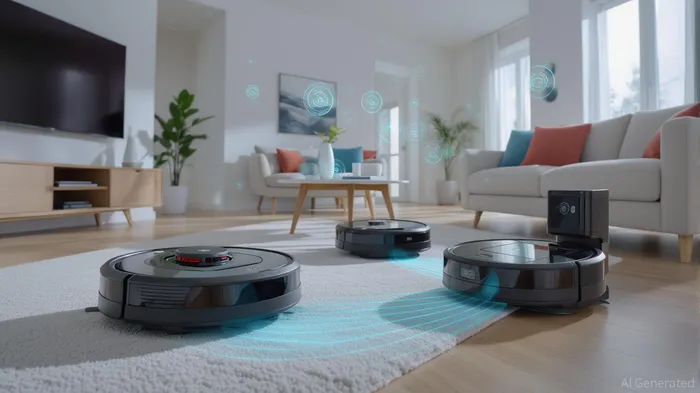 New product lines like the Roomba® Max 705 Combo and Roomba® 105 Vac Robot series
aim to capture the mid-tier and premium markets, . These models emphasize 2-in-1 cleaning (vacuuming and mopping) and advanced features like AutoWash™ and AutoEmpty™ docks,
leveraging AI to refine navigation and user experience.
Simultaneously, iRobot has shifted to an model, outsourcing production to Shenzhen-based Picea Robotics. This move reduces capital expenditures and aligns with global supply chain realities, though it also raises questions about long-term control over quality and innovation. As one analyst noted, "The asset-light approach is a double-edged sword-it cuts costs but may dilute the brand's ability to differentiate in a crowded market"
according to industry analysis.
The Picea Acquisition: A Lifeline or a Last Resort?
The most consequential development of 2025, however, is iRobot's impending acquisition by Picea Robotics. In December 2025, the company
restructuring, under which Picea-a major contract manufacturer and iRobot's secured lender-will acquire 100% of its equity interests. This transaction,
expected to finalize by February 2026, will delever iRobot's balance sheet, eliminate $161.5 million in past-due debt to Picea, and transition the company to private ownership.
While the deal ensures business continuity, it also signals a loss of shareholder value. Current equity holders will receive no stake in the restructured entity, and the company will delist from Nasdaq
according to market reports. For investors, the acquisition raises critical questions: Will Picea's ownership stifle innovation, or will it provide the financial stability needed to compete with Chinese rivals? The answer may lie in Picea's own capabilities. As a manufacturer with 1,300 IP rights and 20 million units sold globally, Picea brings technical expertise that could accelerate iRobot's AI and IoT integration
according to company disclosures.
Market Dynamics: A Battle for the Smart Home
iRobot's challenges are emblematic of a broader industry trend: the commoditization of home robotics. The global robotic vacuum market, valued at $14.3 billion in 2025, is expected to grow at a CAGR of 12–14% through 2028, but this growth is being driven by price competition and subscription-based models
according to market research. Meanwhile, the market-encompassing security, energy management, and AI-driven automation-is expanding at 11.9% CAGR, with North America and Europe leading adoption
according to industry reports.
For iRobot, the key to differentiation lies in its premium brand positioning and ecosystem integration. Its Roomba j9+ and s9+ models remain top performers, praised for their suction power and smart home compatibility with Alexa and Google Home
according to consumer reviews. However, the company must contend with a reality: consumers are increasingly willing to trade brand loyalty for lower prices and cutting-edge features from Chinese competitors.
Investment Implications: Risks and Opportunities
The Picea acquisition and iRobot's strategic pivot present a mixed outlook for investors. On one hand, the restructuring stabilizes the company's finances and preserves its R&D pipeline. On the other, it eliminates shareholder upside and raises concerns about long-term innovation. As Bloomberg notes, "The deal buys time but does not address the structural challenges of competing in a market where cost and speed of iteration are paramount"
according to financial analysis.
For those willing to take a longer view, iRobot's focus on AI and smart home integration offers potential.
according to market forecasts. However, success will depend on Picea's ability to balance cost efficiency with innovation-a tightrope walk in an industry where margins are thin and competition is fierce.
Conclusion: A Test of Resilience
iRobot's 2025 has been a year of reckoning. The company's financial struggles and market share losses underscore the challenges of maintaining dominance in a sector defined by rapid innovation and global competition. Yet, its strategic moves-, operational restructuring, and the Picea acquisition-reflect a determination to adapt. For investors, the path forward is uncertain but not without promise. In a world where the smart home is no longer a luxury but a necessity, iRobot's ability to reinvent itself may yet determine its place in the future of robotics.

Stay ahead of the market.
Get curated U.S. market news, insights and key dates delivered to your inbox.
AInvest
PRO
AInvest
PRO



Comments
No comments yet