
iRobot's Roomba Line Faces Major Shifts in 2025: What This Means for Investors


 Aime Summary
iRobot's Chapter 11 Bankruptcy: What It Means for Investors and the Home Robotics Market
Retail investors and market watchers are paying close attention to iRobotIRBT--, the company behind the popular Roomba robot vacuum. Just a few years ago, the brand was a household name and a market leader. But in 2025, the company filed for — a move that signals major change in both its operations and ownership. This article breaks down what's happening, why it matters, and what investors should keep in mind.
The core facts: What's happening with iRobot and its Roomba brand
iRobot is undergoing a major restructuring through a court-supervised Chapter 11 process. The company announced that Picea, its secured lender and contract manufacturer, will acquire 100% of iRobot's shares as part of this pre-packaged bankruptcy plan. Once finalized — expected by February 2026 — iRobot will be taken private, and current shareholders will lose their equity in the company according to data.
This isn't just a routine financial adjustment — it's a strategic move to survive in a competitive market. iRobot has seen its market share shrink due to rising competition from Chinese manufacturers like Ecovacs and Roborock according to reports. Additionally, U.S. import tariffs on goods from Vietnam added $23 million in costs in 2025 according to reports. The restructuring aims to stabilize the company financially while preserving its product development and customer support.
What's driving the change — and what the 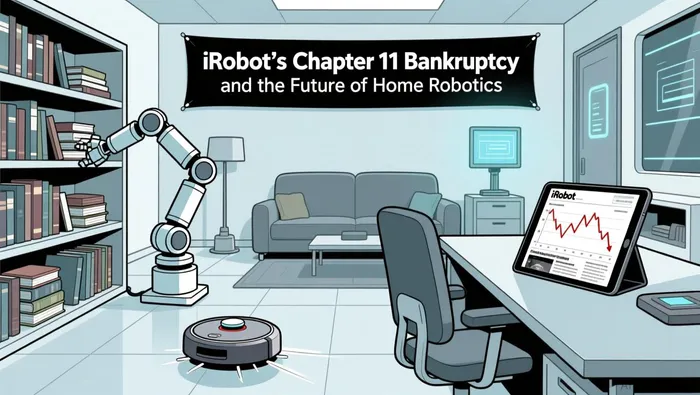 numbers say
The company's financial struggles have been well-documented. . Meanwhile, , according to financial data. These figures highlight the urgency of the situation — the company simply can't sustain its current operations on its own.
The restructuring includes a debt cancellation of $190 million, which is a major step toward financial stability. iRobot still holds 1,657 global patents and continues to invest in R&D, with . That's a sign that the company still believes in its long-term potential, even as it repositions itself.
Still, the road ahead is rocky. , . These figures make it clear that iRobot's path to profitability will be challenging — especially in a market where consumers have more affordable and technologically advanced options than ever before.
What it means for investors and the home robotics market
For current shareholders, the news is not encouraging. As part of the restructuring, the company's stock will be delisted from Nasdaq, and all existing equity will be wiped out. This is a clear signal that the public market is no longer the right place for iRobot at this stage. Investors who bought in during a recent stock rally — which saw iRobot surge 72% in four days — may be left with a very different reality.
That said, the restructuring could benefit long-term customers and the market. iRobot has been a leader in home robotics and smart home integration for years. By removing the pressure of public expectations and focusing on operational efficiency, the company may be able to innovate more freely — a crucial advantage in a fast-moving tech space.
The home robotics market itself is expected to grow significantly, . iRobot's brand recognition and patent portfolio mean it still has a role to play in shaping this future — even if the company's ownership has changed.
Looking ahead: iRobot's new path as a private company
The restructuring is expected to be completed by February 2026, at which point iRobot will be privately owned by Picea according to filings. While this removes the company from public scrutiny, it also allows for more flexibility in long-term planning. The company has said there will be no disruption to app functionality, customer programs, or product support — so existing Roomba owners should continue to receive the same level of service.
What remains to be seen is whether iRobot can regain its competitive edge. The company has faced years of declining market share, and the competition from Chinese manufacturers shows no sign of slowing. That said, iRobot's technology and brand loyalty remain strong — and with the burden of debt and public expectations lifted, it may finally have the freedom to focus on what it does best: innovation in home robotics.
For now, the market is watching closely. The coming months will determine whether iRobot can successfully navigate this transition and position itself for growth in a market that's far from saturated.

Delivering real-time insights and analysis on emerging financial trends and market movements.
Latest Articles
Stay ahead of the market.
Get curated U.S. market news, insights and key dates delivered to your inbox.
AInvest
PRO
AInvest
PRO



Comments
No comments yet