
iRobot's Restructuring Plan: What Recent Developments Mean for Investors


 Aime Summary
For years, iRobotIRBT-- and its iconic Roomba vacuum cleaners have been a household name in smart home technology. But 2025 brought a major shift for the company as it filed for Chapter 11 bankruptcy in a pre-packaged restructuring led by its secured lender and contract manufacturer, Picea. This move isn't just a financial maneuver—it's a strategic step that could reshape iRobot's future as a private entity by early 2026. For investors, this marks a pivotal moment to assess what the restructuring means for the company's long-term growth, market position, and what (or who) stands to benefit from this transformation.
Understanding iRobot's Chapter 11 Restructuring
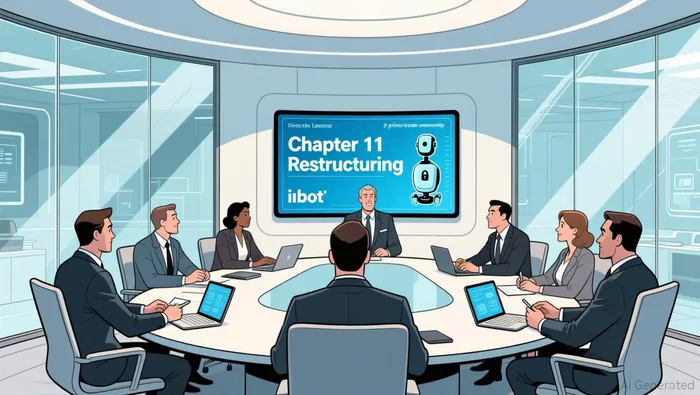
In December 2025, iRobot voluntarily entered into a pre-packaged Chapter 11 process under the U.S. Bankruptcy Court for the District of Delaware. This process is designed to allow the company to shed debt, restructure its finances, and emerge with a cleaner balance sheet. At the center of the deal is Picea, iRobot's secured lender and primary contract manufacturer, which will acquire 100% of iRobot's equity. This means that iRobot will become a private company and will no longer be listed on the Nasdaq. Current shareholders will not receive any equity in the new structure.
This restructuring is part of a broader effort to stabilize the company's financial position after several years of declining revenue and rising debt. In Q3 2025, for example, iRobot reported $155.1 million in revenue, but its cash reserves stood at just $24.8 million while its debt to Picea reached $90.9 million. These figures highlight the urgency of the situation and the need for a fundamental reset.
Key Financials and Strategic Implications
The restructuring isn't just about cutting costs—it's also about positioning iRobot for innovation and long-term competitiveness. Despite the company's recent financial struggles, it has maintained significant R&D investment, spending $13.77 million in Q3 2025 alone. This is a crucial asset in the rapidly evolving robotic vacuum market, where iRobot holds 1,657 global patents.
One of the most immediate impacts of the restructuring is the removal of iRobot from public markets. This shift means the company won't be subject to the same level of public scrutiny or shareholder pressure, which could allow it to operate with more strategic flexibility. However, this also means that retail investors will no longer have the opportunity to buy shares in the company.
From a business standpoint, the deal also reduces the risk of further debt accumulation and aligns the company with Picea, its most important business partner. This is a critical move in a market where competition is intensifying and customer expectations are evolving. Companies like Roomba's closest rival, Roborock, are already rolling out advanced models with self-washing mopping features and smart mapping.
Market Outlook and Competitive Landscape
The global robotic vacuum market is forecasted to reach $9.983 billion by 2031, showing that demand for smart cleaning technology is far from slowing down. iRobot remains a market leader in terms of brand recognition and product innovation. But recent events, including the failed Amazon acquisition and ongoing production delays, have exposed vulnerabilities in the company's business model. These events have exposed vulnerabilities in the company's business model.
The restructuring gives iRobot a chance to reset and potentially attract new strategic partners or investors. While the deal with Picea is not a rescue by a big tech giant, it is a calculated move that could allow the company to refocus on core strengths while avoiding the pitfalls of debt-laden operations. In the short term, however, the lack of a major equity infusion or public support means iRobot must rely on its intellectual property and R&D pipeline to prove its value proposition. This could be critical for its future success.
Looking Ahead: What This Means for Retail Investors
For investors, the key takeaway is that iRobot is undergoing a transformation rather than a complete collapse. The restructuring is a strategic repositioning that could either lead to a stronger iRobot or a new entity with a different ownership structure and product roadmap. However, with the company going private, there will be fewer public signals to monitor its performance compared to when it was on Nasdaq. This is a significant shift for retail investors.
Meanwhile, the broader market for smart home appliances continues to grow. While iRobot is not alone in the robotic vacuum space, its brand still carries significant weight. Investors should keep an eye on how the restructuring plays out and whether the company can maintain its innovation pace without public market pressure. For now, the focus is on whether Picea's backing will be enough to help iRobot maintain its leadership in the market or whether it will lose ground to more agile competitors like eufy or Roborock.
In the end, the success of iRobot's restructuring will depend on execution. If the company can streamline operations, protect its IP, and continue pushing the boundaries of smart cleaning technology, it could emerge from the process as a leaner and more competitive player. But if it fails to adapt to market changes or loses momentum in innovation, even the best restructuring plan won't save it from obsolescence.

Delivering real-time insights and analysis on emerging financial trends and market movements.
Latest Articles
Stay ahead of the market.
Get curated U.S. market news, insights and key dates delivered to your inbox.
AInvest
PRO
AInvest
PRO



Comments
No comments yet