
iRobot's Financial Struggles and Market Reaction: A Cautionary Tale for Tech Investors


 Aime Summary
In the annals of technological innovation, few stories are as compelling-or as cautionary-as those of once-dominant companies that falter in the face of shifting markets. iRobotIRBT--, the inventor of the Roomba, now finds itself in a familiar but perilous position: a tech pioneer grappling with declining demand, operational chaos, and a valuation that seems to defy logic. As the company
reported a 25% year-over-year revenue drop in Q3 2025, with cash reserves dwindling to $24.8 million, the parallels to historical missteps by Kodak, Nokia, and HP are impossible to ignore.
The Unraveling of iRobot's Financial Fortunes
iRobot's Q3 2025 results paint a grim picture.
Revenue plummeted to $145.8 million, a 33% decline in the U.S. and 13% in EMEA, as production delays and shipping disruptions compounded existing market headwinds. The company's GAAP operating loss ballooned to $17.7 million, a stark contrast to the $7.3 million profit in the same period the prior year
according to financial reports. Yet, paradoxically, its stock price surged 11.71% post-earnings, defying the logic of a business teetering on the brink
according to market data.
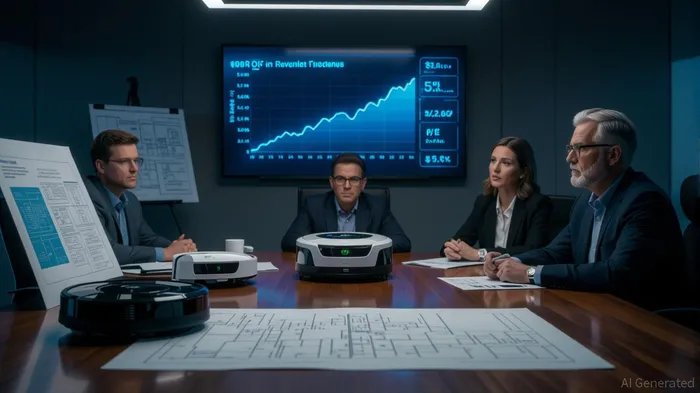 Analysts have not been kind. With a consensus rating of "Reduce" and a 12-month price target of $11.22, the market appears to be pricing in a near-total collapse.
At a current stock price of $5.24, the implied downside is staggering. The company's valuation metrics-P/E of -0.58 and P/S of 0.26-
reflect a business that is not only unprofitable but also trading at a fraction of its sales relative to peers.
A Pattern of Decline: Lessons from the Past
iRobot's struggles echo the trajectories of tech giants that failed to adapt.
Kodak, which invented the digital camera, clung to its film business until bankruptcy in 2012.
Nokia, once the mobile phone titan, was slow to embrace smartphones, allowing Apple and Samsung to overtake it. HP, during its 2012–2025 decline, saw its P/E ratio drop from 2.96 to 4.45 as earnings eroded, while its P/S ratio remained stubbornly low, signaling undervaluation relative to sales
according to financial data.
BlackBerry's P/E ratio, which
swung from a high of 343.5 in 2022 to -187.72 in 2025, underscores the volatility of investor sentiment when a company loses its competitive edge. Similarly, iRobot's P/E of -0.58 and P/S of 0.26 suggest a market that is pricing in not just poor earnings but also a fundamental loss of confidence in the company's ability to innovate or pivot
according to valuation analysis.
The Paradox of Optimism
What explains the stock's post-earnings rally? One theory is that investors are betting on a last-minute rescue, such as a buyout or restructuring. Indeed,
recent reports suggest iRobot may be considering bankruptcy protection or a takeover by a Chinese supplier. Yet, such scenarios are fraught with uncertainty. Unlike HP, which managed to pivot toward AI-driven PCs and subscription services, iRobot has yet to demonstrate a clear path to recovery
according to industry analysis.
The CEO, Gary Cohen, has pointed to new product launches like the J-series as potential turnaround catalysts. However, these efforts have not translated into improved financial performance, raising questions about the company's ability to compete with cheaper, more agile rivals
according to investor sentiment.
Valuation Risks and Investor Implications
For investors, the lesson is clear: valuation metrics are not just numbers-they are signals. When a company's P/E turns negative and its P/S ratio sinks below industry averages, it is often a harbinger of deeper structural issues. iRobot's situation mirrors the late stages of Nokia's decline, where a P/S ratio of 1.28 in 2013 masked a company that was already losing relevance
according to historical data.
The broader tech sector's declining revenue multiples-from 19.04x in 2020 to 6.31x in 2023-
further amplify the risks. In an environment where investors demand tangible growth and profitability, iRobot's lack of both is a red flag.
Conclusion
iRobot's story is a microcosm of the challenges facing once-dominant tech brands. Its financial struggles, coupled with a valuation that seems to ignore basic fundamentals, serve as a stark reminder of the perils of complacency. As the company races to secure capital or a lifeline, investors would be wise to heed the lessons of Kodak, Nokia, and HP. In the tech world, innovation is not just a virtue-it is a survival mechanism.

Stay ahead of the market.
Get curated U.S. market news, insights and key dates delivered to your inbox.
AInvest
PRO
AInvest
PRO



Comments
No comments yet