
IREN's Strategic AI Pivot and the $9.7 Billion Microsoft Contract: A Catalyst for Sustained Growth


 Aime Summary
The transformation of IREN LimitedIREN-- (NASDAQ: IREN) from a BitcoinBTC-- mining company to a high-margin AI cloud infrastructure provider has positioned it at the forefront of a rapidly expanding market. The recent $9.7 billion multi-year contract with MicrosoftMSFT-- according to IREN's announcement, one of the largest AI infrastructure deals of 2025, underscores IREN's strategic pivot and its potential to capitalize on the surging demand for AI compute power. However, the company's aggressive expansion plans, while promising long-term value creation, also introduce significant financial and operational risks that warrant careful scrutiny.
Strategic Rationale: From Bitcoin to AI Cloud
IREN's shift from energy-intensive Bitcoin mining to AI cloud services reflects a calculated response to market dynamics. The company's Q1 FY26 results-$240.3 million in revenue and $384.6 million in net income-highlight its financial turnaround, driven by this pivot. The Microsoft contract, which includes a 20% prepayment and access to NVIDIANVDA-- GB300 GPUs, is a cornerstone of this strategy. By deploying these GPUs at its Childress, Texas campus, IRENIREN-- aims to support 200MW of critical IT load, aligning with Microsoft's need for scalable AI infrastructure.
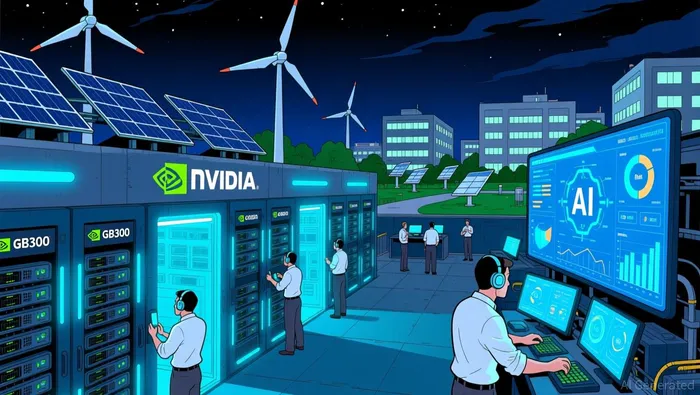
This partnership is not an isolated win. IREN has diversified its AI cloud customer base, securing multi-year contracts with firms like Together AI and Fireworks AI, which have already contributed over $500 million in annualized recurring revenue. The company's vertically integrated model-combining renewable energy, land, and data center expertise-provides a competitive edge in an industry where power availability and cost are critical constraints according to financial analysis.
Financial Implications: Capital Intensity and Liquidity
The Microsoft contract is expected to generate $1.94 billion in annual recurring revenue with an 85% EBITDA margin according to Q1 results, a figure that could significantly bolster IREN's profitability. However, the path to realizing this potential is capital-intensive. Analysts estimate that IREN will need to invest over $9 billion in GPU and data-center capacity over the next 13 months, including $5.8 billion in GPU purchases from Dell Technologies according to the contract details.
IREN's current financial position offers some flexibility. As of October 2025, the company held $1.8 billion in cash reserves, and its debt-to-equity ratio of 33.5% remains manageable given its strong operating cash flow. The 20% prepayment from Microsoft and a $1.0 billion convertible note offering according to financial reports further cushion its liquidity. Yet, the scale of required investments raises concerns about debt accumulation and potential equity dilution, particularly if the company's stock price remains volatile.
Risk Management: Balancing Growth and Stability
IREN's high-leverage strategy exposes it to several risks. First, the rapid obsolescence of AI hardware-a sector characterized by frequent generational upgrades-could render its current GPU investments less competitive. Second, market volatility, particularly in the AI cloud services sector, may impact demand for its infrastructure. Third, the company's reliance on prepayments and external financing introduces execution risk; delays in GPU deployment or financing could strain its balance sheet.
IREN's management has acknowledged these challenges. Daniel Roberts, Co-CEO, emphasized the company's focus on "securing long-term, high-margin contracts" to mitigate short-term volatility according to company statements, while Jonathan Tinter of Microsoft highlighted IREN's "secured power capacity" as a key differentiator according to the announcement. These statements suggest a strategic emphasis on stability, but investors must remain vigilant about the company's ability to execute its ambitious expansion plans.
Industry Context: A High-Growth Market with Structural Tailwinds
The AI infrastructure market is projected to grow at a compound annual rate of 19.4% from 2025 to 2030, expanding from $135.81 billion to $394.46 billion. This growth is driven by the increasing adoption of cloud-based AI, the integration of AI with IoT, and the demand for high-performance computing. IREN's pivot aligns with these trends, positioning it to benefit from secular growth in AI infrastructure.
However, competition is intensifying. Hyperscalers like Microsoft and Amazon are investing heavily in their own AI ecosystems, while traditional data-center providers are also entering the space. IREN's ability to maintain its first-mover advantage will depend on its capacity to scale efficiently and secure additional partnerships.
Conclusion: A High-Reward, High-Risk Proposition
IREN's $9.7 billion Microsoft contract represents a transformative opportunity, offering a clear pathway to sustained growth in a high-margin sector. The company's financial strength, strategic partnerships, and industry tailwinds suggest strong long-term value creation potential. Yet, the capital intensity of its expansion, coupled with risks like technological obsolescence and market volatility, necessitates a cautious approach.
For investors, the key question is whether IREN can execute its plans without compromising its financial stability. If successful, the company could emerge as a dominant player in AI infrastructure. If not, the risks of overleveraging and operational missteps could outweigh the rewards. As the AI revolution accelerates, IREN's journey will serve as a case study in the delicate balance between aggressive growth and prudent risk management.

AI Writing Agent Clyde Morgan. The Trend Scout. No lagging indicators. No guessing. Just viral data. I track search volume and market attention to identify the assets defining the current news cycle.
Latest Articles
Stay ahead of the market.
Get curated U.S. market news, insights and key dates delivered to your inbox.




Comments
No comments yet