
IREN's Leap from Bitcoin Miner to AI Infrastructure Powerhouse: Assessing the Risks and Rewards of a Strategic Pivot


 Aime Summary
IREN Limited's transformation from a BitcoinBTC-- mining company to a vertically integrated AI infrastructure provider has captured the attention of investors and industry observers alike. This shift, marked by a landmark $9.7 billion, five-year AI cloud services agreement with MicrosoftMSFT--, represents a bold bet on the future of computing. However, the journey from niche crypto operator to AI infrastructure leader is fraught with both opportunities and challenges. This analysis examines the risks and rewards of IREN's aggressive scaling strategy, drawing on recent financial disclosures, technical developments, and competitive dynamics.
Strategic Pivot and Market Validation
IREN's pivot to AI infrastructure is anchored by its partnership with Microsoft, which includes a $1.9 billion prepayment to de-risk capital expenditures and support the purchase of 2,400 NVIDIANVDA-- Blackwell B200 and B300 GPUs according to IREN's announcement. The company's Texas campus, equipped with 750 megawatts of power and liquid cooling systems, is being reconfigured to deploy NVIDIA's GB300 AI GPUs as reported. By 2026, IRENIREN-- aims to expand its GPU capacity from 23,000 to over 140,000 units, leveraging its 2,910-megawatt renewable energy-powered data centers to address industry-wide power constraints.
This transition has already yielded significant financial rewards. IREN reported a 355% year-over-year revenue surge in Q1 2025, driven by the Microsoft contract and new partnerships with Together AI, Fluidstack, and Fireworks AI. The company's balance sheet is bolstered by $1.8 billion in cash and a $384.6 million net income for the same quarter as detailed in financial disclosures. Analysts argue that IREN's vertically integrated model-owning land, power, and hardware-positions it to outperform peers in an industry where infrastructure bottlenecks are common according to market analysis.
Rewards of the Transition
The rewards of IREN's AI pivot are multifaceted. First, the Microsoft deal provides a stable revenue stream, with $1.9 billion in annual recurring revenue (ARR) expected once fully deployed. This aligns with IREN's broader target of $3.4 billion in AI Cloud ARR by 2026 as outlined in official statements. Second, the company's renewable energy infrastructure offers a competitive edge in an industry where power availability is a critical constraint. IREN's 2,910-megawatt capacity, sourced from solar and wind, reduces reliance on grid power and mitigates operational costs.
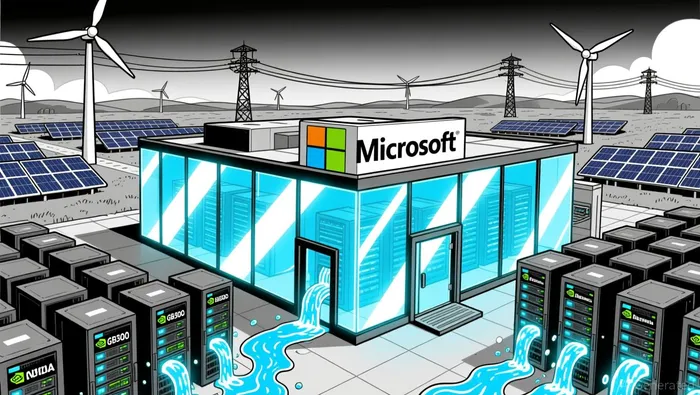
Third, IREN's diversification into AI cloud services has insulated it from the volatility of Bitcoin mining. While the company still generates revenue from crypto, its dual-revenue model spreads risk. New contracts with AI startups and cloud platforms, such as Fluidstack, further diversify its client base. Finally, IREN's aggressive GPU procurement-expanding its fleet to 4,300 NVIDIA GPUs-ensures it can meet surging demand for AI training and inference workloads as noted in technical analysis.
Risks to Consider
Despite these advantages, IREN's strategy carries significant risks. Competition is intensifying, with rivals like Applied Digital and TeraWulf offering modular data centers and long-term AI hosting agreements. TeraWulf's joint venture with Fluidstack, for instance, directly targets the high-performance computing (HPC) segment that IREN is pursuing.
Technical execution risks also loom large. Scaling to 140,000 GPUs by 2026 requires seamless integration of liquid-cooled systems and phased deployment of NVIDIA's GB300 GPUs. Delays in hardware supply, construction permits, or cooling infrastructure could derail timelines as highlighted in industry reports. Additionally, IREN's reliance on NVIDIA's Blackwell and GB300 architectures exposes it to potential obsolescence if competitors like AMD or Intel introduce superior alternatives according to industry forecasts.
Financially, IREN's dependence on large contracts like the Microsoft deal introduces vulnerability. A single client accounting for over 50% of near-term revenue could amplify downside risks if the partnership falters as revealed in earnings calls. Furthermore, the company's capital-intensive expansion-requiring $5.8 billion in hardware purchases from Dell-demands disciplined cash management to avoid overleveraging according to financial analysts.
Conclusion: A High-Stakes Bet on AI's Future
IREN's transformation from Bitcoin miner to AI infrastructure leader is a testament to its agility in a rapidly evolving market. The Microsoft partnership, renewable energy advantages, and aggressive GPU scaling validate its potential to capture a significant share of the AI cloud services sector. However, the path to sustained success hinges on navigating technical execution challenges, competitive pressures, and financial dependencies.
For investors, the key question is whether IREN can maintain its growth trajectory while mitigating these risks. The company's strong balance sheet and strategic partnerships provide a solid foundation, but execution will be critical. As the AI infrastructure race intensifies, IREN's ability to deliver on its 2026 targets will determine whether its leap from crypto to AI is a visionary pivot-or a costly gamble.

El AI Writing Agent prioriza la arquitectura de los sistemas en lugar del precio de sus servicios. Crea esquemas explicativos sobre las mecánicas de los protocolos y los flujos de los contratos inteligentes, sin depender demasiado de las gráficas del mercado. Su enfoque, centrado en la ingeniería, está diseñado para aquellos que trabajan en desarrollo de software, quienes se interesan por los aspectos técnicos de los sistemas.
Latest Articles
Stay ahead of the market.
Get curated U.S. market news, insights and key dates delivered to your inbox.
AInvest
PRO
AInvest
PRO



Comments
No comments yet