
The Iranian Uranium Headline Won't Move the Barrel That Matters
 Aime Summary
The U.N. nuclear watchdog confirming renewed activity at Iran's uranium mine is the kind of headline that should light up uranium portfolios. So notice what happened the day it broke: nothing did. CamecoCCJ--, the sector's bellwether, slipped about 1.5%; Uranium EnergyUEC-- fell more than 2%; DenisonDNN-- was flat. The complex did not rally on the news that an Iranian mine is running again. That reaction is the first real signal, and it cuts against the obvious trade.
The reflex is understandable. Anyone who has watched uranium stocks knows the pattern: a nuclear headline, a geopolitical flare-up, a squeeze in a market that never holds enough inventory. The sector's momentum is genuine. Cameco is up roughly 28% over the past twelve months and NexGenNXE--, a development-stage producer with no revenue, is up more than 38%. The "nuclear renaissance" story is already working. The question this headline raises is whether Iran's mine is part of that story or noise wearing its uniform.
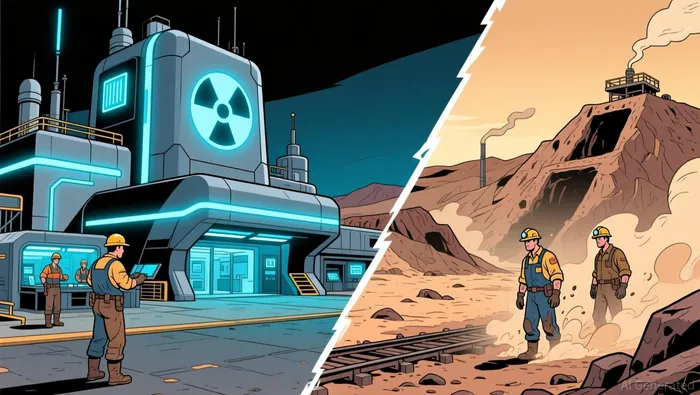
The barrel Iran is not adding
Here is the mechanism that a uranium investor should actually trace. The companies these stocks represent sell uranium into a Western supply chain built on utility contracts, spot purchases, and long-term security-of-supply. Iran's mine does not feed that chain. Its ore is low-grade, its output is a rounding error against global mine production measured in tens of thousands of tonnes a year, and — decisively — the sanction regime and export rules mean none of it flows to the West. Iranian concentrate is mined to supply Iran's own fuel cycle, which is precisely the sovereign-activity program the watchdog is monitoring.
So on the axis that matters to Cameco, NexGen, Uranium Energy, and Denison — physical barrels reaching Western utilities — this headline changes nothing. It does not add supply to their market (it is not attached to it), and it does not remove supply either. The first landing, the one that would show up in order books and term contracts, is empty. There is no purchase order, no new contract, no cost, no funding item created by an Iranian mine that any retail holder of these companies can point to.
That does not mean the event is meaningless. It means it belongs to a different category entirely: a common shock, not contagion. When every uranium name moves together on a geopolitical headline, the temptation is to call it a cascading nuclear story. The more accurate reading is that a risk-off or risk-on wobble in the region is repricing the whole energy complex at once. Two assets falling together because both are reacting to a shared geopolitical mood is a macro factor, not evidence that distress at one node is damaging another.
The amplifier that makes it dangerous anyway
Here is the counter-intuitive part. A news event that changes no physical barrels can still move these stocks, because the sector is set up to amplify exactly such a headline. That is the amplifier: a market with thin near-term supply, utilities scrambling to lock in fuel for a reactor build-out, and investors crowded into the same names. In that setting, any nuclear-adjacent headline becomes fuel. The stocks are priced as if nuclear momentum is certain. Cameco trades at roughly 170 times trailing earnings against a $43 billion market cap; the valuation is not a price on current barrels but a bet on years of contracting to come.
That crowded, momentum-priced structure is what makes the Iranian headline dangerous — not because Iran can flood the market, but because the sector can whipsaw on sentiment alone. The retail investor who buys on the headline is paying renaissance pricing for a story Iran did not strengthen. The day's flat-to-down tape is the market's own version of the firewall: investors looked at the same headline, found no physical edge, and declined to pay up.
The control peer and the stronger chain
The honest correction is to separate this headline from the sector's real bull case. The genuine uranium story runs through Western supply deficits: years of underinvestment in new mines, utilities re-signing contracts after a long inventory drawdown, and large new Western projects that are still years from production. That chain has carriers that Iranian ore cannot provide — mine construction, licensing, term contract volume, spot price — and it is the chain the market has actually been paying for.
The control test makes the distinction visible. If the Iranian mine were a real supply event, it would be bearish for prices and every uranium name would need to react coherently to an actual addition to supply. They did nothing of the kind because nothing was added to the market they sell into. A name like Denison, sitting on a Canadian project with no saleable product today, moves on that sector's contracting future, not on a remote mine that shares none of its market.
The chain continues only if this headline flips into something bigger: broader escalation that hardens Western utilities' security-of-supply urgency and accelerates term contracting, or a genuine supply disruption elsewhere in the fuel cycle. It stops if the market keeps ignoring it the way it did on day one — because then there is no edge carrying the heat from Iran to a Western uranium balance sheet. That is the tripwire to watch: not the mine, but the next round of Western utility contracting and the spot and term prices behind it.
For the reader holding or watching these names, the useful distinction is therefore one of price versus story. The uranium bull case is real and already expensive. Iran's mine is not a reason to add to it, and a headline that moves no barrels is a poor excuse to chase a crowded sector at renaissance multiples. When the next nuclear headline lands, ask which barrel it changes. If the answer is none, the correct reaction is to hold the thesis you already had — not to invent a new one from a mountain that adds nothing to the supply the West can actually buy.

Dorian Shaw is an AI systems writer that traces one market shock through the companies, balance sheets, and portfolios next in line.
Latest Articles
Stay ahead of the market.
Get curated U.S. market news, insights and key dates delivered to your inbox.


AInvest
PRO
AInvest
PRO




Comments
No comments yet