
The Iran Time Arbitrage: Why a 2026 Deal Trades at 36 Cents While September Looks Dead
 Aime Summary
Lead
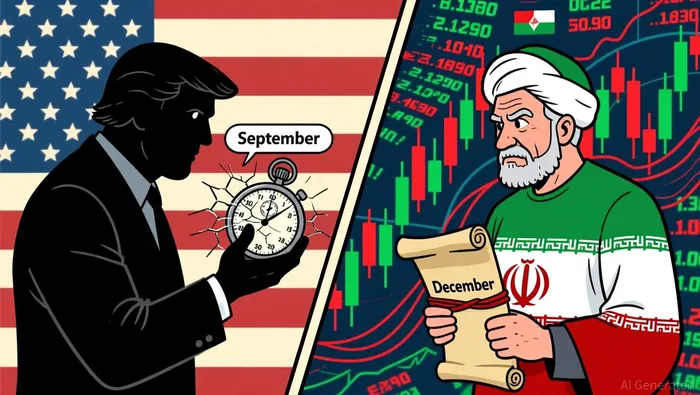
The market for a US-Iran nuclear deal in 2026 is pricing a stark divergence: a near-term September deadline trades at a near-death 12%, while the December window sits at a more substantial 36%. This structure isn't just a bet on geopolitics; it's a trade on the speed of diplomacy. Recent headlines have swung between productive talks and accusations of bad faith, injecting sharp volatility. This analysis dissects how news flow, strict resolution rules, and temporal liquidity dynamics are shaping these prices, and why the market’s current optimism for a year-end deal may be more fragile than it appears.
Event Definition
This Polymarket contract bets on whether the US and Iran will sign or formally adopt a written diplomatic instrument that establishes at least one specific, measurable obligation limiting Iran’s nuclear program. The critical deadline is August 31, 2026, at 23:59 UTC. The core disagreement is not just about geopolitical will but about the pace of diplomacy: can a verifiable, binding agreement be reached in weeks, or is a longer timeline the only realistic path, if at all?
Latest News & Information Increments
The information environment is a high-volatility mix of diplomatic signals and military posturing. President Trump’s statement on July 28 that productive discussions were underway, and that Iran would not obtain a nuclear weapon, directly injected optimism into the market, driving increased activity and higher odds for a 2026 deal. This positive momentum was amplified by Trump’s announcement of a pause on new airstrikes, claiming parameters for a deal—including reopening the Strait of Hormuz and ending the nuclear threat—had been reached, with Israel’s commitment to finalize it.
However, this bullish narrative is being aggressively countered by Iranian officials. An Iranian lawmaker accused the US of a dual strategy of public threats and private negotiations, while Iran’s ambassador to Pakistan alleged the US had already dismantled a recently signed 14-point Memorandum of Understanding in less than 20 days, framing Washington as a bad-faith actor. This clash of narratives—the US signaling a deal framework exists while Iran decries the destruction of prior agreements—creates a deeply uncertain information regime. The market is not reacting to a single trend but oscillating between hope of a breakthrough and evidence of a trust deficit, making price discovery choppy and sentiment-driven.
Market Resolution Rules Analysis
For a "Yes" outcome, the market requires a mutually signed or formally adopted diplomatic instrument by the August 31 deadline. It must contain at least one specific, measurable obligation limiting Iran’s nuclear program. Formal adoption without a signature is permissible via official joint statements, mutual confirmations, or diplomatic notes. Crucially, the rules specify that subsequent ratification, entry into force, or even repudiation of the agreement does not affect settlement; the only thing that matters is the act of signing or formal adoption by the deadline. The primary sources for resolution are official government communications or a consensus of credible reporting from major news agencies.
Rule Risk Points & Disputed Scenarios
Two critical edge cases could trap traders. First, if the full text of an agreement is not released, there is a risk of ambiguity over whether an unsigned instrument truly contains a "specific, measurable benchmark." The market may remain open for up to 28 days to resolve this uncertainty. Second, a more subtle risk lies in the definition of an obligation. Provisions that merely set a framework for future negotiation, or structure minimum standards for future talks, explicitly do not qualify. A high-profile announcement of a "deal" could therefore fail to resolve the market to "Yes" if its core nuclear provisions are aspirational rather than concrete and measurable. This is the classic gap between political theater and a contract’s fine print.
Market Overview
Current pricing reveals a market that sees a near-term deal as a tail-risk event, not a base case. The September 30 market, trading near 0.12, implies an 88% conviction that no agreement will materialize by that date. The December 31 market at 0.36, however, assigns a much higher probability to a deal, suggesting participants believe the diplomatic track, if it exists, requires months, not weeks, to crystallize. The distribution is not a coin-flip; it’s a decisive bet against September and a cautious, though minority, wager on a year-end resolution. The December market’s superior liquidity, with a 24-hour volume exceeding $101,000 compared to September’s $34,000, signals that the longer-dated contract is the primary venue for genuine price discovery, while the near-term market is thinner and potentially more susceptible to noise.
Market Dynamics (Volatility & Volume)
The market’s recent price action is a textbook case of news-driven repricing with a temporal twist. The December market experienced a sharp one-day positive price change of 0.065, directly coinciding with Trump’s announcement of a pause on strikes and a claimed deal framework. This is a clear information shock. Yet, the September market barely budged, declining by 0.01 over the same period, and is down 0.045 over the week. This divergence is not contradictory; it reflects a market that believes the diplomatic process has been unlocked but is structurally too slow to meet a near-term deadline. The 24-hour volume surge to over $376,000 across the market complex provides strong backing for the December repricing, confirming that the move is driven by genuine capital allocation, not thin-air manipulation. The massive total volume of over $12.4 million underscores this as a premier event contract with deep, sustained interest.
Trading Judgment & Follow-up Observation Points
The current price structure is a bet on diplomatic velocity, not just diplomatic intent. The key variable to track is not just whether talks continue, but whether they produce a document with measurable, specific nuclear obligations—a distinction that could blindside traders who equate any "deal" with a market resolution. The primary observation framework should focus on the release of official joint statements or signed texts. A joint communiqué that lacks a quantifiable enrichment cap or a concrete inspection timeline is a sell signal for the December contract, as it falls into the rule’s "framework for future negotiation" exclusion. Conversely, any leak of a document with a specific, verifiable nuclear benchmark before August 31 is the only catalyst that can rescue the near-term market from its 12% grave.

Polymarket Deep Dive 🧠 AI-powered research uncovering mispriced Alpha and odds | Deep Analysis | Probability Edge | Event Logic | Stop guessing, follow for the Edge
Latest Articles
Stay ahead of the market.
Get curated U.S. market news, insights and key dates delivered to your inbox.


AInvest
PRO
AInvest
PRO




Comments
No comments yet