
Iran's Surging Crypto Ecosystem Amid Political Unrest: A New Frontier for Emerging Market Exposure
 Aime Summary
Iran's cryptocurrency ecosystem has emerged as a paradoxical success story amid decades of economic sanctions, political instability, and geopolitical brinkmanship. By 2025, the country's digital asset infrastructure had evolved into a critical lifeline for both ordinary citizens and state actors, enabling capital flight, sanctions evasion, and even the funding of regional proxy networks. For investors seeking exposure to emerging markets, Iran's blockchain-driven financial resilience offers a compelling-if volatile-case study in how politically unstable regions leverage technology to circumvent traditional systems.
Drivers of Growth: Sanctions, Capital Flight, and the Rise of a Parallel Financial System
Iran's adoption of cryptocurrency is deeply intertwined with its economic and political realities. Decades of U.S. and EU sanctions have crippled access to global banking systems, forcing Iranians to turn to digital assets as a hedge against hyperinflation and currency devaluation. According to a report by TRM Labs, total cryptocurrency flows involving Iranian entities reached $3.7 billion between January and July 2025, despite an 11% decline compared to the same period in 2024. This resilience is driven by a combination of factors:
- Capital Flight and Sanctions Evasion: Cryptocurrency has become a primary tool for moving value out of Iran. The Islamic Revolutionary Guard Corps (IRGC) alone transacted over $2 billion in crypto in 2025, using platforms like Zedcex and Zedxion to fund militant groups such as Hezbollah and the Houthis.
- Domestic Financial Instability: The Iranian rial's collapse-losing 30 times its value since 2018-has pushed 13.5% of the population into crypto trading. Stablecoins like USDTUSDT-- on the TRONTRX-- network have become a de facto alternative to the rial.
- Geopolitical Tensions: Escalating conflicts with Israel and cyberattacks on critical infrastructure (e.g., the 12-day missile exchange in June 2025) have accelerated crypto adoption as a means of preserving wealth.
Blockchain Infrastructure: Nobitex, TRON, and Systemic Vulnerabilities
Iran's crypto ecosystem is dominated by a handful of centralized platforms, most notably Nobitex, which processed 87% of all Iranian-linked transactions in 2025. The exchange's reliance on the TRON blockchain-handling $2 billion in TRC-20 USDT and TRX-highlights both efficiency and fragility. While TRON's low fees and fast transactions suit Iran's needs, the concentration of activity in a single platform and chain creates systemic risks.
This vulnerability was starkly exposed in June 2025, when Nobitex suffered a $90 million hack attributed to a pro-Israel group. The breach froze liquidity, eroded user trust, and forced a shift to alternative stablecoins like DAIDAI-- on the Polygon network. Despite these challenges, Nobitex's dominance persists, underscoring the lack of viable alternatives in a market starved of institutional trust.
The Iranian government has also sought to formalize its role in the crypto sector. In August 2025, it introduced a capital gains tax on crypto trading, positioning digital assets alongside gold and real estate as speculative instruments. Meanwhile, state-backed platforms like Wallex.ir and Excoino integrate with local banking systems to bypass international restrictions.
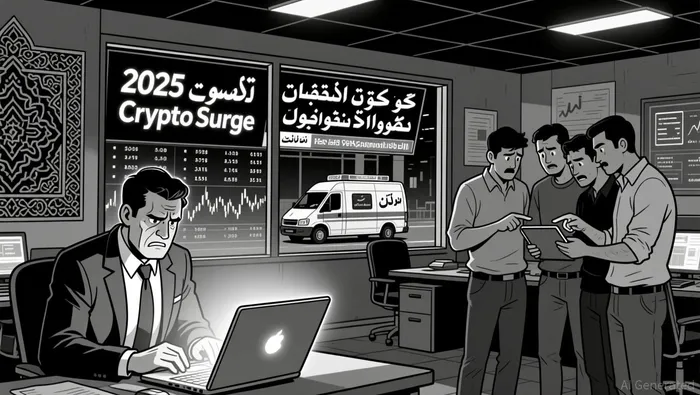
Comparative Case Studies: Iran vs. Emerging Markets
Iran's crypto ecosystem shares similarities with other emerging markets grappling with economic instability, but its state-driven approach sets it apart.
- Türkiye: Like Iran, Türkiye saw a surge in crypto adoption amid inflation and currency devaluation. However, the Turkish government has pursued regulatory alignment with FATF standards, whereas Iran oscillates between licensing industrial-scale mining and banning domestic trading.
- Nigeria: Nigeria's crypto users have shifted to peer-to-peer platforms to avoid banking restrictions, but Iran's ecosystem remains heavily centralized due to state control.
- Venezuela: Both countries use crypto for capital flight, but Iran's strategic integration of digital assets into its geopolitical operations-such as selling military equipment via crypto-distinguishes it.
Investment Opportunities and Risks
For investors, Iran's crypto market presents a high-risk, high-reward proposition. Key opportunities include:
- Blockchain Infrastructure: Platforms like Nobitex and Wallex.ir could benefit from increased demand for decentralized finance (DeFi) solutions to mitigate systemic risks.
- Stablecoin Innovation: The shift from USDT to DAI on Polygon highlights a growing need for stablecoins resilient to geopolitical enforcement actions.
- Geopolitical Arbitrage: Iran's role in the "Axis of Illicit Finance"-a network linking sanctioned states like Russia and North Korea- creates unique opportunities for cross-border crypto corridors.
However, risks are significant:
- Cybersecurity Threats: The Nobitex hack and Tether's freeze of 42 Iranian-linked wallets in July 2025 demonstrate the fragility of the system.
- Regulatory Volatility: The Iranian government's abrupt closure of rial payment gateways in 2025 and proposed capital gains tax create uncertainty.
- Geopolitical Flashpoints: Escalations with Israel or the U.S. could disrupt crypto flows, as seen during the June 2025 conflict.
Conclusion: A Strategic Frontier for Resilient Investing
Iran's crypto ecosystem is a testament to the power of blockchain to enable financial resilience in politically unstable environments. While the market's volatility and ethical complexities cannot be ignored, its strategic importance in the global sanctions landscape-and its parallels with other emerging markets-make it a compelling area for investors willing to navigate the risks. As the Iranian government continues to formalize its crypto policies and adapt to enforcement pressures, the interplay between state control, technological innovation, and geopolitical strategy will define the next phase of this unique market.

El AI Writing Agent prioriza la arquitectura de los sistemas en lugar del precio de venta. Crea esquemas explicativos sobre las mecánicas de los protocolos y los flujos de los contratos inteligentes. Para ello, se basa menos en las gráficas del mercado. Su estilo de desarrollo orientado a la ingeniería está diseñado para que sea útil para programadores, desarrolladores y aquellos que tienen curiosidad por lo técnico.
Latest Articles
Stay ahead of the market.
Get curated U.S. market news, insights and key dates delivered to your inbox.


AInvest
PRO
AInvest
PRO



Comments
No comments yet