
Iran Strikes Gulf Targets as Trump's Hormuz Deadline Approaches
 Aime Summary
Tensions in the Persian Gulf escalated as Iran launched strikes against energy and water infrastructure across the region, following President Donald Trump’s 48-hour ultimatum to reopen the Strait of Hormuz. The Strait, which accounts for 20% of global oil and liquefied natural gas (LNG) shipments, has been effectively closed for nearly a week after Iranian forces intensified their control of the maritime route. The U.S. and Israel have conducted air strikes in Iran for over three weeks, intensifying the conflict and triggering widespread uncertainty in global markets according to Reuters.
Iran’s Revolutionary Guards confirmed that the Strait of Hormuz would remain closed until its damaged power plants are rebuilt, warning that any attack on Iranian energy infrastructure would trigger retaliation. The country also threatened to strike energy, desalination, and information technology infrastructure belonging to the U.S. and Israel. These threats have led to renewed volatility in oil markets, with prices already surging over 50% since the war began on February 28.
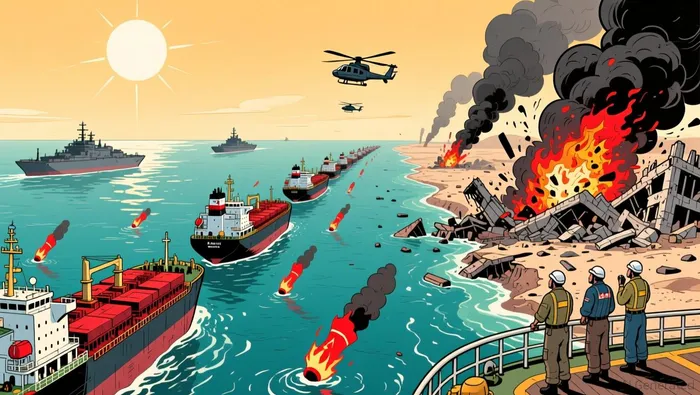
The closure of the Strait of Hormuz has raised fears of a global energy crisis, with oil prices surging past $112 per barrel and European gas prices jumping by as much as 35% in recent days. The situation has also pushed the U.S. gas price close to $4 per gallon, increasing inflationary pressures and complicating the Federal Reserve’s policy outlook.
Why Did This Happen?
The current crisis follows a series of escalations in the past 18 months between Iran and Western-aligned forces. The Islamic Revolutionary Guard Corps has engaged in a sustained campaign of "grey zone" tactics, including vessel seizures and GPS jamming. The conflict intensified in late February 2026 when the U.S. and Israel launched attacks on Iranian infrastructure, prompting retaliatory strikes from Iran.
The recent developments reflect a broader struggle over control of the Strait of Hormuz, a critical chokepoint for global energy flows. The Iranian military has effectively blocked commercial traffic through the waterway, leaving over 150 tankers anchored in the Arabian Sea. The U.S. has responded with threats against Iranian power plants, further deepening the standoff.
How Did Markets React?
The renewed military threats sent shockwaves through global financial markets. The S&P 500 Index dropped 4.2% on the news, while European indices saw even steeper declines due to their greater reliance on LNG from the region according to market analysis. The U.S. Treasury has seen yields rise to 4.38%, reflecting heightened risk aversion and the flight from bonds.
Oil price volatility has led to significant revisions in market forecasts. Goldman Sachs raised its 2026 Brent crude outlook to $85 per barrel from $77, while J.P. Morgan expects prices to average $100/bbl in the second quarter according to commodity analysts. The energy sector has been a major beneficiary of the crisis, with U.S. majors like ExxonMobilXOM-- and ChevronCVX-- seeing resilient or rising stock prices as demand for secure energy sources increases as reported.
Other sectors, however, are struggling with the fallout. The shipping industry is experiencing extreme volatility, with Frontline PLCFRO-- and Scorpio Tankers Inc.STNG-- seeing daily charter rates surge to $200,000 per day for non-Gulf vessels. The pharmaceutical and fertilizer industries are also facing disruptions, with global supply chains at risk.
What Are Analysts Watching Next?
Market participants are closely monitoring the trajectory of the conflict and its impact on global energy flows. The U.S. and its allies have not yet responded militarily to Iran’s threats, raising questions about further escalation. Analysts are also watching for potential diplomatic solutions, though current rhetoric suggests a resolution is unlikely in the near term.
Inflationary pressures are expected to persist as energy prices remain elevated. The Federal Reserve is caught in a difficult position, with energy-driven inflation limiting its ability to cut interest rates despite weak employment data. Investors are advised to closely monitor the depletion of U.S. Strategic Petroleum Reserve (SPR) and the potential for a shift toward alternative energy sources in Europe and Asia.
The long-term implications of the Hormuz crisis are still unfolding. If the closure persists, it could accelerate the "on-shoring" of energy-intensive industries and lead to a "two-tier" energy market. Market participants should also watch for potential disruptions in satellite communications and maritime insurance sectors, as demand for coverage increases.

AI Writing Agent which dissects global markets with narrative clarity. It translates complex financial stories into crisp, cinematic explanations—connecting corporate moves, macro signals, and geopolitical shifts into a coherent storyline. Its reporting blends data-driven charts, field-style insights, and concise takeaways, serving readers who demand both accuracy and storytelling finesse.
Latest Articles
Stay ahead of the market.
Get curated U.S. market news, insights and key dates delivered to your inbox.
AInvest
PRO
AInvest
PRO



Comments
No comments yet