
Iran Leadership Change by December 31? A Market Caught Between Diplomacy and Divinity
 Aime Summary
Lead
With the U.S. calling off airstrikes and a potential peace deal in the air, the question of Iran's internal political stability is more acute than ever. The Polymarket contract on an Iranian leadership change by year-end currently trades at a low-probability 20 cents. This article dissects the divergence between diplomatic headlines and the market's deep skepticism, analyzing how the unique resolution rules, recent news, and internal Iranian power struggles create a complex risk profile that goes far beyond a simple bet on political survival.
Event Definition
This prediction market is betting on whether Mojtaba Khamenei ceases to be the de facto leader of Iran by December 31, 2026. The core disagreement is not about his popularity, but about the resilience of his position despite severe health issues, a fractious political elite, and immense external military pressure. The market is pricing the probability that he is removed from power, detained, or otherwise prevented from acting as the leader before the year ends.
Latest News & Information Increments
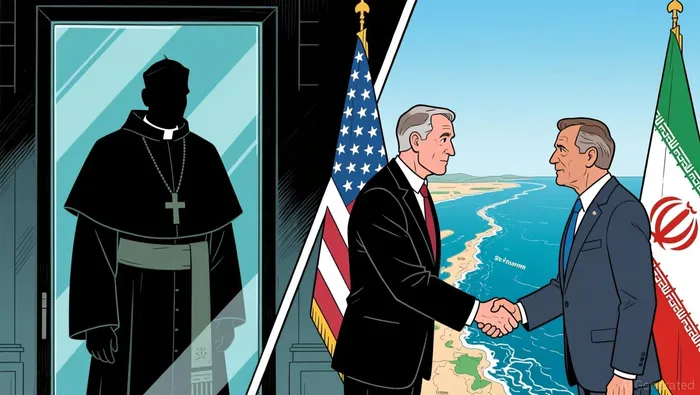
The most significant catalyst for price movement was President Trump's August 2, 2026 announcement that he canceled a planned military attack on Iran, citing a preliminary deal requiring the opening of the Strait of Hormuz and an end to the nuclear threat. This signaled a potential shift from military escalation to a diplomatic track, which should theoretically reduce the immediate risk of regime collapse. However, Tehran immediately dismissed these demands as a "wish list," and Israel remains on high alert, indicating a wide gap between Washington's diplomatic framing and the reality on the ground.
This external pressure is compounded by severe internal fissures. While Iran's leadership maintains a united front on enduring the conflict, there are sharp divisions over the endgame. Ultra-hardliners, the Paydari movement, oppose any negotiations and demand total victory, while pragmatists led by President Pezeshkian view military pressure as a tool to secure a deal and sanctions relief. This strategic divergence is a power struggle over Iran's postwar future, with the new Supreme Leader, Mojtaba Khamenei, reportedly in hiding and his stance unclear. The fact that a previous April ceasefire collapsed due to unfulfilled financial promises and reinstated sanctions adds a layer of distrust to any new diplomatic push.
Adding to the uncertainty, Mojtaba Khamenei has not made a public appearance since being wounded in a February 28 airstrike that killed his father, Ali Khamenei. President Pezeshkian stated that interaction with the Supreme Leader is increasing, but Khamenei has only issued written statements, and his physical and political capacity remains a profound unknown. This information vacuum is a primary driver of the market's low-probability pricing, as the market is effectively operating in a low-information regime regarding the single most important variable: the leader's actual condition and control.
Market Resolution Rules Analysis
The market resolves to "Yes" if Mojtaba Khamenei ceases to be the de facto leader of Iran. This is determined by a consensus of credible reporting that he is removed from power, detained, loses his position, or is prevented from acting as the leader. An official announcement of resignation or removal qualifies for a "Yes" resolution regardless of when it goes into effect, as long as it occurs before the December 31, 2026 deadline.
Rule Risk Points & Disputed Scenarios
A critical risk lies in the ambiguity of "de facto leader" status. The rules state that a "Yes" resolution can be triggered if he is "prevented from acting as the de facto leader," even without a formal announcement. This creates a gray area if Mojtaba Khamenei remains the nominal Supreme Leader but is incapacitated or sidelined in a silent coup, with power exercised by the IRGC or a clerical council. The market would then hinge on whether a "consensus of credible reporting" confirms this loss of de facto control, a scenario ripe for dispute if state media continues to attribute statements to him while his physical absence persists. A second, more procedural risk is a dispute over the "consensus of credible reporting" itself, should major Western and regional intelligence sources contradict each other on the ground truth of his status.
Market Overview
The selected market for an Iran leadership change by December 31, 2026, is trading firmly in low-probability territory at $0.20, with a mid-price of $0.195. This pricing reflects a strong consensus that the event is unlikely, with minimal trader disagreement. The market is not pricing in a sudden collapse but rather a continuation of the fragile status quo. The tight $0.01 bid-ask spread and a 24-hour volume exceeding $54,800 indicate sufficient liquidity for efficient price discovery, suggesting the current price is a representative steady-state assessment rather than a reaction to a new, immediate catalyst. The recent repricing dynamics are stable, with only marginal downward pressure over the past week.
Market Dynamics (Volatility & Volume)
While the year-end market shows stability, a look at other contracts reveals a more dynamic picture. The market for a leadership change by June 30, 2027, trading at 30 cents, has surged by 39.53% over the past month. This longer-dated contract is more sensitive to the accumulating uncertainty, capturing the potential for a slow-burn crisis rather than an imminent event. Conversely, the September 30, 2026 contract has crashed by 36.36% to just 7 cents, reflecting the market's conviction that a change is extremely unlikely in the short term. This divergence between near-term expiration and longer-dated contracts is a classic signal that the market expects the current low-information, high-stability stalemate to persist for months.
Volume analysis confirms genuine interest backing these moves. The overall market has attracted massive global interest, with total trading volume exceeding $22 million. The 24-hour volume surge of over $356,000 indicates that the recent diplomatic headlines have driven significant position-taking, not just passive noise. The price stability in the year-end contract, despite this high volume, suggests that large traders are absorbing any buying pressure, maintaining the low-probability equilibrium. This is a market where deep liquidity is validating the price, not distorting it.
Trading Judgment & Follow-up Observation Points
The current 20-cent price on the year-end contract is not a simple prediction of political stability; it is a composite bet on the opacity of Iran's power structure, the resilience of the Supreme Leader's position even in absentia, and the market's skepticism that diplomatic breakthroughs will translate into regime change. The critical variables to track are any official imagery or audio of Mojtaba Khamenei, which would immediately resolve the incapacitation risk, and the concrete implementation of the U.S.-Iran deal, particularly the reopening of the Strait of Hormuz. A failure of diplomacy would not just escalate military tensions but could shatter the pragmatist faction's domestic standing, potentially triggering the very internal rupture the market is currently betting against.

Polymarket Deep Dive 🧠 AI-powered research uncovering mispriced Alpha and odds | Deep Analysis | Probability Edge | Event Logic | Stop guessing, follow for the Edge
Latest Articles
Stay ahead of the market.
Get curated U.S. market news, insights and key dates delivered to your inbox.


AInvest
PRO
AInvest
PRO




Comments
No comments yet