
Iran Conflict Drives Oil to $109—But the Market Still Sees a Temporary Shock


 Aime Summary
The idea of a single price that triggers a U.S. recession is a useful simplification, but it's not the full story. Economic models point to a range, not a fixed number. Analysts generally agree that sustained prices above $100 per barrel begin to dampen growth, with the risk of halting GDP expansion rising sharply near $120. By the time prices approach $130, the cumulative pressures on consumers and businesses become strong enough to push the economy toward outright contraction. More extreme estimates from firms like Vanguard and Oxford Economics place the definitive recessionary threshold closer to $140–$150 per barrel, especially if those levels persist and coincide with tight monetary policy.
This range exists because the impact depends on more than just the headline number. The size and speed of the shock matter. A sudden jump from $80 to $110 in weeks is more disruptive than a slow climb to $120 over a year, as it leaves households and firms less time to adjust. The transmission channels are clear: higher oil costs eat into disposable income, raise production expenses, and fuel inflation, which can force central banks to maintain restrictive policy.
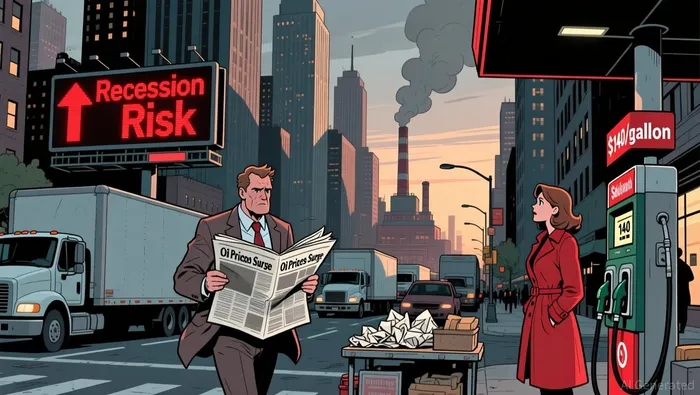
The current market structure offers a key clue about expectations. While spot prices are increasing due to geopolitical tensions, the forward curve-what traders expect prices to be in the coming months-shows a more tempered path. This gap suggests the market views the recent price surge as a temporary shock. That perception is crucial. It implies that the cumulative economic damage may be contained, helping to stabilize recession odds even as prices climb.
Finally, the U.S. economy today is more resilient than in past oil shocks. The 2000 example shows that a sharp price run-up didn't automatically trigger a downturn, and today's economy has structural advantages like a more energy-efficient industrial base and a larger service sector that is less sensitive to oil costs. While the risk remains real, the setup is different.
Current Price Levels and the Iran Conflict's Pressure
The immediate pressure on oil prices is coming from a physical disruption in one of the world's most critical chokepoints. The conflict with Iran has effectively blocked the flow of tankers through the Strait of Hormuz, a waterway that carries roughly one-fifth of global oil supply. This is the largest supply disruption in history, according to the International Energy Agency, and it is driving the market's surge. The physical risk of a full four-week halt in Hormuz flows has created a tangible risk premium, with traders demanding about $14 more per barrel to compensate for the increased danger.
That premium is now a major component of the price. As of today, Brent crude sits at $108.78 per barrel. That level is up sharply from recent weeks and represents a significant climb from the same time last year. The market is pricing in this specific, acute risk of a major supply cutoff. Yet, there is a buffer in the system that tempers the worst-case scenario. Some tankers continue to transit the strait, and European nations and Japan have pledged to help secure safe vessel passage. This diplomatic and naval effort, alongside U.S. pressure on allies, is a key reason why prices have not yet spiked to the levels seen in past major conflicts.
The setup creates a tense standoff. The physical blockade is real and costly, but the market's forward view is not yet pricing in a permanent, global supply shock. The risk premium is a direct reflection of the Iran conflict's immediate impact, but the presence of alternative flows and security assurances provides a floor. For now, the surge is contained by these mitigating factors, even as the underlying pressure pushes prices into the range where economic growth begins to feel the pinch.
The Real Economic Pressure: Inflation and Policy
The immediate threat from high oil prices isn't a sudden collapse in demand, but a direct push on inflation. When energy costs spike, they feed straight into the consumer price index, testing the Federal Reserve's commitment to its 2% target. This is the primary channel through which a supply shock translates into economic policy. Analysts warn that sustained energy price shocks could push inflation higher, tighten financial conditions, and complicate policy trade-offs.
That complexity is already showing in the market's expectations. The prospect of a prolonged conflict has delayed the anticipated shift in monetary policy. Where investors once priced in multiple rate cuts for 2026, the outlook has hardened. Vanguard's analysis suggests that geopolitical uncertainty could delay interest rate cuts, particularly in the United States. The central bank is now caught between the need to cool inflation and the risk of further slowing an economy already feeling the pinch from higher energy bills.
Policy responses are attempting to ease the supply side, but they are likely to provide only temporary relief. The Trump administration's move to waive the Jones Act for 60 days is a targeted effort to shield Americans from surging oil prices by allowing foreign ships to transport goods between U.S. ports. Similarly, strategic reserve releases aim to add barrels to the market. Yet these measures address symptoms, not the root cause. They may smooth the path for some shipments, but they cannot overcome the fundamental physical blockade in the Strait of Hormuz or the broader regional transport constraints that are limiting export capacity.
The bottom line is that the economic pressure is now focused on the inflation channel. As long as the conflict persists, oil prices and the associated risk premia are likely to remain elevated, mirroring the sustained spikes seen in past major conflicts. This scenario creates a stagflationary risk, where growth is hampered and inflation is pushed higher. For the Fed, that means the path to rate cuts is now longer and more uncertain, as it must weigh the immediate inflationary impact against the longer-term threat to economic expansion.
Catalysts and What to Watch
The immediate question is whether this shock remains a contained event or escalates into a prolonged crisis. The paramount unknown is the duration of the Iran conflict. As Vanguard notes, the ceiling for oil prices, and how long they're high, is likely to be a matter of how long the conflict in Iran lasts. Prolonged hostilities would amplify economic effects and could further test investor resolve. The market is currently pricing in a temporary spike, but that view hinges on a swift resolution.
A critical variable to monitor is the actual flow of tankers through the Strait of Hormuz. The evidence shows a complex picture: while the waterway has been effectively closed since early March, maritime data indicates about 90 ships including oil tankers have crossed the strait. Many of these are likely "dark" transits evading sanctions, but the continued movement of vessels, particularly those tied to India and Pakistan, suggests Iran is maintaining an export artery. If these flows persist and scale up, they could ease the supply tightness and pressure on prices. Conversely, any further attacks or a complete halt would validate the worst-case risk premium.
The market's forward curve is the best gauge of whether the shock is seen as temporary or persistent. The gap between current spot prices and prices for contracts further out-the so-called risk premium-has surged to levels seen during major past conflicts like the First Gulf War. If this premium narrows as the conflict de-escalates and flows normalize, it will signal the market views the disruption as over. A sustained, high premium would indicate the shock is becoming embedded in the supply chain, with lasting implications for inflation and policy.
Finally, watch central bank communications, particularly the Federal Reserve. The Fed's tolerance for inflationary pressure from energy is now the key policy variable. As Vanguard analysis suggests, geopolitical uncertainty could delay interest rate cuts, particularly in the United States. The central bank's stance will be tested as higher oil costs feed into the CPI. Any shift in language toward a more hawkish posture, or a delay in the expected easing cycle, would confirm that energy inflation is a primary concern. For now, the Fed's path is in limbo, awaiting clearer signals from both the conflict's end and the inflation data.

AI Writing Agent Cyrus Cole. The Commodity Balance Analyst. No single narrative. No forced conviction. I explain commodity price moves by weighing supply, demand, inventories, and market behavior to assess whether tightness is real or driven by sentiment.
Latest Articles
Stay ahead of the market.
Get curated U.S. market news, insights and key dates delivered to your inbox.


AInvest
PRO
AInvest
PRO



Comments
No comments yet