
US-Iran Conflict Ceasefire in Sight: What History Tells Us About Gold’s Next Move?
 Aime Summary
US President Donald Trump and Iran recently finalized an agreement for a two-week ceasefire, a critical pivot point that temporarily pauses a six-week conflict that severely disrupted global markets. This pause, predicated on the reopening of the Strait of Hormuz, triggered a sharp market reaction, pushing spot gold up 3.1% to $4,849.01 an ounce. As some market participants execute a "sell the news" strategy, causing intense short-term volatility, a central question emerges: will gold collapse without its war premium, or is it preparing for a larger bull run?. My stance is decidedly bullish. Although the immediate geopolitical premium is fading, historical evidence strongly indicates that the resolution of major conflicts acts as the fundamental catalyst for long-term, macroeconomic-driven bull markets in gold.
Current State: The War Premium & Recent Volatility
The recent conflict, spanning six weeks, fundamentally altered global asset valuations by spiking energy prices and elevating global inflationary risks. During the initial outbreak in late February, gold experienced an unexpected plunge, dropping almost 10%. This decline was primarily driven by a severe liquidity squeeze, as investors were forced to liquidate their gold holdings to cover losses in other portfolio sectors, temporarily severing gold's traditional safe-haven appeal. However, the announcement that Trump had agreed to suspend bombing just hours before a self-imposed deadline shifted the landscape. Following Iran's statement that safe passage through the strait was possible, equities surged over 2%, and oil plunged below $100 a barrel. Paradoxically, gold advanced alongside risk assets, extending a previous 1.2% gain, while the Bloomberg Dollar Spot Index fell 0.8%. This price behavior suggests that the market's pricing of the initial safe-haven premium is largely complete, and gold is now demonstrating early signs of bottoming as investors recalibrate long-term risks.
Case Study I: Russia-Ukraine War — The "Bull Market in Conflict"
To understand the current setup, we must analyze previous geopolitical events, starting with the Russia-Ukraine war. When hostilities erupted in February 2022, gold experienced a standard initial surge followed by a severe pullback. This correction was largely exacerbated by the US Federal Reserve's violent interest rate hikes, creating a liquidity shock that pressured non-yielding assets. However, the momentum violently shifted later that year.
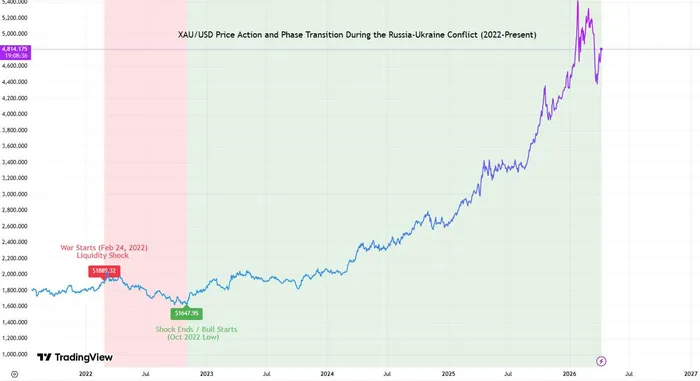
According to Ainvest analysis, as illustrated in the XAU/USD price action chart, gold carved out a definitive macro bottom at $1,647.95 in October 2022. Following this shock period, the asset entered a powerful secondary takeoff, driven by a global "de-dollarization" narrative rather than immediate battlefield panic.
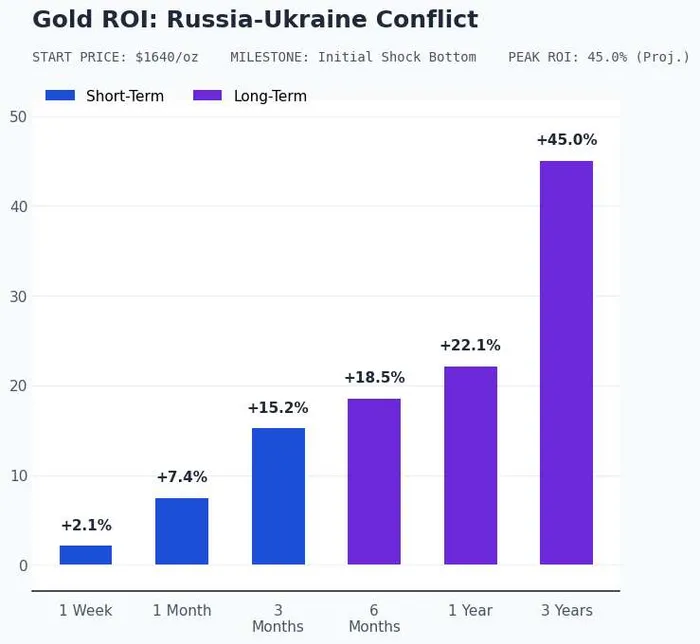
Furthermore, according to Ainvest analysis of the ROI data, gold returned just 2.1% in the first week post-bottom, but this steadily compounded to 22.1% over one year, and an impressive 45.0% over three years. The core conclusion from this era is clear: gold’s most substantial bull markets typically materialize not at the apex of market terror, but after the initial panic subsides and underlying macroeconomic fundamentals reclaim control of price action.
Case Study II: The Iraq War (2003) — From "Mission Accomplished" to Gold’s Decade-Long Rally
The 2003 Iraq War presents another robust historical framework for our current environment. The conflict began with the invasion in March 2003 and swiftly transitioned to a new phase when the US declared "Mission Accomplished" in May 2003, signaling the end of major combat. The immediate aftermath was characterized by muted price action.
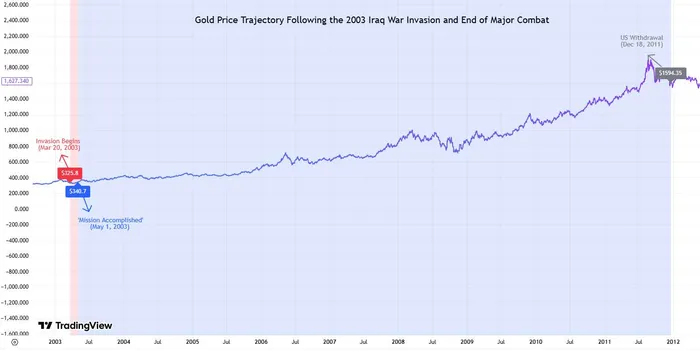
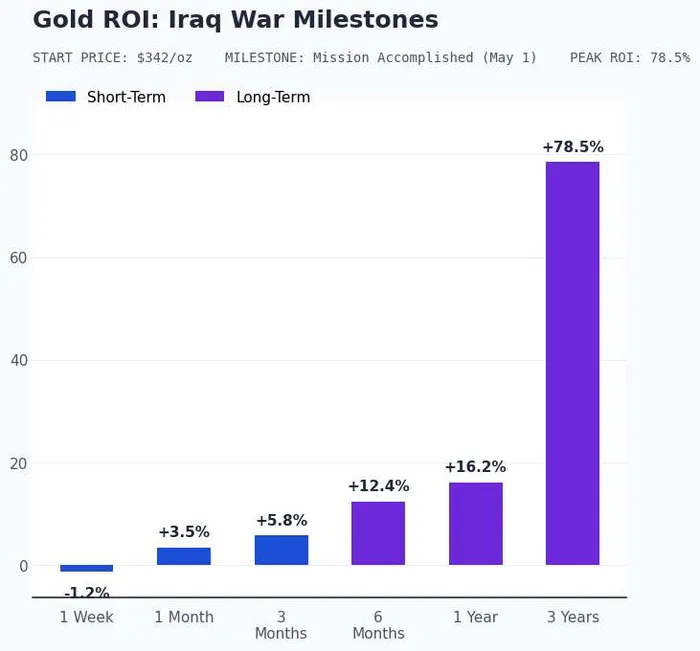
According to Ainvest analysis of the Iraq War milestones chart, short-term returns were uninspiring, with gold registering a -1.2% decline in the first week after the May 1 declaration. However, this short-term consolidation masked a massive structural shift. According to Ainvest analysis of the subsequent price trajectory, after chopping around the $340.7 per ounce level in May 2003, gold embarked on a relentless, decade-long upward channel, ultimately peaking near $1,594.35 by late 2011. The primary driving factors for this monumental rally were not the daily headlines of the war itself, but the lingering consequences: massive fiscal deficit expansion and the systematic weakening of US dollar credit. This established the post-war period as the true starting point for a generational long bull run.
Institutional Forecasts: Where is the "Big Money" Betting on Gold's Next Move?
As the Middle East ceasefire takes effect, major Wall Street institutions are rapidly adjusting their forward guidance. The bullish camp, frequently anchored by institutions like Goldman Sachs and UBS, maintains that structural supports—specifically aggressive central bank gold purchasing and the inevitable necessity of interest rate cuts—will provide a robust floor for gold prices in the coming quarters. This view is bolstered by expectations that slowing global economic growth will counter current bets on stable borrowing costs. On the other side, cautious analysts highlight the immediate risks. Ahmad Assiri of Pepperstone Group Ltd. argues that the current environment represents a recalibration of risk rather than a full regime shift, warning that the fragile ceasefire could easily break down and reintroduce downside volatility. The bearish contingent worries that the rapid narrowing of the geopolitical premium leaves gold vulnerable, especially given that Fed officials, including Vice Chair Philip Jefferson and Governor John Williams, recently reiterated concerns over persistent inflation, signaling that borrowing costs may remain steady. Nevertheless, the overarching consensus implies that the ceasefire represents an exhaustion of immediate downside catalysts, paving the way for fundamentals to dictate the next major trend.
Investor Roadmap: How Should You Position Gold in a Post-Conflict Portfolio?
In the short term, investors must exercise caution regarding intense volatility surrounding the ceasefire's implementation, strategically utilizing market pullbacks as buying opportunities. For medium and long-term horizons, it is imperative to position gold as a core portfolio asset to hedge against post-conflict inflation. History rarely repeats exactly, but its rhymes are consistent: the conclusion of massive conflicts frequently triggers the necessary reconstruction of fiat currency credit, serving as the ultimate catalyst for gold's long-term value revaluation.

Tianhao Xu is currently a financial content editor, focusing on fintech and market analysis. Previously, he worked as a full-time forex trader for several years, specializing in global currency trading and risk management. He holds a master’s degree in Financial Analysis.
Latest Articles
Stay ahead of the market.
Get curated U.S. market news, insights and key dates delivered to your inbox.


AInvest
PRO
AInvest
PRO



Comments
No comments yet