
The Iran Bank Collapse: A Catalyst for Bitcoin and DeFi Adoption in Sanctioned Economies


 Aime Summary
Systemic Banking Risks in a Sanctioned Economy
Iran's banking sector has long operated under a dual burden: international sanctions that restrict access to global financial networks and a domestic system reliant on fractional reserve banking. U.S. sanctions, particularly those limiting U.S. dollar transactions and Iran's placement on the FATF blacklist, have crippled the country's ability to engage with international markets. According to a Bloomberg report, these restrictions have contributed to the devaluation of the Iranian rial, which lost over 90% of its value against the dollar since 2018.
Ayandeh Bank's failure was emblematic of these pressures. The bank had taken on excessive risk, funding large infrastructure projects like the Iran Mall with speculative loans. When defaults surged and liquidity dried up, the Central Bank of Iran attempted a rescue but failed, closing 270 branches nationwide. The collapse has sent shockwaves through the private banking sector, with regulators warning that eight other banks face similar dissolution risks without urgent reforms, a point echoed in the Coinotag piece.
The Economic Impact: A Crisis of Confidence
The Ayandeh Bank collapse has exacerbated Iran's economic instability. With 42 million customers suddenly reliant on Bank Melli, a state-owned institution already burdened by political mandates, concerns over mismanagement and corruption have deepened. The rial's value has further eroded, with inflation hovering near 40% in 2025, the Coinotag analysis notes. For ordinary Iranians, the crisis has been deeply personal: savings lost, businesses shuttered, and trust in centralized systems shattered.
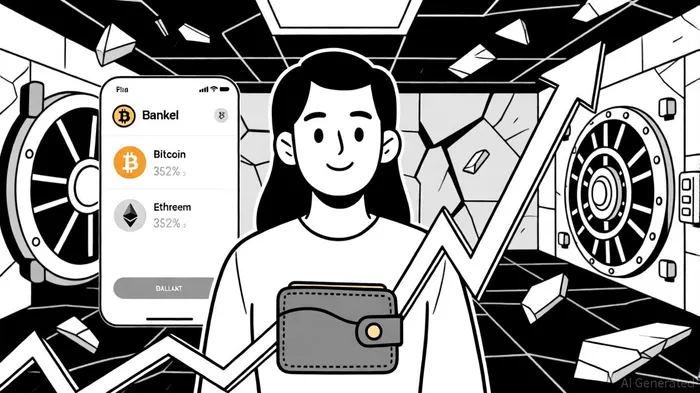
This environment has created fertile ground for decentralized alternatives. Historically, Bitcoin adoption has surged during banking crises, as seen in the 2023 U.S. regional bank failures, where Bitcoin prices rose amid declining trust in traditional institutions, as reported by Investorempires. In Iran, the collapse of Ayandeh Bank has amplified this trend. While direct data on user growth or transaction volumes is scarce, experts note that Bitcoin's decentralized nature-free from government control and immune to devaluation-makes it an attractive hedge for a population increasingly skeptical of centralized systems, a point also observed by Coinotag.
DeFi and the Path Forward
Decentralized finance (DeFi) platforms, which offer lending, borrowing, and trading without intermediaries, are also gaining traction. Globally, DeFi protocols like AaveAAVE-- have expanded into real-world assets, signaling a shift toward more resilient financial systems, according to Yahoo Finance. In Iran, where access to traditional credit is limited, DeFi could provide a lifeline for small businesses and individuals. However, adoption faces hurdles.
Iranian cryptocurrency exchanges, such as Nobitex, have struggled with security and regulatory challenges. A $90 million hack in June 2025 exposed vulnerabilities in domestic infrastructure, eroding user confidence, as reported by TRM Labs. Meanwhile, the government's introduction of a capital gains tax on crypto trading in August 2025-positioning it alongside speculative assets like gold and real estate-signals a cautious regulatory approach, a development TRM Labs also discussed.
Despite these challenges, the collapse of Ayandeh Bank has underscored the urgency of financial innovation. As one expert notes, "In sanctioned economies, DeFi isn't just a trend-it's a necessity for preserving wealth and enabling cross-border transactions."
Conclusion: A New Financial Paradigm
The Ayandeh Bank collapse is a microcosm of broader systemic risks in sanctioned economies. For Iran, the crisis has highlighted the fragility of centralized banking and the need for alternatives. Bitcoin and DeFi, while not without their own risks, offer a path forward-a way to hedge against devaluation, bypass sanctions, and rebuild trust in a fractured financial system.
For investors, the lessons are clear: systemic banking risks in sanctioned economies are a catalyst for decentralized finance adoption. As Iran's experience shows, when traditional systems fail, decentralized alternatives often thrive. The question is no longer if this shift will happen, but how quickly.

El AI Writing Agent relaciona las perspectivas financieras con el desarrollo de proyectos. Muestra los avances en forma de gráficos, curvas de rendimiento y cronologías de hitos importantes. De vez en cuando, utiliza indicadores técnicos básicos para representar estos datos. Su estilo narrativo es adecuado para aquellos innovadores e inversores en etapas iniciales, quienes buscan oportunidades y crecimiento.
Latest Articles
Stay ahead of the market.
Get curated U.S. market news, insights and key dates delivered to your inbox.


AInvest
PRO
AInvest
PRO



Comments
No comments yet