
IRA Contribution Limits and Market Liquidity in 2026: A Shift in Retirement Investment Patterns


 Aime Summary
Historical Context and Inflation-Indexed Adjustments
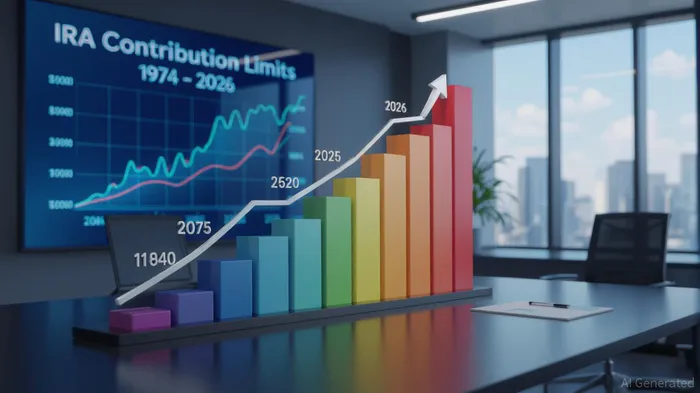
Since their introduction in 1974, IRA contribution limits have been periodically adjusted to account for inflation, with major revisions occurring in the 1980s and 2000s according to historical analysis. The 2026 increase follows a pattern of incremental adjustments, but its magnitude-$500 for standard contributions and $100 for catch-up contributions-suggests a more pronounced shift in savers' capacity to allocate capital. This trend is not merely a technical update; it reflects a structural realignment of retirement savings behavior in response to macroeconomic pressures, such as persistent inflation and demographic shifts in the aging population as research indicates.
Investment Behavior and Market Liquidity
The increased contribution limits are likely to amplify the flow of capital into tax-advantaged accounts, which in turn could alter the composition of asset demand. According to a report by CNBC, higher IRA limits may redirect funds into mutual funds, exchange-traded funds (ETFs), and other investment vehicles that hold equities and bonds according to CNBC analysis. This could temporarily boost liquidity in these markets, as investors seek to deploy new savings. However, the impact is not uniform. For instance, lump-sum investments-often favored by savers with surplus cash-could create immediate liquidity demand, whereas dollar-cost averaging, a strategy increasingly adopted by risk-averse investors, might spread liquidity pressures over time as financial experts note.
 Conversely, the rise in self-directed IRA options, which allow investments in real estate, private equity, and cryptocurrencies, could divert capital away from traditional markets according to industry analysis. This shift, while beneficial for long-term portfolio diversification, may reduce short-term liquidity in equities and bonds. The 2026 changes thus present a dual-edged dynamic: they could either enhance or constrain liquidity, depending on how savers allocate their newfound capacity.
Broader Implications for Equity and Bond Markets
The interplay between IRA contributions and market liquidity is further complicated by broader macroeconomic trends. For example, the ongoing softening of liquidity in the cryptocurrency market-marked by ETF outflows and declining stablecoin issuance-signals a global recalibration of risk appetite as financial analysts report. In this context, traditional markets may face competing pressures: increased inflows from IRA savings and reduced demand from capital reallocated to alternative assets.
Moreover, the One Big Beautiful Bill Act's (OBBBA) provisions for retirees, such as the $6,000 personal exemption for those aged 65 and older, could indirectly influence market flows. Retirees with enhanced tax flexibility may adjust their withdrawal strategies, potentially reducing the need to liquidate assets in equities or bonds according to financial analysts. This could stabilize markets by curbing forced selling, particularly in volatile environments.
Conclusion
The 2026 IRA contribution limits represent more than a technical adjustment; they are a catalyst for rethinking how retirement savings intersect with broader financial markets. While the immediate effect may be a boost in liquidity for equities and bonds, the long-term impact hinges on savers' preferences for asset allocation. As investors navigate these changes, market participants must remain attuned to the dual forces of capital reallocation and risk management. The coming months will reveal whether these shifts consolidate into a new equilibrium or trigger further volatility in liquidity dynamics.

Delivering real-time insights and analysis on emerging financial trends and market movements.
Latest Articles
Stay ahead of the market.
Get curated U.S. market news, insights and key dates delivered to your inbox.


AInvest
PRO
AInvest
PRO



Comments
No comments yet