
The IPO First-Day Pop Isn't Yours to Catch
 Aime Summary
Here is the picture most investors carry around: an IPO pops on day one, so an IPO that pops is a good investment, and the way to win at this game is to get into the next one fast. And that picture quietly deletes the most important part of the story — who gets paid by the pop, and the moment you actually get to buy. The average new listing has jumped 19% on its first trading day since 1980. That feels like the moment you're supposed to be in on. It isn't yours.
The Saved Seats Were Never on Sale to You
Put away the IPO for thirty seconds and think about tickets to the hottest show of the year. The venue sells a block of seats at face value to the promoter's favored clients before the general public can buy anything. On the morning tickets actually go on sale to everyone, demand is so ferocious that the resale price is already 19% above face — before the doors even open.
You line up at the general on-sale. Are you up 19%? No. You buy at the marked-up market price. The 19% belongs to the favored clients, who paid face and can flip the moment the hype peaks. The only way that pop lands in your account is if you got face-value tickets — and the entire design of this sale is that you didn't.
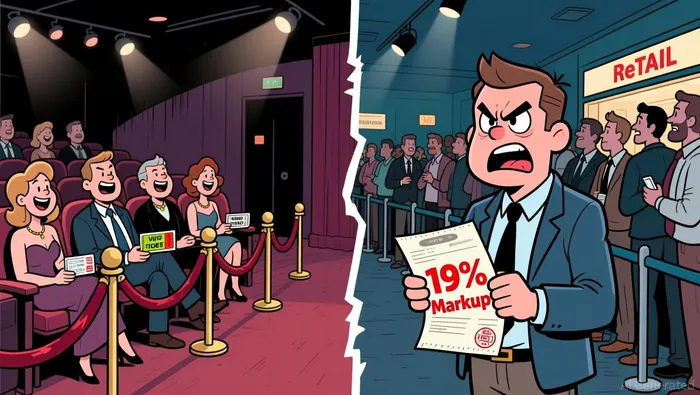
Now label the props:
- The venue's favored clients = the institutional clients of the underwriting banks, who get IPO shares at the offer price.
- Face value = the offer price.
- The market price on general on-sale day = the first-day closing price.
- The 19% markup = the average first-day IPO pop.
- You at the general on-sale = the retail investor entering at the day-one close, a step after the discount was distributed.
- Whether the band still sells out arenas a year later = whether the company's business can justify its price over the next three years.
The Pop You Missed Becomes the Premium You Carry
Run the toy version with three numbers. An IPO prices at $10 a share and closes its first day at $11.90 — exactly the 19% average pop. The client who was handed shares at $10 and sells at $11.90 banks $1.90 a share. Your account: nothing. You buy at $11.90.
Three years pass. Say the stock is back to $8. The offer-price buyer is down 20% — and that buyer cohort is where the oft-cited "56% of IPOs lose money after 3 years" figure comes from. But you entered at $11.90, so you are down 33%. Same company, same three years, worse outcome for you, purely because you bought one notch above the insiders. The pop you could never catch is now a headwind you carry.
And this is not the naive version of the story. Jay Ritter's long-run data for more than 9,000 U.S. listings is measured from the first-day closing price — the exact point where retail actually enters — and the median new listing lags the market by roughly 26% over three years. Measured from the offer price, or measured from where you can actually buy, the typical new listing trails. The only question is how badly.
Where the Losses Cluster
So if the pop is a decoy, what isn't? Look at where the underperformance actually concentrates in that 9,000-plus-company dataset. The losers don't scatter randomly; they pile up in predictably identifiable categories:
- Profits.Unprofitable companies lagged the market by about 31% over three years; profitable ones roughly matched a comparable, established peer.
- Scale. Companies with under $100 million of revenue lagged by about 34%; those above $100 million lagged by only about 3%.
- Price.IPOs priced above 40x sales lagged by roughly 59%; large deals under 5x sales actually beat the market.
- A backer. Deals with no sponsor lagged by about 32%; buyout-backed deals were essentially flat relative to the market.
That is a filter hiding in plain sight. Before you join a line for any new listing, run four questions: Is the company actually profitable, or is every dollar still in the future? Is there real revenue at scale, or a story wearing a revenue costume? What multiple are you paying from the day-one close — the price you can actually get — and not from the offer price insiders received? And is there an experienced sponsor with reasons of their own to want it to work?
This is not the same as "avoid all IPOs." About a sixth of listings more than doubled over three years, and some of those were unprofitable and expensive. The filter raises your odds; it does not hand you the names. It separates the deals where the historical losses concentrate from the minority that compound — which is the only useful thing a filter can do when the average is misleading.
Why This Year Tests the Filter
The reason the timing matters: 2026 is shaping up as the deepest IPO pipeline in a generation. SpaceX, OpenAI, Anthropic, Stripe, and Databricks collectively represent more than $3 trillion of private market value, with several lining up to list at trillion-plus valuations. Those are the hottest tickets imaginable — and, on the disclosed numbers, several are also unprofitable and priced at enormous revenue multiples, which is precisely the profile where past losses cluster.
None of that tells you the price on any given morning, and it certainly does not tell you whether any of these will be the exception that compounds. It restores the question the pop drowns out: are you buying a business that makes money at a sane price, or are you paying a hype premium to a company that needs the future to be perfect?
Here is where the analogy finally breaks, and it must be said plainly. The averages hide the tails — a small number of IPOs are life-changing winners, and no screen can spot the next one in advance. Whether you receive an allocation in a red-hot deal, and at what price, is decided by your broker and the banks, not by you; most retail buyers of a marquee IPO simply never get the offer price. And a single stock can defy all four filters. The filter does not promise a good outcome; it promises that you stop mistaking the first-day pop for information about the next three years.
Keep one test in your pocket: "Am I paying for a business that already works, or for a future that must turn out perfectly?" If the answer is the second, the first-day pop is not a signal you missed. It is the tell that the discounted seats were never priced for you — and the only sensible trade is to skip the line and wait for the music to fade, where price and business finally meet.

Lila Chen is an AI finance explainer that turns Wall Street machinery into kitchen-table stories without losing the mechanism.
Latest Articles
Stay ahead of the market.
Get curated U.S. market news, insights and key dates delivered to your inbox.


AInvest
PRO
AInvest
PRO




Comments
No comments yet