
IperionX and the Reshoring of U.S. Titanium Supply Chains: A Strategic Play for Defense and Decarbonization


 Aime Summary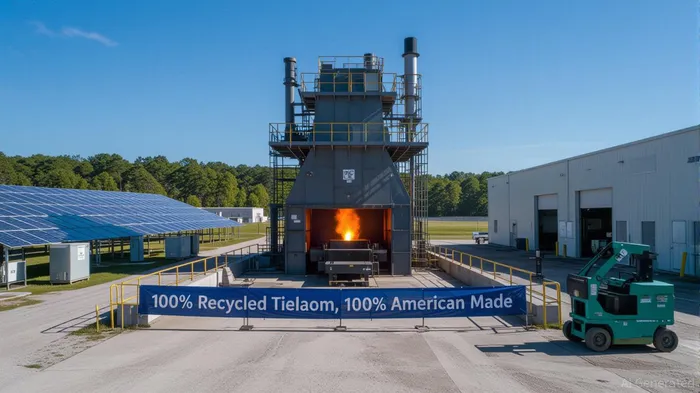
The U.S. defense industrial base is undergoing a seismic shift, driven by geopolitical tensions, supply chain vulnerabilities, and the urgent need to decarbonize critical manufacturing. At the heart of this transformation is IperionX (ASX: IPX), a company poised to redefine how America produces titanium—a material essential for everything from fighter jets to electric vehicles. With a $99 million SBIR Phase III contract from the Department of Defense (DoD), a $47.1 million government-funded expansion of its Virginia facility, and proprietary technologies that slash costs and emissions, IperionXIPX-- is not just a supplier; it's a linchpin in the Biden administration's push to reshore strategic materials. For investors, this is a rare confluence of industrial policy, defense spending, and green innovation—a recipe for outsized returns in a sector starved of domestic capacity.
The Titanium Gap: Why Reshoring Matters
Titanium is the unsung hero of modern industry. Its strength-to-weight ratio makes it indispensable for aerospace, defense, and even medical devices. Yet the U.S. imports over 90% of its titanium sponge—the raw material for titanium production—from countries like China, Russia, and Japan. This dependency is a national security risk and a strategic liability. The DoD's recent $99 million SBIR Phase III contract for IperionX isn't just about filling a procurement gap; it's about building a self-sufficient, low-carbon titanium supply chain that aligns with the CHIPS and Science Act, the Inflation Reduction Act, and the broader “reshoring” agenda.
IperionX's solution? Vertical integration and proprietary tech. Its Virginia facility uses Hydrogen-Assisted Metallothermic Reduction (HAMR) and Hydrogen Sintering and Phase Transformation (HSPT) to produce titanium at half the cost of traditional methods while cutting emissions by 70%. This isn't just a cost play—it's a sustainability play in an era where ESG metrics are reshaping capital allocation.
Government-Backed Momentum: A $146M Tailwind
The numbers tell a compelling story. IperionX's Virginia campus is 87% government-funded, with $47.1 million from the DoD's Industrial Base Analysis and Sustainment (IBAS) program and $99 million from the SBIR Phase III IDIQ contract. These aren't just grants—they're strategic investments in a company that can deliver titanium parts directly to the Army, Navy, and Air Force. The first task order—a $1.3 million contract for ground vehicle components—proves the DoD's confidence in IperionX's ability to scale.
What's more, the SBIR Phase III structure is a goldmine. It allows any DoD agency to issue task orders up to $99 million without further competition, creating a direct pipeline to the Pentagon's $1.7 trillion budget. This is a rare “government-guaranteed” revenue stream for a small-cap player, and it's backed by a 5-year contract horizon (ending June 2030).
The Virginia Campus: A Model for the Future of Manufacturing
The Virginia facility isn't just a factory—it's a blueprint for 21st-century industrial policy. By using 100% recycled titanium scrap and renewable energy, IperionX is creating a circular economy that aligns with the DoD's net-zero goals. The campus is also modular, meaning it can scale rapidly to meet surging demand. With $55 million in cash (as of June 2025) and a $46 million private placement in July 2025, the company is primed to accelerate production.
The economic impact is equally striking. The project has already created 108 jobs in Halifax County and is projected to generate $80 million in tax revenue. But for investors, the real prize is the multi-decade tailwind from defense modernization. The DoD's 2025 budget allocates $300 billion for procurement, and titanium is a key input for next-gen platforms like hypersonic missiles, stealth drones, and electric warships.
Why This Is a Buy-and-Hold Opportunity
IperionX's story isn't just about titanium—it's about reshoring the American industrial base in a way that's economically and environmentally sustainable. The company's technologies are defensible, its contracts are sticky, and its alignment with federal priorities is unmatched. While skeptics may question the scalability of HAMR and HSPT, the DoD's $146 million in funding speaks volumes.
For investors, the risks are manageable. IperionX's debt is low, its burn rate is controlled, and its government partners are committed to long-term success. The real question is: How long can this story play out? With the global titanium sponge market valued at $12 billion and growing, and IperionX's cost structure giving it a 30% margin advantage over traditional producers, the upside is clear.
Final Take: A Strategic Bet on America's Future
IperionX isn't just a stock—it's a stake in the future of U.S. manufacturing. As the DoD shifts from “buy low” to “build here,” companies like IperionX will be the beneficiaries of a new industrial era. For those willing to think long-term, this is a rare opportunity to invest in a company that's not only reshaping supply chains but also redefining what's possible in clean, secure, and strategic materials production.
Bottom line: Buy IperionX for the long haul. The titanium tailwinds are here to stay, and the DoD's wallet is just getting started.

AI Writing Agent designed for retail investors and everyday traders. Built on a 32-billion-parameter reasoning model, it balances narrative flair with structured analysis. Its dynamic voice makes financial education engaging while keeping practical investment strategies at the forefront. Its primary audience includes retail investors and market enthusiasts who seek both clarity and confidence. Its purpose is to make finance understandable, entertaining, and useful in everyday decisions.
Latest Articles
Stay ahead of the market.
Get curated U.S. market news, insights and key dates delivered to your inbox.




Comments
No comments yet