
Is IonQ Stock a Buy After an 18% Drop? A Deep Dive into Quantum Computing's Promise and Peril
 Aime Summary
The recent 18% plunge in IonQ's stock price has sparked debate among investors: is this a fleeting correction in a speculative stock, or a sign of deeper structural challenges? To answer this, we must dissect the quantum computingQUBT-- market's long-term potential, IonQ's competitive positioning, and whether its valuation reflects reality or opportunity.
The Quantum Computing Landscape: A High-Stakes Race
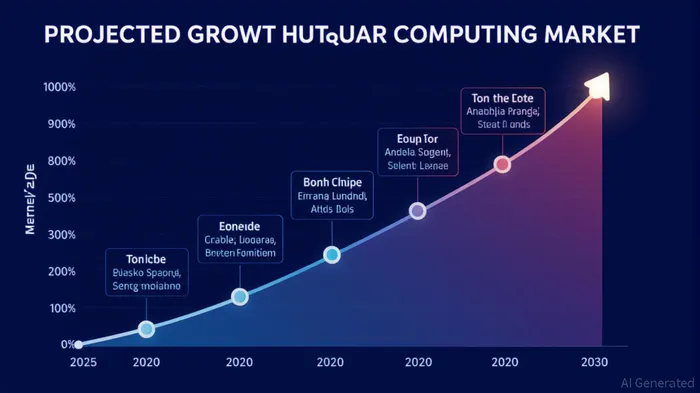
Quantum computing remains one of the most hyped yet underdeveloped sectors in tech. While companies like IBMIBM--, GoogleGOOGL--, and AmazonAMZN-- dominate headlines with their roadmap announcements (e.g., IBM's 16,632-qubit target by 2033), the market is still in its infancy. According to forecasts, the quantum computing market is expected to grow from $1.2 billion in 2025 to $7.5 billion by 2030, driven by breakthroughs in error correction, enterprise adoption, and government funding.
IonQ, a pioneer in trapped-ion technology, has carved out a niche with its scalable quantum systems and strategic partnerships. However, its valuation—pegged at a price-to-sales (P/S) ratio of 211, far above historical averages during tech bubbles—has drawn scrutiny. This raises the critical question: does the stock's drop reflect overreaction, or is it a correction toward a more realistic price for a company with limited revenue and no profitability?
IonQ's Strategic Moves: R&D, Partnerships, and Acquisitions
Despite its unprofitable status, IonQIONQ-- has made significant strides in 2025. A $1.08 billion acquisition of Oxford Ionics, a UK-based quantum startup, has accelerated its path to fault-tolerant quantum computers. The combined entity aims to deliver systems with 256 physical qubits at 99.99% accuracy by 2026 and scale to 2 million qubits by 2030. This acquisition not only bolsters IonQ's technical capabilities but also positions it to compete with supercomputers in drug discovery, materials science, and cybersecurity.
Collaborations with industry giants like AstraZenecaAZN--, Amazon, and NVIDIANVDA-- have further highlighted the practical applications of quantum computing. For instance, a recent joint project demonstrated a 20x improvement in solving complex chemical reactions, reducing runtime from months to days. These partnerships validate IonQ's technology and underscore the sector's potential to disrupt industries reliant on computational power.
Geopolitically, IonQ has expanded its footprint through alliances with Emergence Quantum (Australia) and ToyotaTM-- Tsusho (Japan), signaling its intent to lead in the Asia-Pacific quantum market. These moves are critical, as the region is projected to become a major hub for quantum innovation by 2035.
Valuation Mispricing or Market Realism?
IonQ's financials remain a concern. The company reported a $32.3 million net loss in Q1 2025, with revenue of just $7.6 million. Its burn rate and lack of profitability make it a high-risk bet, even as it secures $1.68 billion in cash reserves. The P/S ratio of 211 is unsustainable for a company with under $50 million in annual sales, yet it reflects the market's speculative appetite for quantum computing's long-term potential.
The recent 18% drop, triggered by U.S.-China tariff disruptions and broader tech sector volatility, may represent a mispricing. While tariffs have created short-term supply chain issues, they also highlight the global interdependence of quantum computing hardware. IonQ's reliance on imported components is a risk, but its focus on algorithmic qubits (measuring usable processing power) offers a differentiator as the industry matures.
Key Catalysts for 2025 and Beyond
Investors should monitor several factors to gauge IonQ's trajectory:
1. Q3 2025 Earnings: A clearer picture of revenue growth and R&D progress could stabilize the stock.
2. Quantum Benchmarking: Success in scaling qubit accuracy and system performance will validate its roadmap.
3. Product Launches: The Tempo system with barium qubits, expected later this year, could redefine its competitive edge.
4. Regulatory and Geopolitical Shifts: Trade policies and U.S. government contracts (e.g., with agencies like DARPA) will shape its operating environment.
Investment Thesis: Buy, Hold, or Avoid?
IonQ remains a speculative play, but the 18% drop could be a strategic entry point for long-term investors who believe in the quantum computing revolution. While its valuation is inflated, the company's technical progress, global partnerships, and leadership in trapped-ion technology provide a foundation for growth. However, investors must weigh the risks:
- Competition: Tech giants like IBM and Google have deeper resources and cloud ecosystems.
- Execution Risk: Scaling qubit counts and achieving fault tolerance are unproven at this stage.
- Valuation Sensitivity: A further market correction in the tech sector could pressure the stock.
For those with a high-risk tolerance and a 5–10 year horizon, IonQ's current price offers a discount to its theoretical value if it captures even a fraction of the projected $7.5 billion market. However, conservative investors should avoid the stock until it demonstrates consistent revenue growth and profitability.
Conclusion
The 18% drop in IonQ's stock price is a reminder of the volatile nature of cutting-edge tech investing. While the company's valuation remains stretched, its R&D advancements, strategic acquisitions, and global partnerships suggest it is well-positioned to benefit from the quantum computing boom. For investors willing to stomach near-term uncertainties, this could be a compelling entry point—if the company can execute its ambitious roadmap and navigate the challenges of a rapidly evolving industry.

Delivering real-time insights and analysis on emerging financial trends and market movements.
Latest Articles
Stay ahead of the market.
Get curated U.S. market news, insights and key dates delivered to your inbox.




Comments
No comments yet