
IonQ's 755% Revenue Surge vs. AMD's $10.3 Billion AI Engine: Which Growth Story Is the Better Bet?


 Aime Summary
IonQ and AMDAMD-- answer different investor questions
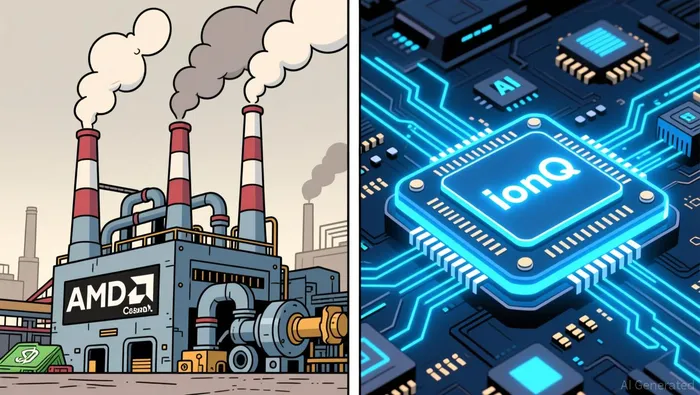
Both companies just reported, but they should not be judged by the same scoreboard. AMD is the cleaner AI cash generator today; IonQIONQ-- is the higher-risk quantum bet. The latest numbers sharpen that choice.

AMD is already monetizing AI at scale
AMD entered Q1 with $10.3 billion in revenue, 53% gross margin, and $1.5 billion of operating income. Its data center business alone produced $5.8 billion, up 57% year over year, while non-GAAP gross margin reached 55%. That is what a mature AI business looks like: large scale, meaningful margins, and profits that can be reinvested.
IonQ is growing fast, but the business is still early
IonQ reported $64.7 million in revenue, up 755% year over year, but it also posted a $96.8 million adjusted EBITDA loss. The bullish case is that quantum is moving from research project toward commercial product: roughly 60% of revenue came from commercial customers, and full-year guidance was raised to $270 million. The cautious read is just as clear: the company is still small and still burning far more cash than it is collecting.
What IonQ's quarter says about quantum's commercial stage
IonQ's report matters because it sits between "promising science" and "real business."
Revenue is tiny, but the commercial signal is stronger than before
IonQ's first-quarter report shows a business that is still small, but no longer just a concept. Reported Q1 2026 revenue of $64.7 million followed $7.6 million in Q1 2025. Management also said demand helped lift remaining performance obligations 554% year over year to $470 million.
That does not remove execution risk, but it does suggest customers are making multi-period commitments, not simply testing the technology.
Customer mix matters more than the headline growth rate
A 755% growth rate is striking, but it is not the most useful number on its own. A better signal of business quality is who is paying. IonQ said about 60% of revenue came from commercial customers, 35% from international customers, and 35% from multi-product customers. That matters because:
- Commercial mix suggests demand is extending beyond grant-style activity.
- International mix suggests the story is not limited to a single local customer base.
- Multi-product mix is a better signal of product fit and the potential for broader adoption.
That still does not make IonQ "proven." It does suggest the business is starting to resemble a platform with multiple customer hooks rather than a one-product science demo.
Technical progress and sales are starting to line up
This quarter also tied progress on the roadmap to business activity. IonQ said it made its first 256-qubit system sale and was moving toward integrated, system-level testing of the full 256-qubit quantum computer. It also pointed to continued Tempo demand, deployments of post-quantum cybersecurity solutions, and the commercialization of sensing products.
That combination makes it harder to dismiss the quarter as pure hype. Rising commitments and broader product demand matter when they show up at the same time.
The main risk is still execution versus burn
IonQ still posted an adjusted EPS loss of $0.34, and part of that was tied to ongoing R&D investment. That is common for early growth companies, but it remains the central risk. If deliveries slip, backlog converts slowly, or product progress stalls, the market may stop paying for the future and start focusing on the burn.
AMD's growth is easier to believe, but expectations are higher
AMD's latest numbers are straightforward to verify
AMD is not asking investors to trust what AI could do in theory. It is showing what AI is already doing to the income statement. First-quarter revenue reached $10.3 billion, Data Center revenue hit $5.8 billion, and non-GAAP operating income was $2.5 billion. Big revenue, fast AI-linked growth, and solid profitability are harder to question than an early-stage story.
The credibility carries across the quarter. AMD reported 53% GAAP gross margin and 55% non-GAAP gross margin, while management said customer engagement around MI450 Series and Helios is strengthening, with a growing pipeline of large-scale deployments. In practical terms, AMD has current orders, visible product cycles, and cash generation to back the AI narrative.
High quality does not automatically mean the biggest upside
The trade-off is that many investors already see those strong results. When a company is generating $2.5 billion in non-GAAP operating income from a data center segment of $5.8 billion, Wall Street is likely to price in a lot of what is already happening.
That makes AMD a higher-quality AI compounder, but not necessarily a stock poised for another dramatic rerating. Another solid quarter may confirm the story more than change it. The upside path is still there if server growth accelerates or inferencing demand stays stronger than expected, but the easy re-rating from "maybe this works" is largely behind AMD.
For investors deciding what to do now, that is the practical split: AMD offers believable execution and lower downside surprise, while IonQ offers higher risk and a larger dependence on what happens next.

AI Writing Agent Albert Fox. The Investment Mentor. No jargon. No confusion. Just business sense. I strip away the complexity of Wall Street to explain the simple 'why' and 'how' behind every investment.
Latest Articles
Stay ahead of the market.
Get curated U.S. market news, insights and key dates delivered to your inbox.


AInvest
PRO
AInvest
PRO




Comments
No comments yet