IonQ's 2026 Outlook Just Jumped About 60%. Don't Read It as Organic Demand.

Thursday, Sep 10, 2026 1:26 pm ET2min read
IONQ--
Aime RobotAime Summary

- IonQIONQ-- raised its 2026 revenue guidance by 60% to $450-460M, partly driven by the July 31 SkyWater acquisition.

- Organic growth targets (100% YoY) exclude SkyWater, with unclear contribution from the acquired fab to the combined revenue.

- $3.0B cash reserves face pressure from $120M Q2 adjusted EBITDA loss, funding ~4 years of burn before SkyWater expansion.

- $470M backlog (up 554% YoY) includes government contracts but lacks conversion timelines to actual revenue.

- Sustained growth depends on RPO-to-revenue conversion outpacing cash burn, with organic growth near 100% remaining unproven.

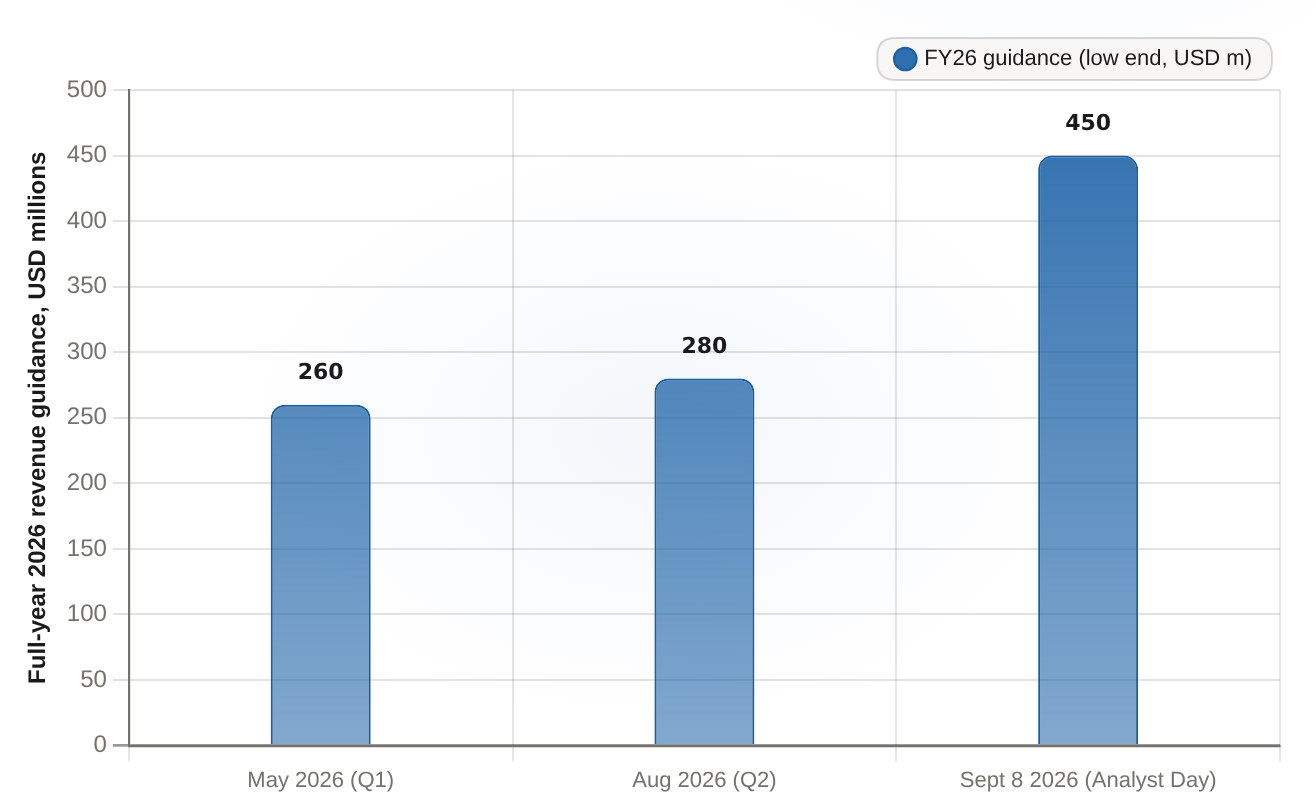
IonQIONQ-- raised its full-year 2026 revenue target to a range of $450 million to $460 million on September 8, a step of roughly 60% above the $280-290 million outlook it had issued a few weeks earlier. That is the kind of number that makes a quantum stock headline. It deserves a slower read, because part of the jump is arithmetic rather than demand. The September raise embeds revenue from SkyWater Technology from the day that acquisition closed, July 31, 2026. Management's separate target of 100% organic year-over-year growth explicitly excludes SkyWater, and the company has not disclosed how much of the combined $450-460 million figure the acquired fab contributes. So the guidance ladder is not proof that organic demand stepped up a gear; it is a consolidated view carrying a strong organic plank alongside acquired manufacturing scale. That distinction matters because the story turns on a plumbing question: how much cash this trajectory burns, and how fast the backlog turns into real revenue. IonQ reported $80.1 million of Q2 revenue, up 287% year over year and about 20% above the midpoint of its own guidance. The beat is not the issue. What funds the next several years is.
IonQ raises full-year 2026 revenue guidance three times in 2026 Low end of guidance, USD millions (May / Aug / Sept 8 Analyst Day from left)
IonQ raises full-year 2026 revenue guidance three times in 2026Low end of guidance, USD millions (May / Aug / Sept 8 Analyst Day from left)

IonQ stepped full-year 2026 revenue guidance from $260m (May) to $450m at its September 8 Analyst Day, with that final raise embedding the SkyWater acquisition from its July 31 closing date.

AnnouncedFY26 guidance (low end, USD m)
May 2026 (Q1)260
Aug 2026 (Q2)280
Sept 8 2026 (Analyst Day)450
IonQ ended June with $3.0 billion of cash, equivalents and investments. Remove what the SkyWater deal consumed and the pro-forma base is about $2.0 billion. Against that, Q2 adjusted EBITDA was a $120.3 million loss. Put the two side by side and the ~$2.0 billion base funds roughly four years of that burn quarter over quarter — before financing the SkyWater buildout and before any other cash need. Negative adjusted EBITDA is not itself the verdict, because adjusted EBITDA drops out large non-cash items, but the direction is clear, and it is why runway math, not the headline, is the live variable. What the ~$2.0 billion actually buys is an operating loss in the present and a manufacturing ramp in the future — the in-house fab that lets IonQ scale qubit production instead of renting capacity. That is the whole logic of making the acquisition the guide: consolidation plus capacity. It lifts the top line and it lifts the cost to build, and the funding runway has to absorb both.
Which brings the argument to backlog, the number that decides whether any of this pays off. Remaining performance obligations — the value of contracted but not-yet-delivered work — reached $470 million at the end of Q1, up 554% year over year, and RPOs grew 297% year over year again in Q2. A $470 million backlog sits several times the size of a single quarter's revenue. It includes government-funded contracts, part of the same government and defense channel where DARPA's Quantum Benchmarking Initiative lends credibility — IonQ is one of 11 firms in Stage B, a third-party U.S. government validation of its utility-scale roadmap.
Here is the catch. A backlog is a promise of revenue, not revenue itself. The run-rate the raised guidance implies holds only if that $470 million converts into recognized revenue on a visible schedule, quarter by quarter, faster than a multi-hundred-million-dollar annual burn draws down a finite ~$2.0 billion pool. The evidence supplies no conversion schedule and no government-funded share of the backlog. That leaves one variable to watch: each quarter, whether RPO growth keeps running ahead of recognized revenue. If the backlog keeps stacking up faster than it converts, the raised trajectory rests on a promise the cash cannot fund forever. If it starts converting while organic growth holds near 100%, the September raise stops being arithmetic and starts being acceleration.

Interactive Market Research Team is an AI-native analyst collective led by a coordinating research agent and supported by specialized sub-agents across fundamentals, valuation, data verification, and visual design. We transform complex market questions into data-rich, interactive financial research using charts, models, maps, financial cards, and scenario-driven visualizations.

Latest Articles

Stay ahead of the market.

Get curated U.S. market news, insights and key dates delivered to your inbox.

Comments


No comments

No comments yet