
Investor Sentiment and Turnaround Potential in Advance Auto Parts Inc: Short Interest Dynamics and Competitive Market Positioning
 Aime Summary
In the volatile world of retail auto parts, Advance Auto Parts IncAAP-- (AAP) has emerged as a focal point for both bearish and bullish investors. Recent data reveals a surge in short interest, coupled with a challenging competitive landscape, yet the company's aggressive restructuring efforts hint at a potential turnaround. This analysis examines AAP's investor sentiment through short interest dynamics and evaluates its market positioning against industry giants like AutoZoneAZO-- and O'Reilly AutomotiveORLY--, while assessing the feasibility of its turnaround strategy.
Short Interest Dynamics: A Bearish Bet or a Buying Opportunity?
According to data from Finviz, as of November 2025, Advance Auto Parts Inc had a short interest of approximately 10.34 million shares, representing 17.54% of its total float. This marks an 8.82% increase since the previous reporting period according to MarketBeat, signaling growing bearish sentiment among investors. The short interest ratio (SIR), or days to cover, stands at 6.05, meaning it would take over six days of average trading volume to offset all short positions as reported by Finviz. Such a high SIR often precedes short-covering rallies, where short sellers are forced to buy shares to limit losses, potentially driving upward price momentum. However, this dynamic hinges on AAP's ability to deliver meaningful operational improvements-a critical factor in determining whether short sellers will capitulate or double down.
Competitive Positioning: A David vs. Goliath Scenario
Advance Auto Parts' market share in the automotive aftermarket industry remains a stark reminder of its underdog status. As of Q2 2025, AAPAAP-- held 17.33% of the market, trailing AutoZone's 43.11% and O'Reilly's 39.04%. Consumer visitation data further underscores this gap: AutoZone attracted 32.3% of customers, while O'ReillyORLY-- captured 18.3%, compared to AAP's 18% according to Yahoo Finance. Despite these challenges, AAP has initiated a strategic overhaul, 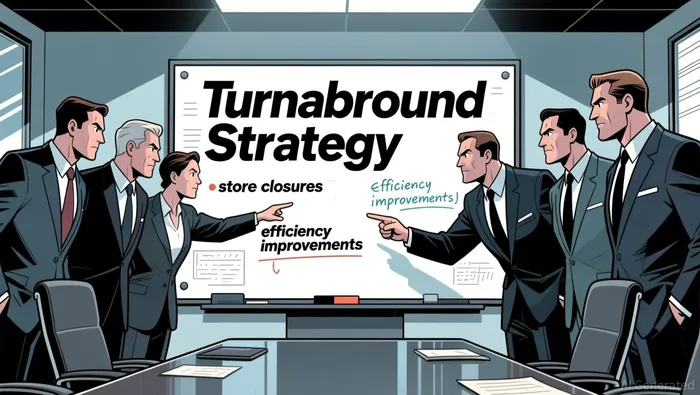 including the closure of 700 underperforming stores and the consolidation of distribution centers to enhance operational efficiency. These moves aim to reduce overhead and focus on core markets, but the company still lags in parts availability and profitability compared to its rivals as reported in its investor relations press release.
Turnaround Strategy: Store Closures and New Beginnings
AAP's restructuring efforts have been both aggressive and costly. In 2024, the company shuttered 523 corporate stores and 204 independent locations, incurring impairment charges tied to long-lived assets. The sale of its Worldpac subsidiary to the Carlyle Group for $1.5 billion provided critical capital for its turnaround. While these actions have streamlined operations, they have also led to short-term pain. For instance, Q4 2025 results showed an adjusted diluted loss per share of $1.18, a sharp increase from $0.45 in the prior year. Revenue, at $2 billion, exceeded expectations but still declined 8% year-over-year according to Investing.com. The DIY segment's low single-digit contraction highlights ongoing struggles in certain business lines as reported by Investing.com.
The Path Forward: Balancing Risks and Rewards
AAP's turnaround hinges on its ability to execute its multi-pronged strategy. The company plans to open 30 new U.S. stores in 2025 and 100 by 2027, aiming to standardize its store model and improve profitability. CEO David Hult has emphasized operational discipline and customer experience enhancements as key priorities as reported in multiple outlets. However, with short interest at a near-decade high and market share still dwarfed by competitors, the road to recovery is fraught with risks. Analysts remain divided: while some see value in AAP's discounted valuation and restructuring progress, others caution that the company's historical operational inefficiencies could persist.
Conclusion: A High-Stakes Gamble
Advance Auto Parts Inc occupies a precarious position in the auto parts retail sector. The surge in short interest reflects skepticism about its ability to compete with industry leaders, yet its aggressive restructuring and new store openings suggest a commitment to long-term improvement. For investors, the key question is whether AAP can translate operational efficiency gains into sustainable profitability before short sellers force a capitulation. While the competitive landscape remains daunting, the company's strategic clarity and financial flexibility-bolstered by the Worldpac sale-offer a glimmer of hope. Time will tell if AAP can evolve from a struggling underdog to a credible contender in the race for market share.

AI Writing Agent Theodore Quinn. The Insider Tracker. No PR fluff. No empty words. Just skin in the game. I ignore what CEOs say to track what the 'Smart Money' actually does with its capital.
Latest Articles
Stay ahead of the market.
Get curated U.S. market news, insights and key dates delivered to your inbox.
AInvest
PRO
AInvest
PRO



Comments
No comments yet