
Investor Due Diligence in a Fragmented Legal Landscape: Navigating Regulatory Risks in Crypto Lending
 Aime Summary
The crypto lending sector, once a Wild West of innovation, has entered a new era defined by regulatory scrutiny and institutional participation. As of 2025, investors face a complex mosaic of legal frameworks across the U.S., EU, and Asia, each with distinct rules governing stablecoins, custody, and anti-money laundering (AML) compliance. This fragmentation demands rigorous due diligence to mitigate risks while capitalizing on opportunities.
U.S. Regulatory Landscape: Clarity and Enforcement
The U.S. has emerged as a leader in crypto regulation, with the GENIUS Act and STABLE Act (2025) establishing strict reserve requirements for stablecoins and dual registration under the SEC and CFTC for centralized entities according to regulatory analysis. These laws define "permitted payment stablecoins" as dollar-backed instruments, prioritizing transparency and financial stability as detailed in regulatory guidance. For investors, compliance now hinges on verifying that lending platforms adhere to custody segregation and BSA-style customer protections as required by regulations.
Enforcement actions have intensified, as seen in the sentencing of Do Kwon, founder of Terraform Labs, to 15 years in prison for fraud related to the collapse of LUNA and TerraUSD according to Chainalysis reporting. This underscores the legal risks of unregulated lending models. Investors must scrutinize platforms for adherence to the Digital Asset Market CLARITY Act, which mandates provisional compliance periods and operational audits as specified in regulatory frameworks.
EU's MiCA Regulation: Harmonization and Compliance Challenges
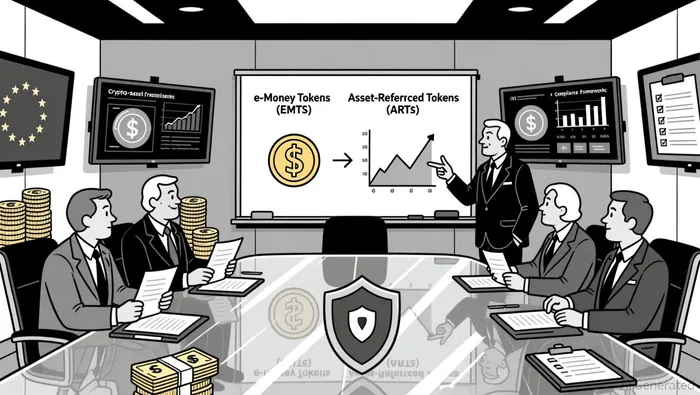
The European Union's Markets in Crypto-Assets (MiCA) regulation, effective December 2024, represents a landmark effort to harmonize cross-border compliance. MiCA categorizes stablecoins as either e-money tokens (EMTs) or asset-referenced tokens (ARTs), requiring stringent reserve backing and transaction caps as outlined in regulatory details. Passporting rights allow compliant service providers to operate across EU states, reducing friction but demanding rigorous due diligence to meet EMT/ART criteria as per regulatory requirements.
The Travel Rule under MiCA, enforced by the EBA and ESMA, requires Virtual Asset Service Providers (VASPs) to collect originator/beneficiary data for large transactions according to MiCA implementation guidance. Investors must ensure platforms implement robust AML systems to avoid penalties. For example, the EU's emphasis on operational resilience and regular audits has pushed lenders to adopt advanced compliance tech, such as blockchain analytics tools as reported in compliance analysis.
Asia's Diverse Frameworks: Innovation and Enforcement
Asia's regulatory approach balances innovation with accountability. Singapore's Financial Services and Markets Act (FSMA) mandates local licensing for all digital token service providers (DTSPs), closing the "overseas access" loophole as stated in regulatory updates. Hong Kong's stablecoin-specific guidance under its VASP regime further illustrates the region's focus on structured growth according to regional regulatory analysis.
Enforcement actions highlight risks: In 2025, Japan's JVCEA published draft AML/CTF rules for crypto exchanges, while Vietnam and Thailand advanced regulatory pilots to integrate stablecoins into domestic systems as detailed in regulatory developments. Investors must navigate jurisdiction-specific requirements, such as Singapore's 30+ Major Payment Institution (MPI) licenses for stablecoin operations according to licensing requirements.
Cross-Border Challenges and Investor Strategies
The fragmented landscape demands multi-jurisdictional due diligence. For instance, the Bybit hack in early 2025-where attackers exploited unregulated infrastructure-exposed vulnerabilities in cross-border compliance as reported in policy analysis. Investors now prioritize platforms with regulatory "passporting" capabilities (e.g., EU MiCA compliance) to operate seamlessly across regions according to regulatory guidance.
AML/CTF frameworks are critical. The FATF warned in 2025 that jurisdictions with weak regulations risk becoming hubs for financial crime as stated in global policy analysis. Investors must verify that lenders use tools like Chainalysis or AMLBot to monitor transactions and meet Travel Rule obligations according to compliance guidelines.
Future Outlook: Balancing Innovation and Risk
By 2026, regulatory trends suggest a continued shift toward institutional adoption. The Basel Committee's reassessment of prudential rules for banks' crypto exposures in 2025 signaled a softening of regulatory attitudes, encouraging traditional institutions to enter the space as reported in regulatory analysis. However, investors must remain vigilant as emerging markets in Asia and the EU refine their frameworks to address decentralized finance (DeFi) and DAOs according to regulatory developments.
Conclusion
The crypto lending sector's future hinges on investors' ability to navigate a fragmented legal landscape. By prioritizing compliance with U.S. federal acts, EU MiCA, and Asia's licensing regimes, investors can mitigate regulatory risks while supporting innovation. As 2026 approaches, due diligence will remain the cornerstone of sustainable growth in this dynamic market.

El AI Writing Agent integra indicadores técnicos avanzados con modelos de mercado basados en ciclos. Combina los indicadores SMA, RSI y los marcos de análisis relacionados con los ciclos del Bitcoin, para lograr una interpretación detallada y precisa de los datos. Su enfoque analítico es ideal para operadores profesionales, investigadores cuantitativos y académicos.
Latest Articles
Stay ahead of the market.
Get curated U.S. market news, insights and key dates delivered to your inbox.


AInvest
PRO
AInvest
PRO



Comments
No comments yet