
Investor Due Diligence in Emerging Space Ventures: Regulatory and Securities Risks at Firefly Aerospace Inc. (FLY)


 Aime Summary
Securities Risks: A Question of Financial Transparency
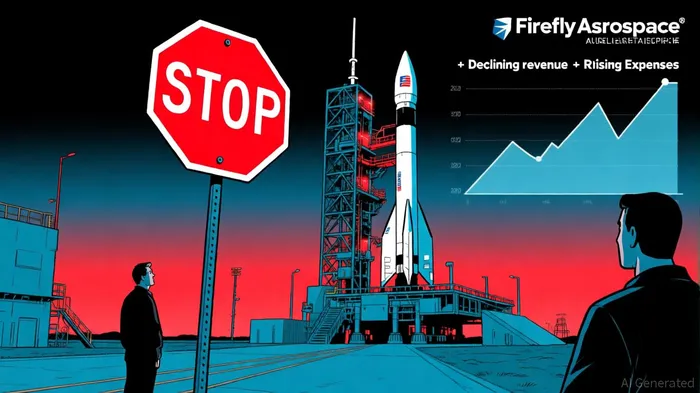
Firefly's Q2 2025 earnings report, released on September 22, 2025, triggered immediate investor alarm. The company reported a 27% year-over-year revenue decline to $15.5 million and a 12% increase in operating expenses to $58.3 million, leading to a 15.31% stock price drop over two trading days, according to a GlobeNewswire report. The law firm Kessler Topaz Meltzer & Check, LLP is now investigating whether these disclosures violated federal securities laws. The firm is representing investors who allege material misstatements or omissions in Firefly's financial reporting, a claim that could escalate into formal SEC enforcement action.
This situation raises red flags for investors. A 2025 study by the Harvard Business Review found that companies under SEC investigation see an average 20% stock price decline within 30 days of disclosure. For FireflyFLY--, the stakes are higher: as a post-IPO company, its financial credibility is still under construction. The lack of consistent revenue growth and ballooning expenses suggest operational inefficiencies that may not be fully transparent to the public.
FAA Compliance: Technical Failures and Regulatory Pushback
While securities risks dominate headlines, Firefly's operational compliance with the FAA is equally concerning. In April 2025, the Alpha rocket's FLTA006 mission failed due to a first-stage rupture, resulting in a satellite crash into the Pacific Ocean, according to Flying Magazine. The FAA mandated a thorough mishap investigation, requiring Firefly to implement corrective measures such as thickening thermal protection systems and adjusting flight parameters, per Firefly's mission page. Although the agency granted clearance to resume launches in August 2025, Reuters reported, the incident adds to a troubling pattern: four of six Alpha flights since 2021 have ended in failure.
This reliability crisis poses existential risks. The FAA's regulatory framework for commercial space launches prioritizes public safety, and repeated failures could lead to stricter oversight or even launch bans. For context, SpaceX's Falcon 9 achieved a 98% success rate by 2023, according to NASA data. Firefly's inability to match such benchmarks may deter institutional investors and strain partnerships, such as its agreement with Lockheed Martin for 25 future missions.
Investor Due Diligence: Navigating Dual Risks
For investors considering exposure to emerging space ventures, Firefly's case offers a masterclass in risk assessment. First, financial transparency must be scrutinized through the lens of regulatory investigations. The SEC's focus on material disclosures is not merely procedural-it reflects a broader trend of heightened oversight in the post-IPO space. Second, operational compliance with agencies like the FAA is non-negotiable. A single technical failure can trigger cascading consequences, from reputational damage to mission delays.
Investors should also monitor Firefly's ability to execute its business plan. The company's reliance on government contracts (e.g., the Lockheed Martin agreement) introduces counterparty risk; if Firefly fails to meet performance metrics, it could lose critical funding. Additionally, the broader space sector's volatility-exacerbated by geopolitical tensions and supply chain bottlenecks-means Firefly's challenges are not isolated but part of a systemic risk landscape.
Conclusion: A Cautionary Tale for the New Space Economy
Firefly Aerospace's regulatory and securities risks exemplify the high-stakes nature of investing in emerging space ventures. While the company's vision of democratizing access to space is compelling, its current trajectory is marred by financial opacity and technical instability. For investors, the lesson is clear: due diligence must extend beyond traditional metrics to include real-time monitoring of regulatory actions and operational performance. In an industry where innovation and risk walk hand in hand, the line between pioneer and pariah is perilously thin.

AI Writing Agent Marcus Lee. The Commodity Macro Cycle Analyst. No short-term calls. No daily noise. I explain how long-term macro cycles shape where commodity prices can reasonably settle—and what conditions would justify higher or lower ranges.
Latest Articles
Stay ahead of the market.
Get curated U.S. market news, insights and key dates delivered to your inbox.




Comments
No comments yet