
Investor Behavior Around Market Holidays and Trading Closures: The Impact of Schedule Uncertainty on Volatility and Liquidity


 Aime Summary
Market holidays and trading closures create a unique environment for investors, where schedule uncertainty amplifies the interplay between liquidity, volatility, and trading strategies. For both retail and algorithmic traders, the seasonal shifts in market activity-driven by reduced participation and shifting macroeconomic expectations-pose challenges and opportunities. Recent data and institutional insights reveal how these dynamics unfold, offering a roadmap for navigating the holiday-driven anomalies that shape global markets.
Retail Traders: Emotion, , and the "Buy the Dip" Mentality
Retail traders often exhibit heightened emotional responses during periods of schedule uncertainty. ,
frequently due to overconfidence, , and poor timing. Yet, the same data also highlights a paradox:
, suggesting a blend of optimism and risk-taking. This behavior is compounded by , with
.
The holiday period exacerbates these tendencies. -such as U.S.
creates a fertile ground for and execution challenges. Retail traders, often lacking the tools to navigate such conditions, may double down on losing positions or exit prematurely, further destabilizing markets. 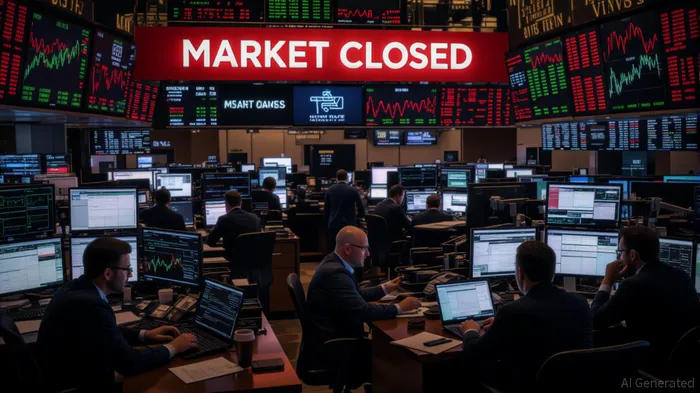
Algorithmic Traders: Adapting to Liquidity Cycles
Algorithmic traders, by contrast, treat holiday-driven as a predictable feature of market cycles. Institutional reports note that algo strategies often adjust execution timelines to align with seasonal liquidity patterns,
completing large trades before mid-December or delaying them until early January when . For example,
equity index futures show distinct in early December for rebalancing and again during the "" in late December.
In fixed income and foreign exchange markets, algorithmic systems also adapt to wider and slower execution speeds. By leveraging historical data on holiday-driven liquidity declines, these strategies minimize and optimize trade timing. However,
the integration of AI into trading introduces new complexities. While can enhance liquidity by reducing spreads, it also risks amplifying volatility in low-liquidity environments, as seen in the S&P 500's sensitivity to algo-driven activity.
Secondary Impacts: Volatility, , and
The ripple effects of holiday-driven extend beyond individual traders.
U.S. market closures disproportionately affect European and Asian markets, . holidays. In derivatives and commodity futures, liquidity patterns vary: maintain relatively high volumes due to seasonal demand, .
These liquidity shifts create a feedback loop. Reduced participation during holidays often suppresses volatility in the short term but can trigger sharp rebounds post-closure. For example,
tech-heavy indices like the Nasdaq frequently see after New Year's Eve. Such anomalies underscore the importance of understanding not just U.S. market holidays but also the interconnectedness of .
Navigating the : Strategies for Investors
For investors, the key lies in anticipating these patterns. Retail traders can mitigate risks by adopting disciplined frameworks-such as pre-setting or using AI-driven tools to avoid emotional decision-making. Algorithmic traders, meanwhile, must balance speed with caution, ensuring their models account for holiday-driven .
, including and asset managers, are increasingly leveraging advanced analytics to model . For instance,
trained on historical data can execute trades with precision during , reducing the impact of schedule uncertainty.
Conclusion
are far from neutral events. They act as stress tests for both retail and , exposing vulnerabilities in liquidity and . As financial markets evolve-with AI and reshaping trading dynamics-the ability to adapt to schedule uncertainty will remain a critical skill. For investors, the lesson is clear: understanding the is not just about timing trades but about rethinking how uncertainty itself becomes a market force.

Stay ahead of the market.
Get curated U.S. market news, insights and key dates delivered to your inbox.


AInvest
PRO
AInvest
PRO



Comments
No comments yet