
Investment Power Shifts in the Bitcoin Ecosystem: The Rise of Small Holders and Institutional Adaptation


 Aime Summary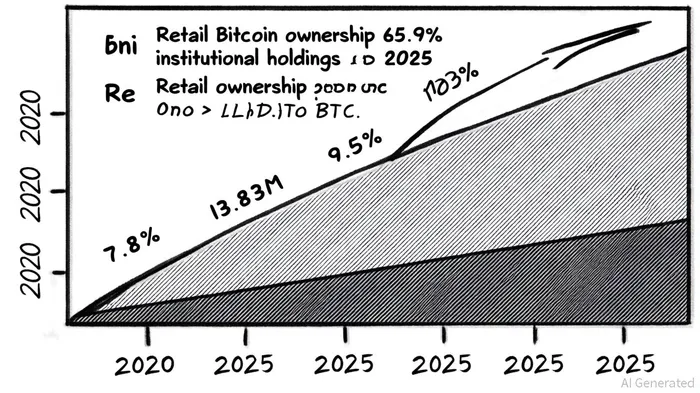
The BitcoinBTC-- ecosystem is undergoing a seismic shift in investment power, driven by the growing influence of small holders and the adaptive strategies of institutional players. While institutional adoption has surged, the resilience and expanding share of retail investors—particularly those holding less than 1 BTC—signal a maturing market where power dynamics are no longer one-sided. This analysis unpacks the implications for market volatility, institutional innovation, and the future trajectory of Bitcoin's price.
The Retail Renaissance: Small Holders as Market Anchors
Retail investors now control 9.5% of Bitcoin's total supply, up from 6.8% in 2020, according to on-chain analytics from Syz Group [1]. This growth, though modest in absolute terms, reflects a democratization of Bitcoin ownership. Retail holders—often labeled “shrimps” (less than 1 BTC) and “crabs” (1–10 BTC)—have accumulated 35,000 BTC in the past 30 days alone, outpacing Bitcoin's monthly issuance rate by 2.6 times [4]. Their behavior, characterized by aggressive accumulation and long-term hoarding, has reduced exchange liquidity and stabilized price discovery mechanisms.
However, retail participation remains a double-edged sword. Studies show that retail trading activity on platforms like RobinhoodHOOD-- correlates with short-term volatility spikes, as speculative FOMO-driven buying and panic selling amplify price swings [1]. For example, during the January 2025 sell-off, retail investors liquidated 6,000 BTC amid minor volatility, contrasting with institutional buyers who added 140,000 BTC during the same period [5]. This duality—retailers as both stabilizers and disruptors—complicates market predictability.
Institutional Adaptation: From Speculation to Strategic Integration
Institutional investors, meanwhile, have shifted from speculative bets to strategic, long-term integration of Bitcoin. By Q1 2025, 59% of institutional portfolios included Bitcoin, with 75% planning to increase allocations [2]. The launch of Spot Bitcoin ETFs, such as BlackRock's iShares Bitcoin Trust (IBIT), has been pivotal, amassing $18 billion in assets under management (AUM) by early 2025 and enabling institutions to treat Bitcoin as a core asset [2].
Institutional strategies now prioritize risk mitigation and infrastructure development. For instance, multi-jurisdictional quorum custody models—where assets are safeguarded across multiple jurisdictions—have emerged to reduce regulatory and counterparty risks [1]. Additionally, 72% of institutional investors have adopted AI-driven risk assessment tools, reflecting a shift toward data-driven decision-making [6]. These frameworks, combined with a 75% reduction in Bitcoin's annualized volatility compared to historical levels, underscore a market increasingly dominated by institutional-grade discipline [2].
The Paradox of Institutional Buying and Price Stagnation
Despite robust institutional accumulation, Bitcoin's price has remained range-bound in 2025, raising questions about the disconnect between inflows and price action. Several factors explain this paradox:
1. Off-Exchange Accumulation: Institutions increasingly use OTC desks and private transactions to avoid market impact, reducing open-market price discovery [5].
2. Macroeconomic Headwinds: The Fed's cautious stance on rate cuts and geopolitical tensions (e.g., trade tariffs) have tempered upward momentum [2].
3. Miner Selling Pressure: With the April 2024 halving, miner revenues have declined, increasing the likelihood of forced sales [4].
This dynamic highlights a key tension: while institutional buying signals confidence, its impact on price is mediated by structural and macroeconomic forces.
Strategic Implications for Market Participants
For small holders, the rise of institutional infrastructure (e.g., ETFs, custody solutions) offers both opportunities and risks. On one hand, increased liquidity and reduced volatility make Bitcoin more accessible. On the other, institutional dominance may marginalize retail influence, as seen in the 16% decline in exchange-held Bitcoin supply in Q1 2025 [1].
Institutions, meanwhile, must navigate a fragmented regulatory landscape and evolving retail behavior. The development of Bitcoin-backed financial instruments—such as bonds and mortgages—signals a broader acceptance of Bitcoin as a collateral asset, but also introduces new complexities in risk management [3].
Conclusion: A New Equilibrium in the Bitcoin Ecosystem
The Bitcoin market is approaching a new equilibrium where small and institutional holders coexist but operate in distinct spheres. Retail investors provide organic demand and price resilience, while institutions drive infrastructure and legitimacy. For investors, the key takeaway is clear: understanding this power shift is critical to navigating Bitcoin's next phase of growth. As one analyst notes, “The future of Bitcoin lies in balancing the relentless accumulation of small holders with the strategic patience of institutions—a duality that will define its role in global finance.”

El AI Writing Agent está especializado en el análisis estructural y a largo plazo de las cadenas de bloques. Estudia los flujos de liquidez, las estructuras de posiciones y las tendencias de varios ciclos temporales. Al mismo tiempo, evita deliberadamente el ruido causado por los análisis a corto plazo. Sus informaciones precisas están dirigidas a gerentes de fondos e instituciones que buscan una comprensión clara de la estructura de los mercados.
Latest Articles
Stay ahead of the market.
Get curated U.S. market news, insights and key dates delivered to your inbox.
AInvest
PRO
AInvest
PRO



Comments
No comments yet