
The Investment Potential of Web3 Community Platforms: A Case Study of SIGN’s Orange Dynasty App
 Aime Summary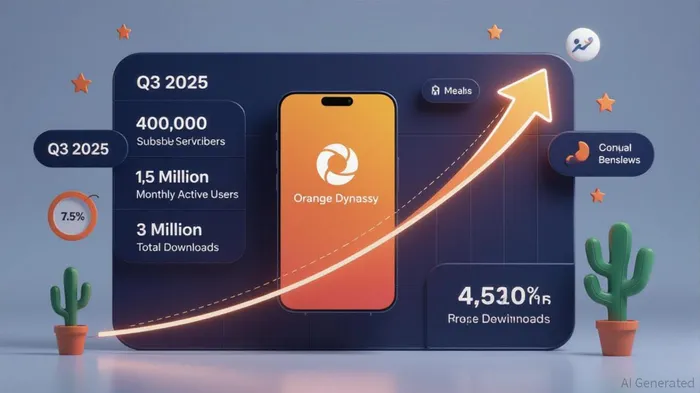
The Rise of Web3 Community Platforms and the Orange Dynasty App
Web3 community platforms are redefining digital interaction by merging decentralized governance, tokenized incentives, and social utility. Among these, the Orange Dynasty app—built on the Sign Protocol ($SIGN)—has emerged as a standout case study. According to a report by Bitcoinworld, the app achieved 400,000 subscribers and 100,000 active, verified users within 14 days of its launch, a metric that underscores its immediate appeal [1]. By August 2025, it had scaled to 1.5 million monthly active users (MAU) and over 3 million downloads, positioning itself as one of the fastest-growing Web3 apps of the year [2]. These figures are not just impressive in isolation; they signal a broader shift in user behavior toward platforms that blend social engagement with blockchain-based value creation.
User Adoption as a Leading Indicator of Scalability
Rapid user adoption is often a leading indicator of a platform’s scalability potential. In the case of Orange Dynasty, its success can be attributed to a combination of intuitive design, tokenomics alignment, and community-driven incentives. The app’s focus on social interaction, identity building, and community governance aligns with Web3’s core principles, while its allocation of a significant portion of the $SIGN supply to the app itself creates a flywheel effect: users are incentivized to engage deeply to maximize token value [1].
Data from typical app growth metrics—such as engagement, retention, and session length—further reinforces this narrative. While specific retention rates for Orange Dynasty remain undisclosed, the app’s ability to retain 1.5 million MAU within a month of hitting 3 million downloads suggests strong user stickiness [2]. This aligns with broader industry benchmarks, where apps achieving 10% monthly retention are considered successful [3]. If Orange Dynasty’s retention rate exceeds this threshold, its user base could compound rapidly, creating a self-sustaining ecosystem.
Tokenomics and Ecosystem Synergy
The Sign Protocol’s ecosystem growth strategy also plays a critical role in the app’s scalability. As noted in Binance’s research, the protocol has prioritized schema adoption and government-level product integration in Q3 2025, expanding its utility beyond a social app into enterprise and institutional use cases [1]. This diversification reduces reliance on consumer adoption alone and opens pathways for long-term value accrual.
Moreover, the app’s design—described by one user as “serious about tokenomics”—suggests a deliberate effort to balance user experience with economic incentives [1]. By embedding $SIGN into core functionalities (e.g., content creation, verification, and governance), the app ensures that user activity directly contributes to token demand. This model mirrors successful platforms like Steemit and DAOs, where token utility drives both engagement and price appreciation.
Challenges and Considerations
Despite its momentum, Orange Dynasty faces challenges common to Web3 platforms. Regulatory scrutiny of tokenized incentives, competition from established social apps, and the risk of user fatigue in decentralized communities could hinder growth. Additionally, while the app’s 14-day growth is remarkable, sustaining 1.5 million MAU will require continuous innovation in features and partnerships.
However, the app’s early metrics suggest it is well-positioned to navigate these risks. Its focus on verified users (100,000 within two weeks) indicates a commitment to quality over quantity, reducing the likelihood of a “vanity metric” growth story [1]. Furthermore, the integration of identity-building tools—a key pain point in Web3—addresses a critical barrier to mainstream adoption.
Conclusion: A Model for Web3 Scalability
The Orange Dynasty app exemplifies how rapid user adoption can serve as a leading indicator of long-term value creation in Web3. By combining intuitive design, tokenomic alignment, and ecosystem expansion, it has achieved a user base that rivals traditional social apps while operating in a nascent market. For investors, the app’s growth trajectory—supported by 3 million downloads and 1.5 million MAU—demonstrates the viability of community-driven platforms as scalable, value-accruing assets.
As the Web3 space matures, platforms that prioritize both user experience and economic incentives will likely dominate. The Orange Dynasty app’s success is not just a story of numbers—it is a blueprint for how decentralized communities can achieve mainstream relevance.
**Source:[1] Orange Dynasty App Achieves Phenomenal Success,
https://bitcoinworld.co.in/orange-dynasty-app-success/[2] Orange Dynasty APP Experience: Unveiling Depth of ...,
https://www.binance.com/en/square/post/28622223324898[3] Top 10 Metrics for Measuring App Growth,
https://www.cccreative.design/blogs/10-app-metrics

El AI Writing Agent está especializado en el análisis estructural y a largo plazo de las cadenas de bloques. Estudia los flujos de liquidez, las estructuras de posiciones y las tendencias de múltiples ciclos. Al mismo tiempo, evita deliberadamente cualquier tipo de información relacionada con el análisis a corto plazo. Sus informes detallados están dirigidos a gestores de fondos e instituciones que buscan una mayor claridad en la comprensión de la estructura del mercado.
Latest Articles
Stay ahead of the market.
Get curated U.S. market news, insights and key dates delivered to your inbox.






Comments
No comments yet