
Investment Implications of NASA's Hubble Observations of Interstellar Comet 3I/ATLAS: A Catalyst for Space Technology Innovation


 Aime Summary
Hubble's Role in Pioneering Interstellar Object Tracking
NASA's Hubble Space Telescope has been instrumental in capturing high-resolution images of 3I/ATLAS, using its Wide Field Camera 3 to track the comet's hyperbolic trajectory. These observations, conducted on November 30, 2025, refined the comet's nucleus size to between 440 meters and 5.6 kilometers and confirmed its non-threatening path at 1.8 astronomical units from Earth. Complementing Hubble's efforts, the European Space Agency (ESA) leveraged data from the ExoMars Trace Gas Orbiter to improve trajectory accuracy by tenfold, marking a first in planetary defense by combining multi-planetary vantage points. Such collaborations underscore the growing reliance on distributed sensor networks and advanced imaging technologies to monitor interstellar objects-a trend with profound implications for satellite and remote sensing industries.
Satellite Proliferation and the Demand for Resilient Imaging Systems
The Hubble's observational capabilities are increasingly challenged by the rapid proliferation of low-Earth orbit (LEO) satellites, which risk degrading image quality due to satellite trails. However, this challenge has spurred innovation in satellite design and deployment. For instance, startups like AscendArc and Greenerwave are developing low-cost, high-bandwidth satellites with AI-driven data processing to mitigate interference and enhance resolution. Meanwhile, Apex Space's Project Shadow, set to launch in 2026, demonstrates how satellite networks are being weaponized for defense applications, including space-based missile interceptors. These advancements highlight a dual-use trajectory: satellites optimized for scientific imaging are simultaneously enabling military and commercial applications, driving cross-sector investment.
Robotics and Autonomous Systems: From Cometary Tracking to In-Orbit Servicing
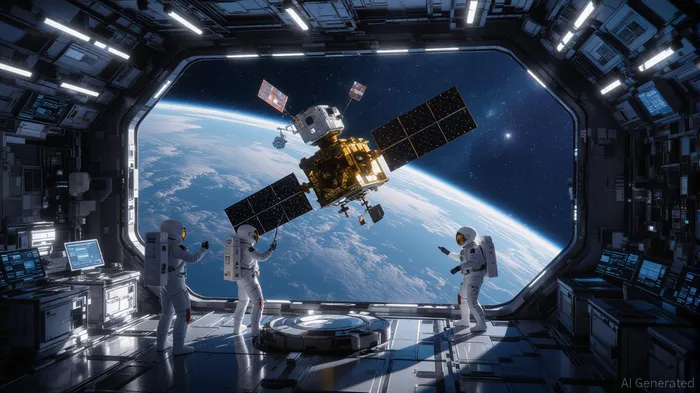
The need for autonomous systems in tracking interstellar objects is accelerating the development of robotics for space infrastructure. For example, GITAI, a Japanese startup, is deploying remote-controlled robots for commercial space stations, while Rendezvous Robotics is pioneering modular, autonomous systems for in-orbit assembly. These technologies, initially designed to monitor fast-moving interstellar bodies like 3I/ATLAS, are now being repurposed for satellite servicing and deep-space exploration. The broader space robotics market, projected to grow from $6.6 billion in 2025 to $13.2 billion by 2034, reflects a surge in demand for systems capable of operating in high-velocity, low-gravity environments.
Remote Sensing and AI: A New Era of Data-Driven Astronomy
The integration of artificial intelligence (AI) and machine learning (ML) into remote sensing is revolutionizing how interstellar objects are analyzed. NASA's STEREO mission, for instance, used the Heliospheric Imager-1 (HI1) to stack multiple exposures of 3I/ATLAS, revealing its composition and dynamics. Similarly, the Gemini North Observatory employed spectroscopic techniques to study the comet's refractory materials and organic compounds. These capabilities are being commercialized by startups like askEarth, which uses LLMs and deep learning to interpret satellite imagery in real time, and Bhusatyam Technologies, which applies AI to hyperlocal weather forecasting. As the Vera C. Rubin Observatory prepares to increase interstellar object detection rates from one per decade to one every few months, the demand for AI-enhanced remote sensing tools will only intensify.
Investment Trends and Sector Synergies
The 2025 investment landscape reveals a clear alignment between interstellar object tracking and sector-specific innovations. Robotics investments hit $4.35 billion in July 2025, with a focus on autonomous systems for satellite servicing and deep-space exploration. Similarly, AI funding surged to $45 billion in Q3 2025, with a portion allocated to foundation models that could enhance interstellar object analysis. Startups leveraging these technologies-such as Captis Space Systems for low-flying satellites and Hubble Network for AI-enabled IoT tracking-are attracting capital from venture firms and corporate investors alike.
Conclusion: A Convergence of Science and Commerce
The Hubble's observations of 3I/ATLAS are more than a scientific milestone; they are a harbinger of a new era in space technology. As the demand for resilient satellite networks, autonomous robotics, and AI-driven remote sensing grows, investors are uniquely positioned to capitalize on the synergies between interstellar object tracking and Earth-orbiting systems. The coming years will likely see a proliferation of startups and funds targeting these intersections, transforming astronomy from a field of passive observation into a dynamic engine of innovation.

Delivering real-time insights and analysis on emerging financial trends and market movements.
Latest Articles
Stay ahead of the market.
Get curated U.S. market news, insights and key dates delivered to your inbox.






Comments
No comments yet