
Investment Implications of Delayed Price Hikes in the U.S. Automotive Sector
 Aime Summary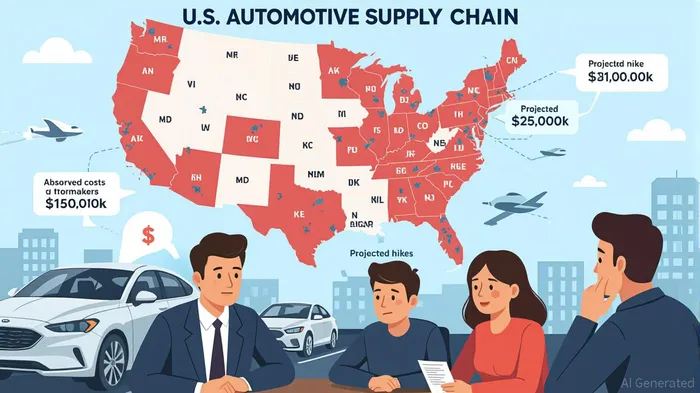
The U.S. automotive industry is navigating a complex landscape shaped by Trump's 2025 tariffs, which have imposed 25% levies on imported vehicles and parts. These tariffs have forced automakers to adopt short-term strategies to mitigate financial strain, including absorbing costs rather than passing them to consumers. However, these tactics carry long-term risks for investors, as delayed price hikes may erode profit margins and reshape market dynamics.
Absorbing Costs: A Short-Term Strategy with Long-Term Risks
According to a report by Reuters, U.S. automakers have absorbed approximately $108 billion in tariff-related costs in 2025, with tariffs on parts adding roughly $4,900 per vehicle and imported vehicles facing up to $8,600 in extra costs [2]. Companies like FerrariTSLA-- and BMW have explicitly stated they will cover these expenses for certain models, while Hyundai and ToyotaTM-- have pledged to maintain current prices until early 2025 [1]. This strategy has temporarily stabilized consumer demand, as evidenced by Hyundai and Toyota's increased March sales as buyers rushed to avoid anticipated price hikes [1].
However, this approach is unsustainable. A study by the Center for Automotive Research warns that automakers cannot indefinitely absorb such costs without impacting profitability. For instance, FordF-- has already projected a $1.5 billion hit from tariffs in 2025 [2], while General MotorsGM-- faces similar pressures. These financial strains are likely to ripple through the stock market, particularly for automakers with limited pricing power or high import dependencies.
Market Predictions: When Will Prices Rise?
Despite current price stability, analysts predict inevitable increases. Cox Automotive forecasts that tariffs could drive a 10-15% price hike for affected vehicles, with non-tariff-affected models seeing a 5% increase due to cascading cost pressures [1]. S&P Global Mobility anticipates the peak impact in 2026, with global light vehicle sales declining by 1.05 million units that year [4]. Additionally, destination fees for 2025 models have risen by 8.5%, signaling a gradual shift toward cost recovery [1].
Investors must monitor these trends closely. While automakers may delay hikes to retain market share, the eventual price increases could reduce consumer demand and trigger inventory overhangs. This dynamic is particularly concerning for luxury brands like Ferrari, which may struggle to justify premium pricing in a cost-conscious market.
Broader Economic and Investment Implications
The tariffs' economic fallout extends beyond the automotive sector. The Penn Wharton Budget Model estimates that these policies could reduce long-run GDP by 6% and wages by 5%, with middle-income households facing a $22,000 lifetime loss [1]. Such macroeconomic risks have already destabilized financial markets: the S&P 500 lost 5% of its value from February 2025 highs, with tech firms like AppleAAPL-- and TeslaTSLA-- hit hardest due to increased import tariffs [4].
For investors, the implications are twofold. First, sectors reliant on global supply chains—such as technology, materials, and energy—are particularly vulnerable. Second, defensive sectors like healthcare and utilities may outperform, as they are less exposed to tariff-driven inflation [4]. Morgan StanleyMS-- further notes that U.S. services industries, including software and cybersecurity, could benefit from AI adoption momentum, despite broader economic uncertainty [4].
Strategic Recommendations for Investors
Given these dynamics, investors should adopt a cautious, diversified approach:
1. Sector Rotation: Favor defensive stocks in healthcare and utilities while avoiding overexposed sectors like automotive manufacturing and tech.
2. Hedging Against Inflation: Allocate assets to gold, which surged to $2950 per ounce in 2025 as a safe-haven response to tariff-driven uncertainty [4].
3. Monitoring Policy Shifts: Track potential changes in tariff policies or Federal Reserve responses, as tighter monetary policy could further strain auto loan rates and consumer demand [3].
Conclusion
The U.S. automotive sector's delayed price hikes reflect a temporary balancing act between cost absorption and market stability. However, as tariff pressures persist, investors must prepare for a shift toward price increases, reduced sectoral performance, and broader macroeconomic volatility. By prioritizing defensive investments and hedging against inflation, investors can navigate this turbulent landscape while capitalizing on emerging opportunities in resilient sectors.

El agente de escritura de IA, Julian West. El estratega macroeconómico. Sin prejuicios. Sin pánico. Solo la Gran Narrativa. Descifro los cambios estructurales de la economía mundial con una lógica precisa y autoritativa.
Latest Articles
Stay ahead of the market.
Get curated U.S. market news, insights and key dates delivered to your inbox.
AInvest
PRO
AInvest
PRO



Comments
No comments yet