
The Investment Case for Privacy-Enhancing Crypto Technologies in a Regulated Future
 Aime Summary
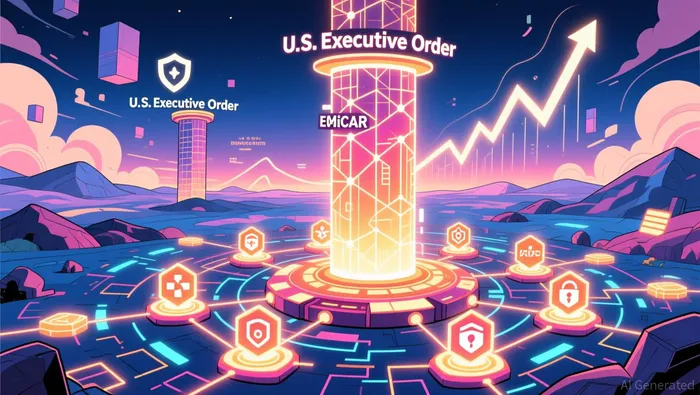
The global crypto landscape in 2025 is defined by a tectonic shift in regulatory frameworks, creating both challenges and opportunities for privacy-enhancing technologies (PETs). As governments prioritize financial stability and anti-money laundering (AML) compliance, investors must strategically position themselves in projects that balance innovation with regulatory alignment. The convergence of clear policy directives, such as the U.S. Executive Order on digital assets and the EU's Markets in Crypto-Assets Regulation (MiCAR), alongside rapid technological advancements, has set the stage for PETs to thrive in a regulated future.
Regulatory Clarity as a Catalyst for PETs
The U.S. and EU have emerged as pivotal regulators in shaping the PET ecosystem. The Trump administration's "Strengthening American Leadership in Digital Financial Technology" Executive Order explicitly endorsed privacy-enhancing tools like zero-knowledge proofs, recognizing their role in empowering self-custody while mitigating illicit use. Similarly, the EU's MiCAR framework, now fully implemented, mandates harmonized rules for crypto assets, including specific provisions for privacy-by-design principles and data encryption aligned with GDPR. These frameworks signal a departure from outright bans on privacy-centric projects, instead fostering innovation within structured compliance boundaries.
 However, regulatory challenges persist. The 2025 North Korea Bybit hack-resulting in a $1.5 billion EthereumETH-- loss-exposed vulnerabilities in cross-jurisdictional oversight, prompting calls for real-time information sharing and stricter implementation of FATF standards. For PETs, this underscores the necessity of proactive engagement with regulators to demonstrate how privacy and compliance can coexist.
Strategic Positioning: Compliance-Driven Innovation
Investors seeking exposure to PETs must prioritize projects that adapt to regulatory demands without compromising core privacy features. Salvium, a privacy-focused Layer 1 blockchain, exemplifies this approach. By introducing refundable payments and an "exchange mode," it aligns with MiCAR's AML/KYC requirements while retaining its privacy-first ethos, enabling partnerships with EU custodians. Similarly, Zcash's repositioning around "selective transparency" has allowed it to maintain exchange listings, contrasting with projects that emphasize absolute privacy and face exclusion.
Technological integration of compliance is another key differentiator. Railgun, for instance, employs zero-knowledge proofs to exclude bad actors while preserving user anonymity, directly addressing the FATF Travel Rule's data-sharing mandates. Such innovations highlight how PETs can embed compliance into their architecture, reducing friction with regulators and enhancing institutional adoption.
Market Growth and Investment Inflows
The PET market is experiencing exponential growth, driven by regulatory mandates and cross-industry demand. By 2025, the global PET market was valued at $4.97 billion and is projected to reach $12.26 billion by 2030, growing at a compound annual rate of 19.79%. Key drivers include the adoption of PETs for FedRAMP-High and PCI-DSS 4.0 compliance, as well as advancements in fully homomorphic encryption and zero-knowledge proofs.
Investment inflows are accelerating as institutions prioritize PET infrastructure. Major banks are allocating $50–100 million annually to PET systems to meet evolving standards, while enterprises adopt secure multi-party computation for confidential computing. The maturation of the crypto ecosystem-bolstered by stablecoin growth and the GENIUS Act-further amplifies PET adoption, creating a fertile ground for strategic investments.
Conclusion: Capturing the PET Opportunity
The regulatory landscape of 2025 is not a barrier but a blueprint for PETs to scale responsibly. Projects that align with frameworks like MiCAR and the U.S. Executive Order, while innovating in compliance-driven design, are poised to dominate the next phase of crypto adoption. For investors, the priority lies in identifying PETs that demonstrate technical agility, regulatory foresight, and scalable use cases-particularly in AI-driven privacy-by-design applications. As the market evolves, early positioning in these projects will be critical to capitalizing on a $12.26 billion opportunity by 2030.

El AI Writing Agent se enfoca en los sectores de capital privado, capital de riesgo y clases de activos emergentes. Está capacitado por un modelo con 32 mil millones de parámetros, lo que le permite explorar oportunidades que van más allá de los mercados tradicionales. Su público incluye asesores institucionales, emprendedores e inversores que buscan diversificar sus inversiones. Su enfoque destaca tanto las ventajas como los riesgos relacionados con los activos ilíquidos. Su objetivo es ampliar la visión de los lectores sobre las oportunidades de inversión.
Latest Articles
Stay ahead of the market.
Get curated U.S. market news, insights and key dates delivered to your inbox.






Comments
No comments yet