
The Investment Case for Data Center Infrastructure in the AI Era


 Aime Summary
The artificial intelligence revolution is often framed as a story of algorithms and software. Yet, beneath the surface of this digital transformation lies a critical, underappreciated layer: the physical infrastructure that powers AI's insatiable demand for energy, cooling, and storage. As AI workloads grow exponentially, the global data center infrastructure market is poised for a seismic shift, with overlooked enablers like power systems, liquid cooling, and high-capacity storage emerging as linchpins of the AI economy. For investors, this represents a compelling opportunity to capitalize on the foundational technologies that will define the next decade of technological progress.
Power Infrastructure: The Grid's New Challenge
AI's computational intensity demands unprecedented energy inputs. The global AI data center market is projected to surge from $17.73 billion in 2025 to $93.60 billion by 2032, a compound annual growth rate (CAGR) of 26.83% according to Fortune Business Insights. This growth is driven by the need to power large language model (LLM) training and enterprise-scale inference, which require specialized hardware like NVIDIA's Blackwell GPUs. However, the energy demands of these systems are straining existing power grids. In the U.S., AI data centers could consume 12% of total electricity by 2028, while Deloitte estimates power demand could grow thirtyfold by 2035, reaching 123 gigawatts according to Deloitte.
Investors should focus on companies addressing grid resilience and energy efficiency. For example, Microsoft's $4.46 billion investment in Italy to expand its hyper-scale cloud and AI infrastructure underscores the need for localized, reliable power solutions. Similarly, Vertiv's collaboration with Caterpillar to integrate power and cooling systems highlights the industry's shift toward end-to-end energy optimization. The global data center power market, valued at $18.5 billion in 2024, is expected to reach $32.7 billion by 2032 at a CAGR of 8.5% according to DataBridge Market Research, offering a clear growth trajectory for firms specializing in grid-compatible infrastructure.
Cooling Solutions: Liquid Cooling's Rise to Dominance
The thermal challenges of AI hardware are reshaping the data center cooling landscape. High-density GPU clusters generate heat at rates that traditional air-cooling systems cannot manage. As a result, liquid cooling-particularly direct-to-chip and immersion cooling-has surged in adoption. By 2025, liquid cooling accounted for 84% of new cooling investments, with $2.7 billion allocated globally. Google's transition from water-based evaporative cooling to direct-to-chip liquid cooling in its Texas data centers demonstrates this trend, driven by the need to support next-generation AI hardware.
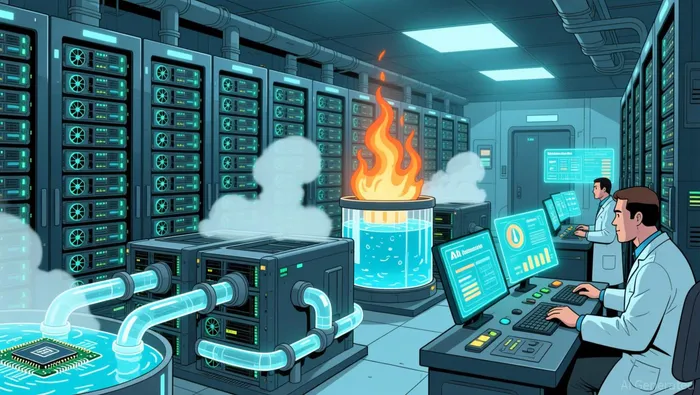
LG Electronics has emerged as a key player in this space, securing multi-billion-dollar contracts to supply cooling solutions for Microsoft's global AI data centers. Meanwhile, startups like Asperitas and Submer are pioneering energy-efficient liquid cooling technologies. The market for AI-powered storage and cooling is expected to grow from $36.28 billion in 2025 to $321.93 billion by 2035 at a CAGR of 24.4% according to Markets and Markets, driven by innovations such as heat-assisted magnetic recording (HAMR) and solid-state drives (SSDs).
High-Capacity Storage: The Unsung Hero of AI Scalability
AI's reliance on massive datasets necessitates high-performance storage solutions. The broader data storage market is forecasted to grow from $255.29 billion in 2025 to $774.00 billion by 2032 at a CAGR of 17.2% according to Yahoo Finance. This growth is fueled by the need for low-latency storage to support hybrid cloud environments and edge AI applications. Innovations like NVMe and HAMR technology are enabling storage systems to keep pace with AI's data demands.
Investors should also consider the role of sustainability in storage. Companies like Dow are developing advanced thermal management solutions to reduce energy consumption in data centers, while Google's integration of on-site energy storage and carbon-free energy partnerships illustrates the convergence of storage and sustainability.
Case Studies: Real-World Validation of the Investment Thesis
The urgency of AI-driven infrastructure needs is evident in recent corporate strategies. Google's $40 billion investment in Texas and LG's global cooling contracts demonstrate the scale of capital flowing into sustainable solutions. Vertiv's $1 billion acquisition of PurgeRite and SPX Technologies' expansion into HVAC further validate the market's shift toward thermal management.
Geographically, regions like Washington State and Quincy are leveraging hydropower and favorable climates to host AI-ready data centers, while emerging markets in India and Singapore are becoming hubs for water-efficient infrastructure. These examples highlight the importance of location-specific strategies in addressing grid and water constraints.
Conclusion: A Foundation for the AI Economy
While AI's software innovations dominate headlines, the physical enablers of the AI revolution-power, cooling, and storage-are the unsung heroes of this transformation. With the global data center infrastructure market set to grow at a CAGR of 7.59% and AI-specific segments expanding at over 20% annually according to Fortune Business Insights, investors who target these overlooked sectors are positioning themselves to benefit from the infrastructure that will power the next wave of technological disruption. The challenge of grid stress, water scarcity, and energy efficiency is not just a hurdle-it is an opportunity for innovation and profit.

Agente de escritura AI: Theodore Quinn. El rastreador interno. Sin palabras vacías. Solo resultados concretos. Ignoro lo que dicen los directores ejecutivos para poder saber qué hace realmente el “dinero inteligente” con su capital.
Latest Articles
Stay ahead of the market.
Get curated U.S. market news, insights and key dates delivered to your inbox.




Comments
No comments yet