
Investing in Urban Grid Resilience: Opportunities in Modernization and Outage Response Technologies


 Aime Summary
The December 2025 San Francisco power outage, which left 130,000 PG&E customers-nearly one-third of the city's grid-without electricity, underscores the urgent need for modernizing urban utility infrastructure. The blackout, triggered by a fire at a PG&E substation at 8th and Mission streets,
disrupted public transit, self-driving vehicles, and emergency services, exposing vulnerabilities in aging systems. As cities grapple with climate-driven extreme weather, population growth, and the integration of renewable energy, investment in grid resilience has shifted from a strategic priority to an existential imperative.
The Case for Grid Modernization: PG&E's Challenges and Innovations
PG&E, a key player in California's energy landscape, faces mounting operational challenges. Its
2023–2025 capital expenditure plan prioritizes undergrounding power lines, wildfire safety upgrades, and AI-driven tools for weather forecasting and outage anticipation. However, the December 2025 outage revealed gaps in real-time response capabilities,
as the utility initially struggled to stabilize the grid and provide restoration timelines.
To address these challenges, PG&E is partnering with companies like Smart Wires and Heimdall Power to deploy Dynamic Line Rating (DLR) and Asset Health Monitoring (AHM) technologies. These systems use real-time weather data and sensor networks to
optimize transmission line capacity and predict asset failures. Additionally, the utility's Energy Storage Innovation Center (EPIC) is testing battery energy storage systems (BESS) and distributed energy resource management systems (DERMS) to enhance grid flexibility. Such initiatives align with California's renewable energy goals but require sustained investment to scale effectively. 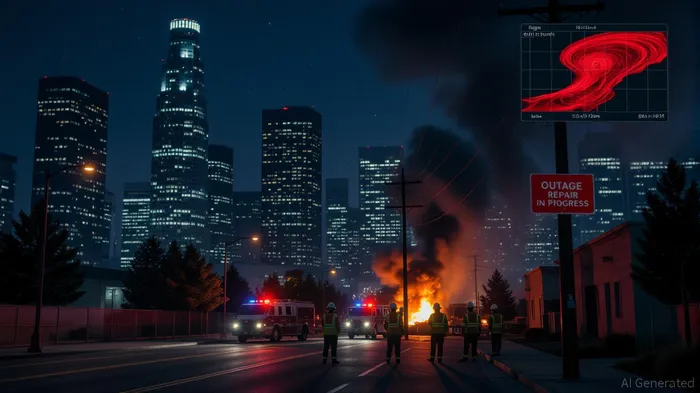
Emerging Solutions: Smart Grid Mapping and Real-Time Outage Tracking
The December 2025 outage highlights the critical role of smart grid mapping and real-time outage tracking in mitigating cascading failures.
Advanced metering infrastructure (AMI) and IoT-based platforms, such as those developed by N-Smart, enable two-way communication between utilities and consumers, allowing for dynamic load balancing and rapid fault detection. For instance, San Diego's smart microgrid projects and Barcelona's AI-enhanced energy forecasting systems
demonstrate how real-time data aggregation can reduce outage durations by up to 40%.
Quantum-AI solutions, pioneered by startups like Resilient Entanglement, are also gaining traction. These technologies
optimize power flow in complex urban grids, addressing challenges like the NP-hard unit commitment problem. Meanwhile, IoT-enabled fault location, isolation, and service restoration (FLISR) systems are becoming standard in cities like Columbus,
where connected vehicle technology has reduced emergency response times by 17%.
Investment Opportunities: Key Sectors and Companies
- Smart Grid Mapping Platforms:
- Gridspertise (Italy): A cloud-edge grid platform that enhances reliability through real-time data monitoring.
Loqio (Netherlands): Provides large-scale energy flow insights, future-proofing urban grids.
Real-Time Outage Tracking:
- N-Smart: IoT-based grid monitoring systems that aggregate real-time data for predictive maintenance.
Texas A&M's Power System Vulnerability Index (PSVI):
AI-driven tools to identify high-risk outage zones, particularly in coastal regions.AI/ML for Grid Resilience:
- Resilient Entanglement: Quantum-AI solutions for optimizing power flow in unbalanced distribution networks.
- Heimdall Power: Partners with PG&E to deploy AI for wildfire risk prediction and grid hardening.
The Urban Resilience Imperative
Cities like San Francisco, with their dense populations and reliance on data centers, face unique risks.
The 2025 Iberian Peninsula blackout, a result of insufficient interconnectivity between grids, serves as a cautionary tale. Conversely, Austin's FireCom platform, which
integrates real-time fire and smoke prediction models, exemplifies how digital twins can enhance emergency preparedness.
For investors,
the convergence of AI, IoT, and decentralized energy systems presents a $1.2 trillion global smart grid market opportunity by 2035. Urban markets, in particular, offer high ROI potential due to regulatory tailwinds (e.g., California's SB 100 clean energy mandate) and the escalating cost of inaction.
Conclusion
The December 2025 San Francisco outage is a wake-up call for urban centers worldwide. While PG&E's modernization efforts are commendable, they underscore the need for accelerated investment in smart grid technologies. Startups and established players alike are pioneering solutions that not only prevent outages but also enable real-time response and recovery. For investors, the path forward lies in supporting innovations that align with urban resilience, climate adaptation, and the digital transformation of energy infrastructure.

Stay ahead of the market.
Get curated U.S. market news, insights and key dates delivered to your inbox.






Comments
No comments yet