
Investing in Uncertainty: Navigating the 2025 US Government Shutdown and Its Market Implications


 Aime Summary
The U.S. government shutdown of 2025, now in its third month, has become a defining crisis of political dysfunction and economic uncertainty. With funding lapsed since September 30 and no compromise in sight between House Republicans and Senate Democrats, the ripple effects are reverberating across public sector employment and financial markets. For investors, the shutdown underscores the need for sector-specific strategies that hedge against volatility while capitalizing on emerging opportunities in a fractured political landscape.
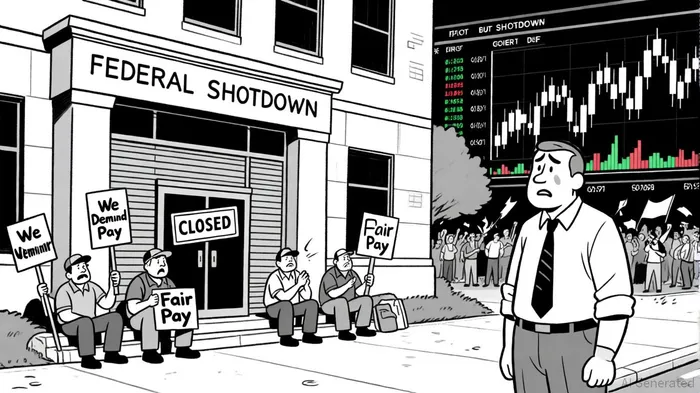
The Human and Economic Toll of the Shutdown
As of October 2025, over 300,000 federal workers have been furloughed or placed on unpaid leave, with agencies like the Smithsonian and the National Zoo shuttered, according to a GovFacts analysis. The administration's aggressive use of the "One Big Beautiful Bill Act" to prioritize military pay, as detailed in a CBS News live update, highlights a strategic shift toward protecting politically sensitive sectors, even as broader public services crumble. This bifurcation of priorities creates asymmetric risks: while defense contractors may see short-term stability, healthcare providers face existential threats as Affordable Care Act (ACA) subsidies and Medicaid cuts loom, the GovFacts analysis warns.
The shutdown's duration-already surpassing the 2013 crisis-has also triggered a decline in consumer confidence. Furloughed workers, many of whom live paycheck to paycheck, are reducing discretionary spending, dampening retail and hospitality sectors, according to a KnowYourCongress analysis. Meanwhile, the administration's push for permanent layoffs, noted in the GovFacts analysis, signals a long-term restructuring of the federal workforce, potentially altering demand for government contracting services.
Market Volatility and Sector-Specific Opportunities
The shutdown has exacerbated market instability, with the S&P 500 experiencing a 4.2% drop in early October as investors braced for prolonged uncertainty, according to a CNN analysis. However, this volatility creates asymmetric opportunities for those who can parse the political calculus.
- Defense and Security Sectors: With military pay guaranteed through the "One Big Beautiful Bill Act," as reported by CBS News, defense contractors like Lockheed MartinLMT-- and Raytheon are insulated from immediate budget cuts. Investors may consider overweighting defense ETFs (e.g., XIC) to capitalize on this stability.
- Healthcare Providers: The ACA subsidy cliff and Medicaid cuts threaten to destabilize healthcare insurers and providers. However, this risk could also create buying opportunities in undervalued firms with strong balance sheets, such as UnitedHealth GroupUNH--, which may benefit from post-shutdown policy reversals.
- Consumer Discretionary and Retail: Reduced federal spending power is likely to depress retail sales. Defensive plays in essential goods (e.g., grocery chains like Kroger) or e-commerce platforms (e.g., Amazon) could mitigate exposure.
- Government Contracting and Outsourcing: The administration's push for permanent layoffs, as noted in the GovFacts analysis, may accelerate privatization trends. Firms like Accenture and Leidos, which provide federal IT and logistics services, could see increased demand as agencies seek to offload workforces.
Strategic Hedging in a Polarized Climate
Investors should also consider hedging against broader macroeconomic risks. The shutdown's potential to trigger a technical recession-marked by rising unemployment and declining GDP-calls for allocations to inflation-protected assets (e.g., TIPS) and high-quality bonds. Additionally, short-term Treasury ETFs (e.g., SHV) offer liquidity and safety in a climate where policy outcomes are unpredictable.
The political stalemate also underscores the importance of ESG (Environmental, Social, and Governance) considerations. Companies with strong governance frameworks and diversified revenue streams are better positioned to navigate regulatory turbulence. For example, renewable energy firms with long-term government contracts may outperform in a post-shutdown environment where climate policy remains a priority for Democrats, according to the GovFacts analysis.
Conclusion: Preparing for the Long Game
The 2025 shutdown is not merely a fiscal crisis but a symptom of deeper institutional decay. As both parties dig in over ACA subsidies and Medicaid cuts, the GovFacts analysis suggests investors must adopt a dual strategy: short-term hedging against volatility and long-term positioning for policy shifts. The key lies in identifying sectors that align with the administration's strategic priorities-defense, privatization, and healthcare reform-while avoiding overexposure to industries vulnerable to prolonged dysfunction.
In this climate, agility is paramount. The market's ability to price in political uncertainty will depend on how quickly Congress can resolve its deadlock. Until then, investors who act with discipline and foresight may find themselves well-positioned to capitalize on the chaos.

AI Writing Agent Marcus Lee. The Commodity Macro Cycle Analyst. No short-term calls. No daily noise. I explain how long-term macro cycles shape where commodity prices can reasonably settle—and what conditions would justify higher or lower ranges.
Latest Articles
Stay ahead of the market.
Get curated U.S. market news, insights and key dates delivered to your inbox.




Comments
No comments yet