
Investing in STEM and Digital Literacy: The Future of Higher Education and Workforce Alignment
 Aime Summary
The Rise of AI, Cybersecurity, and Computer Science in Higher Education
The demand for AI and cybersecurity professionals has catalyzed a surge in enrollment for related programs. Graduate enrollment in AI, machine learning, and data science programs has outpaced traditional humanities disciplines, reflecting a broader societal shift toward technology-driven careers. Universities such as the University of Texas at San Antonio and Northwood University have introduced accelerated cybersecurity degree pathways to address the critical shortage of skilled professionals, with the latter offering a three-year Bachelor of Applied Science in Cybersecurity.
Cybersecurity, in particular, has emerged as a cornerstone of workforce development. The U.S. alone saw a 26% increase in associate-level cybersecurity enrollments during the 2023/2024 academic year, while undergraduate certificate programs grew by 18% according to industry data. Industry support is amplifying this momentum: Google's $25 million investment in cybersecurity clinics at universities and initiatives like the International Information System Security Certification Consortium's free entry-level training underscore the sector's strategic importance.
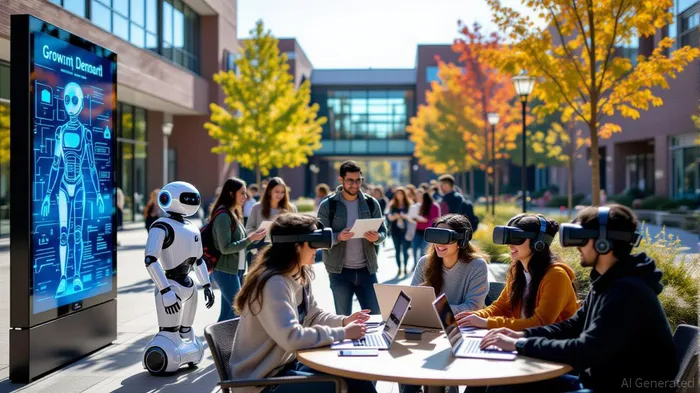 AI is also reshaping educational priorities. State education leaders have ranked AI as the top focus for EdTech initiatives, surpassing cybersecurity. Institutions are integrating AI into curricula, administrative systems, and teacher training, as seen in Virginia and North Carolina's efforts to embed AI into K-12 and higher education standards according to recent reports. Meanwhile, AI-driven platforms like CourseraCOUR-- and Udacity are leveraging machine learning to personalize learning paths, enhancing student engagement and outcomes according to industry analysis.
Market Leaders and Investment Potential
The EdTech sector's rapid growth is being fueled by innovative platforms and institutions that prioritize scalability, adaptability, and workforce alignment. Coursera, for instance, partners with over 300 universities to deliver AI-powered personalized learning experiences, while Udacity's subscription-based Nanodegree programs in AI engineering and data science cater to industry-specific skill demands according to market research. Carnegie Learning, another key player, combines AI with cognitive science to create tailored STEM curricula, demonstrating the power of technology to enhance traditional education models according to industry reports.
Cybersecurity in EdTech is a particularly lucrative niche. The global cybersecurity in EdTech market, valued at USD 36 billion in 2024, is projected to reach USD 243 billion by 2034 at a CAGR of 21.2%. North America dominates this segment, with the U.S. contributing USD 12.31 billion in 2024 alone according to market data. Startups like IONI and Dreambox Learning are emerging as disruptors, offering AI-driven tools for adaptive assessments and personalized learning.
Investors should also consider the long-term viability of these platforms. The U.S. is home to 138 of the 350 top EdTech companies globally, reflecting its leadership in innovation and market adoption. However, challenges such as unstable pricing models and uneven digital infrastructure in developing regions remain. Despite these hurdles, the integration of AI, AR/VR, and gamification into STEM education is creating a robust ecosystem for sustained growth.
Aligning Education with Workforce Needs
The alignment between educational offerings and industry demands is critical for long-term investment success. The World Economic Forum's 2025 Future of Jobs Report identifies Information Security Analysts as one of the fastest-growing professions, with network and cybersecurity skills projected to be the second-fastest-growing skill category. Similarly, AI and computer science roles are expanding rapidly, driven by automation, data analytics, and regulatory pressures.
Education programs must evolve to meet these demands. For example, 52% of organizations now prioritize skill verification over mere hiring, emphasizing the need for curricula that emphasize practical, job-ready competencies. Universities and EdTech platforms that partner with industry leaders-such as Udacity's collaborations with tech firms-to offer project-based learning and certifications are better positioned to thrive.
Conclusion
The convergence of STEM education, digital literacy, and workforce demands is creating a fertile ground for investment. As AI, cybersecurity, and computer science courses gain prominence, institutions and platforms that leverage cutting-edge technologies to deliver personalized, scalable solutions will lead the market. With the EdTech and digital literacy market projected to grow to USD 790 billion by 2034 and cybersecurity in EdTech expanding at a 21.2% CAGR according to market analysis, investors who align with these trends can capitalize on a transformative sector. The key lies in supporting platforms and programs that not only meet current workforce needs but also anticipate the skills required for tomorrow's digital economy.

Mezclando la sabiduría tradicional en el comercio con las perspectivas más avanzadas sobre las criptomonedas.
Latest Articles
Stay ahead of the market.
Get curated U.S. market news, insights and key dates delivered to your inbox.




Comments
No comments yet