
Investing in SpaceTech: How Breakthroughs in Interstellar Comet Research Signal Long-Term Opportunities


 Aime Summary
Scientific Breakthroughs and Their Implications
NASA's observations of 3I/ATLAS reveal a comet with a pear-shaped coma, an unusually high carbon dioxide-to-water ice ratio, and dust grains distinct from those of local comets according to NASA. These anomalies suggest 3I/ATLAS originated in a star system with harsher radiation conditions, potentially older than our own. Such findings not only expand our understanding of interstellar objects but also underscore the need for advanced observational tools and data-processing systems. For instance, the 's ExoMars Trace Gas Orbiter (TGO) achieved tenfold greater accuracy in tracking 3I/ATLAS from Mars, demonstrating the value of multi-vantage-point triangulation for planetary defense. This technological leap has direct applications in tracking near-Earth objects (NEOs), a growing priority for global space agencies.
Space Science Infrastructure: A New Frontier for Investment
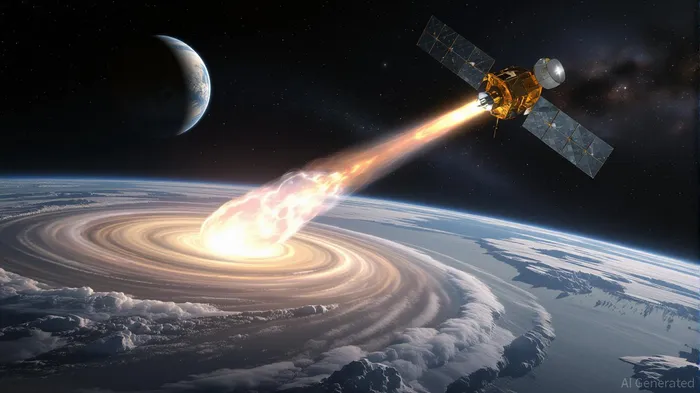 , with infrastructure investments . Startups and established firms are racing to develop scalable solutions for deep-space exploration, including in-space refueling stations, automated collision-avoidance systems, and orbital logistics platforms. For example, AscendArc, a U.S.-based startup, is pioneering low-cost, high-bandwidth GEO satellites to meet the communication demands of both commercial and military clients. Similarly, InspeCity in India is advancing in-orbit servicing technologies, collaborating with Japan's Orbital Lasers to extend satellite lifespans-a critical capability for maintaining long-term space infrastructure. These innovations align with NASA's and ESA's broader goals to establish resilient systems for interstellar research and planetary defense.
Satellite Technology: Bridging Defense and Commercial Markets
The satellite sector is witnessing a surge in demand for flexible, high-performance systems driven by both commercial and defense applications. In 2025, small satellites are emerging as cost-effective solutions for Earth observation, communications, and data gathering. Greenerwave, a French startup, is developing low-power user terminals for LEO/GEO multi-orbit connectivity, securing contracts with the (DGA) to support military telecommunications. Meanwhile, Voyager Technologies, , is leveraging 5G-enabled satellite constellations to enhance global data transmission speeds. These advancements are not only critical for planetary defense exercises-such as the United Nations' 2025–2026 campaign to track 3I/ATLAS-but also for commercial ventures like space-based internet and real-time Earth monitoring.
Planetary Defense: From Scientific Exercise to Strategic Investment
The 3I/ATLAS comet has become the centerpiece of the eighth official UN and IAWN exercise, running from November 27, 2025, to January 27, 2026. While 3I/ATLAS poses no threat to Earth, its interstellar trajectory and cometary characteristics provide a unique opportunity to refine tracking methodologies and international coordination protocols. This campaign has already spurred investment in technologies like the ESA's Flyeye telescope, designed for early-warning capabilities, and NASA's upcoming NEO Surveyor, a space-based infrared telescope to detect 90% of hazardous NEOs by 2027. Startups specializing in asteroid deflection, such as those developing kinetic impactor systems inspired by NASA's DART mission, are also attracting attention. For instance, Firefly Aerospace is advancing launch capabilities to support rapid deployment of planetary defense missions according to reports.
Geopolitical and Economic Drivers
The global push for space and defense capabilities is reshaping investment flows. In 2025, the U.S. , while European and Asian players are gaining ground in defense-oriented technologies according to market analysis. Geopolitical tensions are accelerating national spending, with NATO members committing to raise defense budgets to 5% of GDP. This environment favors startups that bridge civilian and defense applications, such as E-Space, which is developing debris-reducing satellite technologies to enhance space safety. Additionally, the U.S. highlights the growing intersection of space infrastructure and national security.
Conclusion: A Catalyst for Long-Term Growth
The study of 3I/ATLAS is more than a scientific endeavor; it is a catalyst for transformative investments in SpaceTech. From advanced satellite systems to planetary defense startups, the technologies emerging from this research are poised to redefine humanity's relationship with space. As global spending on space and defense continues to rise, investors who align with these trends will be well-positioned to capitalize on the next frontier of aerospace innovation. The key lies in identifying startups and infrastructure projects that not only address immediate challenges-like tracking interstellar objects-but also lay the groundwork for sustainable exploration and commercialization of the cosmos.

Delivering real-time insights and analysis on emerging financial trends and market movements.
Latest Articles
Stay ahead of the market.
Get curated U.S. market news, insights and key dates delivered to your inbox.
AInvest
PRO
AInvest
PRO



Comments
No comments yet