
Investing in the Space Sector Amid Breakthrough Discoveries Like 3I/ATLAS and Jupiter Interactions


 Aime Summary
Scientific Breakthroughs and Technological Imperatives
The study of 3I/ATLAS has provided critical insights into interstellar objects and their behavior. Recent research confirms that its non-gravitational acceleration-initially sparking speculation about exotic explanations-is attributable to conventional cometary outgassing of carbon monoxide and carbon dioxide. This discovery underscores the importance of advanced observational tools, such as the , which will analyze 3I/ATLAS's gas composition during its closest approach to Earth in December 2025. Such missions not only enhance scientific understanding but also demonstrate the technical capabilities required for deep-space exploration.
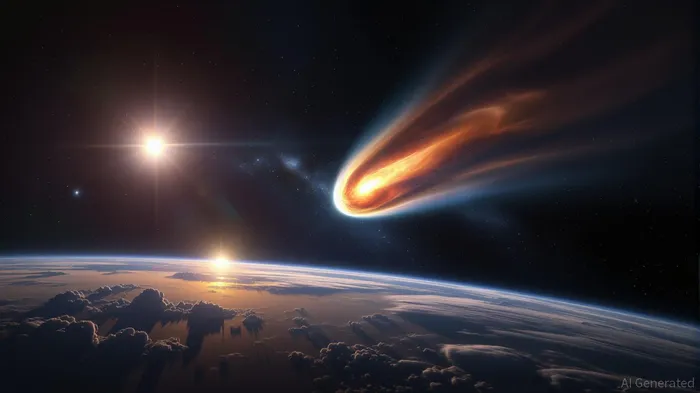
Jupiter's gravitational influence further amplifies the sector's strategic value. A small gravitational impulse from the gas giant near perihelion can alter an object's orbit, as seen with 3I/ATLAS. This dynamic has spurred interest in trajectory optimization techniques, such as the , which NASA's Juno spacecraft could employ to intercept 3I/ATLAS in 2026. By extending Juno's mission, NASA aims to test propulsion systems and autonomous navigation technologies critical for future asteroid-mining ventures as research shows. These efforts highlight how planetary interactions are not just scientific curiosities but practical drivers of technological development.
The Rise of Asteroid Mining and Deep-Space Tech
The asteroid-mining market is projected to grow at a compound annual rate , . This growth is fueled by global demand for rare earth metals and advancements in space robotics, propulsion, and (ISRU). Companies like AstroForge and TransAstra are at the forefront of this revolution. AstroForge's Odin mission, launched in February 2025, aims to image asteroid 2020 OB5, while its upcoming Vestri mission plans to land on a metal asteroid-a first for private industry. TransAstra's , demonstrated through its MiniBee prototype, is designed to extract minerals using lasers, with applications for both asteroid mining and space debris management.
These ventures are supported by a maturing infrastructure. The U.S. and cost-effective launch technologies are creating a regulatory and economic environment conducive to long-term investment. Meanwhile, and Artemis program underscore the public sector's role in advancing technologies that private firms can later commercialize.
Strategic Positioning for Investors
The convergence of scientific discovery and technological innovation presents a unique window for investors. Firms leveraging data from missions like Juno and James Webb Telescope are not only addressing immediate scientific questions but also building the foundational tools for resource extraction and interstellar navigation. For instance, the feasibility of intercepting 3I/ATLAS with Juno's propulsion system demonstrates the viability of adapting existing spacecraft for new missions-a skillset directly transferable to asteroid-mining operations.
Moreover, the study of interstellar objects like 3I/ATLAS is accelerating the development of autonomous systems and high-precision instruments, which are essential for mining operations in low-gravity environments. Investors who align with companies like AstroForge or TransAstra are not merely funding resource extraction; they are supporting the broader ecosystem of space exploration, including advancements in propulsion, robotics, and data analytics.
Conclusion
The space sector is transitioning from a domain of scientific curiosity to a hub of economic opportunity. Breakthroughs in understanding interstellar objects and planetary interactions are not isolated events but harbingers of a new era in resource exploration and technological innovation. As the asteroid-mining market expands and deep-space missions become more sophisticated, early investors stand to gain from firms that bridge the gap between astrophysics and commercial viability. The time to act is now-before the next "gold rush" in space becomes a reality.

Ofreciendo resultados y análisis en tiempo real acerca de las tendencias financieras y los movimientos de mercado en evolución.
Latest Articles
Stay ahead of the market.
Get curated U.S. market news, insights and key dates delivered to your inbox.


AInvest
PRO
AInvest
PRO



Comments
No comments yet