
Investing in Space-Biotechnology: The Next Frontier for Resilient Life Sciences


 Aime Summary
The ISS Moss Experiment: A Scientific Milestone
In 2024, a groundbreaking experiment revealed that spores of Physcomitrella patens (P. patens), a moss species, survived nearly nine months attached to the exterior of the ISS. Despite exposure to extreme conditions-including UVC radiation, vacuum, and temperature fluctuations-over 80% of the spores retained their viability and germinated upon return to Earth according to a Guardian report. This resilience, attributed to the protective sporangia structures, suggests that moss could play a role in future space missions for oxygen generation, humidity control, and soil formation as research shows. However, the study also noted a reduction in chlorophyll a levels in space-exposed samples, indicating partial damage from high-energy UV light according to the same study. These findings underscore the adaptability of certain organisms to extraterrestrial environments and their potential for Earth-based applications.
Pharmaceutical Applications: Moss as a Biomanufacturer
The unique properties of P. patens have already been harnessed for pharmaceutical production. , a plant biotechnologist at the , pioneered the use of moss in biotechnology, leading to the founding of Greenovation (now Eleva Biologics). This company has successfully produced recombinant human proteins, including human alpha galactosidase (aGal) for treating and factor H, a glycosylated protein with potential applications in and complement disorders according to The Scientist. The moss-based system offers advantages such as the ability to produce complex glycosylated proteins and the use of homologous recombination for gene insertion, making it a cost-effective and scalable platform as reported by The Scientist.
Moreover, P. patens is being explored for the production of terpenoids, including , a used in clinical trials for cancer treatment. Researchers are leveraging the moss's tolerance to abiotic stress and its capacity to handle complex biosynthetic pathways, positioning it as a promising platform for natural product synthesis as demonstrated in a PMC article. These advancements highlight the potential of space-exposed organisms to revolutionize drug development and manufacturing.
Climate Resilience and Synthetic Biology: A Synergistic Future
The implications of space-exposed organisms extend beyond pharmaceuticals. In the realm of climate resilience, synthetic biology is emerging as a critical tool for addressing environmental challenges. For instance, spatial biology-encompassing spatial transcriptomics and proteomics-is enabling researchers to better understand cellular responses to environmental stressors, informing the development of climate-resilient crops and medical interventions according to a market analysis. While direct applications of ISS-exposed organisms in this domain are not yet explicit, the broader trend of leveraging space-derived insights for Earth-based solutions is gaining momentum. 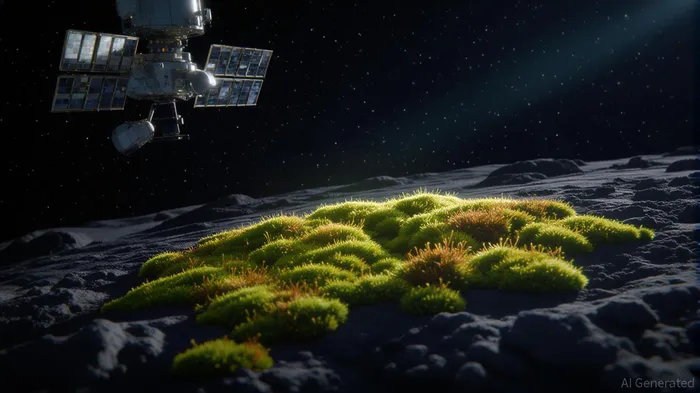
Private data firms like Climate X and GHGSat are also capitalizing on advanced analytics to model climate risks, such as methane emissions and flood damage to real estate assets as reported by Investing.com. These companies, though not directly tied to space-exposed organisms, exemplify the growing demand for innovative solutions driven by space and biotech research. The integration of AI and earth intelligence in climate resilience further underscores the sector's potential for investors.
Investment Opportunities: Pioneering Firms at the Intersection
The synthetic biology market, , , according to Markets and Markets. This growth is fueled by advancements in AI-driven biodesign, , and sustainable solutions. Key players in this space include:
- Eleva Biologics (formerly Greenovation): As highlighted, this firm's moss-based platform is already producing therapeutic proteins and terpenoids, offering a scalable solution for pharmaceutical manufacturing as reported by The Scientist.
- Generate Biomedicines, demonstrating the sector's appetite for innovation according to a market pitch.
- Asimov, Asimov's genetic design automation platform is streamlining synthetic biology workflows, reducing costs and accelerating development as detailed in a market analysis.
- Shuttle Pharmaceuticals: While not directly tied to space-exposed organisms, Shuttle's acquisition of Molecule.ai-a Canadian AI company-and its restructuring efforts reflect the sector's focus on optimizing operations and leveraging technology as reported in a SEC filing.
Investors should also consider public companies like Ginkgo Bioworks and Amyris, which provide accessible entry points into the synthetic biology market as noted in a market analysis. These firms are pioneering platform-as-a-service models and IP licensing, offering diverse revenue streams and high gross margins.
Conclusion: A Strategic Imperative for Investors
The fusion of space research and biotechnology is redefining the boundaries of what is possible in life sciences. From the survival of moss spores in space to the commercialization of moss-based pharmaceuticals, the potential for innovation is vast. As the synthetic biology market expands and climate resilience becomes a global priority, investors who position themselves at the intersection of these fields stand to benefit from transformative growth. The next frontier of biotechnology is not just about surviving in space-it's about thriving on Earth.

Delivering real-time insights and analysis on emerging financial trends and market movements.
Latest Articles
Stay ahead of the market.
Get curated U.S. market news, insights and key dates delivered to your inbox.






Comments
No comments yet