
Investing in Resilience: Grid Modernization and Energy Storage in Post-Outage California


 Aime Summary
The 2025 San Francisco power outage crisis has laid bare the fragility of California's aging energy infrastructure. From equipment failures at the Hunters Point substation to cascading outages affecting 124,000 customers in November, the incidents underscore a critical need for systemic upgrades. Yet, as the state grapples with these challenges, a surge in grid modernization and energy storage initiatives is creating a goldmine of investment opportunities. For those willing to look beyond the headlines, California's push for resilience offers a compelling case for capital deployment.
The Catalyst: A Perfect Storm of Outages and Policy Shifts
The December 2025 outages, which left neighborhoods like the Outer Sunset and Bayview in darkness, were not isolated events. They were symptoms of a grid strained by aging infrastructure, rising demand, and the accelerating transition to renewable energy.
According to Pacific Gas and Electric (PG&E), a broken jumper caused one outage, while others stemmed from unresolved equipment failures. These incidents have forced regulators and utilities to act. California's energy storage capacity now stands at 16,942 megawatts-a 2,100% increase since 2019-
proving that resilience is no longer optional.
Government and Utility-Scale Investments: A Blueprint for Resilience
California's response has been twofold: massive public-private partnerships and aggressive regulatory reforms. The state's $4.8 billion Transmission Plan,
approved by the California Independent System Operator (CAISO), includes 31 projects to expand capacity, including reconductoring and new 500 kV lines in the Bay Area. These upgrades are critical as
electrification and AI-driven data centers push electricity demand to rise 76% by 2045.
Meanwhile, the California Public Utilities Commission (CPUC) is modernizing distribution systems through the High DER proceeding,
streamlining interconnection processes for solar and storage systems. Southern California Edison's grid-hardening efforts,
including wildfire mitigation and smart grid tech, further illustrate the sector's transformation.
Private Sector Momentum: From Batteries to AI-Powered Grids
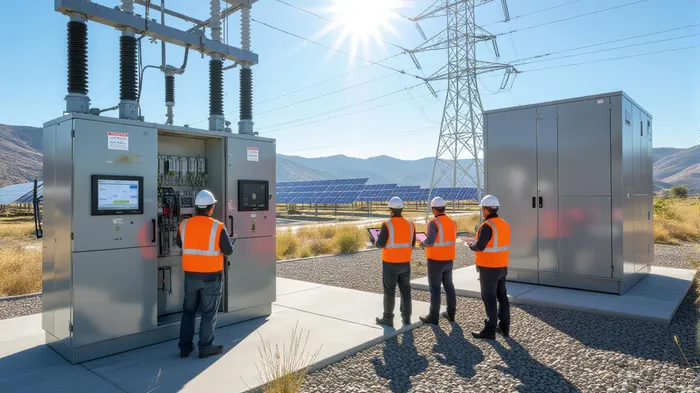 Private investment is accelerating this transition. The state's battery storage boom, now at 17,000 megawatts, is driven by both utility-scale projects and behind-the-meter systems.
Notable examples include Pasadena Water and Power's $9.66 million grant for a 25 MW battery system and
Form Energy's 5 MW/500 MWh iron-air storage project, set to operationalize in 2025.
The Long Duration Energy Storage (LDES) program, with $270 million allocated for non-lithium-ion technologies, is another frontier.
Projects like the 48 MWh zinc hybrid cathode system at Marine Corps Base Camp Pendleton highlight the diversification of storage solutions. These innovations are not just technical achievements-they are financial opportunities.
Key Players and Emerging Trends
Investors should focus on companies at the intersection of grid resilience and clean energy.
Hubbell and Monolithic Power Systems are critical suppliers of smart grid components, while
PG&E's $73-billion capital plan underscores the scale of utility-side investments.
ENGIE North America's 2.4 GW battery storage deal with CBRE and Green Rain Energy's surge in investor interest further signal sector momentum.
However, challenges persist.
The DSGS program, which incentivizes customer-owned batteries, faces funding cuts, threatening its potential to scale to 1,300 MW. Similarly,
reduced profit margins for utilities like PG&E-now capped at 9.78–10.03%-raise questions about long-term investment sustainability.
The Road Ahead: Balancing Risk and Reward
California's grid modernization is a high-stakes bet. While the state's leadership in clean energy is undeniable, the path to reliability requires navigating regulatory hurdles, technological uncertainties, and political pressures. Yet, the stakes are equally high:
a $1.4 trillion investment pipeline from 2025 to 2030 and
a global energy storage market forecast to install 92.9 GW/317.9 GWh by 2030 suggest this is not a passing trend but a structural shift.
For investors, the lesson is clear: resilience is the new dividend. Whether through utility stocks, energy storage developers, or AI-driven grid management firms, California's post-outage landscape offers a blueprint for where the future of energy-and profit-lies.

Stay ahead of the market.
Get curated U.S. market news, insights and key dates delivered to your inbox.
AInvest
PRO
AInvest
PRO



Comments
No comments yet