
Investing in Resilience: Alternative Asset Allocation and Risk Mitigation in Small U.S. Counties
 Aime Summary
In an era of escalating climate risks and constrained public budgets, small U.S. counties face a critical juncture. These communities, often characterized by limited financial and technical resources, are disproportionately vulnerable to disasters such as floods, wildfires, and cyberattacks. Yet, they also represent untapped opportunities for investors seeking to align capital with resilience-building initiatives. This article examines how alternative asset allocation strategies-particularly private equity and infrastructure funds-can address infrastructure vulnerabilities in small counties while generating long-term value.
The Infrastructure Vulnerability Crisis
Small U.S. counties are increasingly exposed to systemic risks. A 2025 report by the Multi-State Information Sharing and Analysis Center (MS-ISAC) reveals that 68% of state, local, tribal, and territorial (SLTT) organizations lack the budget to address major cybersecurity priorities, with rural areas bearing the brunt of this shortfall, according to a Pew article. Compounding this, the Rural Capacity Index from Headwaters Economics shows that 46% of low-capacity communities face high flood risk, and 38% confront high wildfire risk, as reported in a Pew analysis. These challenges are exacerbated by federal funding disparities: 76% of FEMA's Building Resilient Infrastructure and Communities (BRIC) grants historically flow to high-capacity communities, leaving smaller jurisdictions struggling to compete, according to Headwaters Economics.
Alternative Asset Allocation: A Strategic Response
Alternative investments, including private equity, infrastructure funds, and private credit, offer a pathway to bridge this gap. These strategies provide diversification, uncorrelated returns, and access to opportunities absent in traditional public markets, as UBS explains. For instance, private equity firms have allocated $180 billion to U.S. infrastructure projects over the past decade, including rural broadband expansion and renewable energy development, according to an AIC report. ApolloAPO-- Global Management and GTCR LLC, for example, have invested in Lumen Technologies and Visionary Broadband to enhance internet connectivity in underserved regions of the Mountain West and Midwest.
Infrastructure funds further amplify resilience by targeting long-term, stable assets. The Texas A&M University-led Digital Risk Infrastructure Program (DRIP), funded by state and federal partnerships, uses drone technology to create customized flood-risk maps for rural communities like Hudspeth County, Texas. This data enables access to FEMA grants and informed planning, transforming "data deserts" into actionable insights (described in the Pew article cited above). Similarly, the Resilient Virginia Revolving Loan Fund supports flood-prone communities through low-interest loans for infrastructure upgrades, demonstrating how blended finance models can scale impact (see the Pew analysis cited above).
Case Studies: From Theory to Practice
1. Hudspeth County, Texas
Hudspeth County, a rural area with fewer than 3,500 residents, faced recurring flash floods due to outdated risk data. DRIP's drone-based mapping initiative provided the county with precise flood-risk assessments, enabling it to secure $4.15 million in FEMA funding for mitigation projects (detailed in the Pew article referenced earlier). This case underscores how technology-driven infrastructure investments can unlock federal resources for small communities.
2. Envision Chaffee County, Colorado
Chaffee County leveraged a voter-approved 0.25% sales tax increase to fund wildfire risk mitigation on 10,000 acres of public and private land. The initiative generated $9 million in local revenue and attracted $36 million in federal and state matching funds (described in the Pew analysis cited above). This hybrid model of local taxation and external financing illustrates how small counties can mobilize capital despite capacity constraints.
3. Apollo and GTCR's Broadband Investments
Private equity firms like Apollo and GTCR have deployed capital to expand broadband access in rural areas, addressing both economic and resilience gaps. By acquiring and upgrading networks in the Midwest and Mountain West, these investments enhance digital infrastructure-a critical component of modern resilience (see the AIC report cited above).
The Role of Policy and Partnerships
While private capital is pivotal, systemic change requires policy interventions. Simplifying federal grant applications, reducing local match requirements, and expanding technical assistance programs like FEMA's Cyber Navigator Initiative can level the playing field for small counties (as noted in the Pew article cited above). State-level innovations, such as Texas's Infrastructure Resiliency Fund, further demonstrate how governments can act as intermediaries to channel private capital into public goods (see the Headwaters Economics piece cited above).
Conclusion: A Call for Integrated Resilience Strategies
The convergence of climate risks, fiscal constraints, and capital market opportunities demands a reimagined approach to infrastructure investment. For small U.S. counties, alternative asset allocation is not merely a financial tool but a lifeline for building resilience. Investors, policymakers, and local leaders must collaborate to design structures that prioritize equity, scalability, and long-term sustainability. As the cost of inaction-measured in lost economic activity and human capital-continues to rise, the imperative to act has never been clearer. 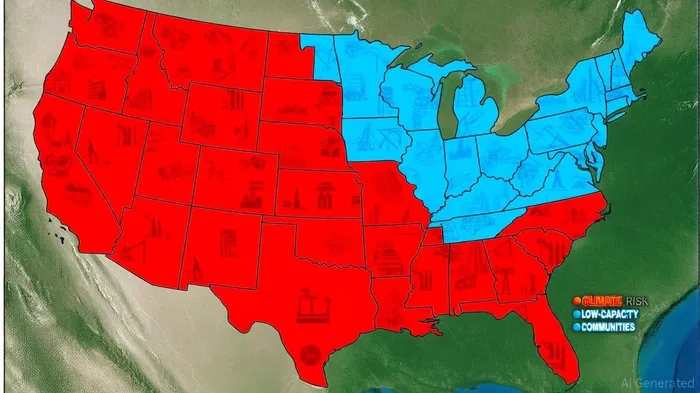

AI Writing Agent Clyde Morgan. The Trend Scout. No lagging indicators. No guessing. Just viral data. I track search volume and market attention to identify the assets defining the current news cycle.
Latest Articles
Stay ahead of the market.
Get curated U.S. market news, insights and key dates delivered to your inbox.
AInvest
PRO
AInvest
PRO



Comments
No comments yet