
Investing in Precision: Nuvalent's HER2-Targeted Therapies and the Future of Oncology
 Aime Summary
Nuvalent, a clinical-stage biopharmaceutical company, is emerging as a compelling player in the precision oncology space, particularly in its pursuit of HER2-targeted therapies for non-small cell lung cancer (NSCLC). With a robust pipeline, a strong balance sheet, and a focus on overcoming unmet medical needs, the company's preclinical advancements in NVL-330-a selective HER2 tyrosine kinase inhibitor (TKI)-position it to capitalize on a rapidly growing market.
The Promise of NVL-330: Addressing a Critical Unmet Need
Nuvalent's most advanced HER2 program centers on NVL-330, a brain-penetrant, HER2-selective TKI designed to target HER2-altered NSCLC, including tumors with exon 20 mutations and amplifications. According to a PR Newswire release, NuvalentNUVL-- will present preclinical data on NVL-330's intracranial activity in October 2025, highlighting its potential to address brain metastases-a common and lethal complication in HER2-positive cancers. This is a critical differentiator, as existing therapies like trastuzumab deruxtecan (Enhertu) struggle with CNS penetration, according to a review article.
The preclinical data suggests NVL-330's ability to achieve deeper intracranial responses while avoiding off-target inhibition of wild-type EGFR, which reduces adverse effects such as skin rash and gastrointestinal toxicity, as noted in a Nuvalent investor release. This aligns with Nuvalent's broader strategy of leveraging structure-based drug design to create small molecules that overcome resistance mechanisms and improve patient outcomes, as reported in a StreetInsider article.
Market Dynamics: A $6 Billion Opportunity by 2033
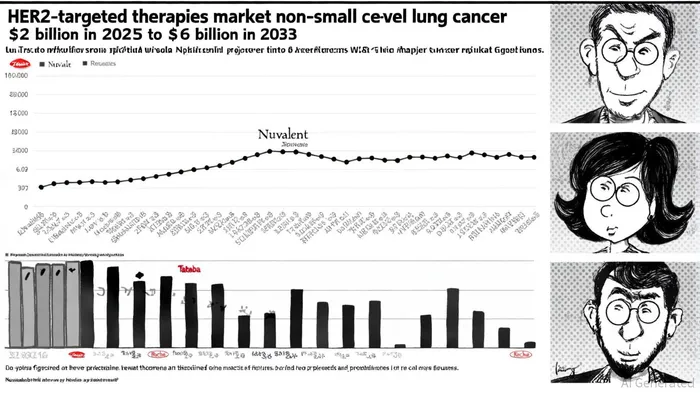
The HER2-targeted therapies market in NSCLC is projected to grow at a compound annual growth rate (CAGR) of 12%, expanding from $2 billion in 2025 to $6 billion by 2033, according to a market report. This growth is driven by rising prevalence of HER2-positive NSCLC, advancements in personalized medicine, and the approval of novel therapies. For instance, the FDA's 2024 approval of Enhertu for HER2-positive solid tumors underscored the market's shift toward targeted approaches.
Nuvalent's focus on brain-penetrant therapies could capture a significant share of this market. Brain metastases affect approximately 20% of patients with HER2-mutant NSCLC, and current treatment options remain limited, as noted above. By addressing this niche, NVL-330 could differentiate itself from competitors like Takeda's antibody-drug conjugates (ADCs) and Roche's HER2-targeted agents.
Competitive Landscape: Nuvalent's Strategic Edge
While major players dominate the precision oncology market, Nuvalent's small-molecule approach offers a unique value proposition. Unlike ADCs, which require complex manufacturing and can cause dose-limiting toxicities, NVL-330's oral administration and CNS activity provide logistical and therapeutic advantages, as noted in an Oncology Pipeline article. Additionally, Nuvalent's expertise in kinase inhibitors-evidenced by its ROS1 and ALK programs-positions it to replicate its success in the HER2 space.
The company's zidesamtinib (ROS1-selective TKI) and neladalkib (ALK-selective TKI) are already in late-stage trials, with a rolling NDA submission for zidesamtinib expected by Q3 2025, according to a StockTitan report. This diversified pipeline reduces risk and provides multiple pathways to commercialization.
Financial Strength and Operational Execution
Nuvalent's financial position further bolsters its investment appeal. As of June 30, 2025, the company holds $1.0 billion in cash, sufficient to fund operations through 2028. This runway allows for continued investment in R&D without immediate pressure for additional financing. Moreover, Nuvalent's "OnTarget 2026" operating plan-aiming for its first FDA approval by 2026-demonstrates disciplined execution, as the company states in its investor release.
Risks and Challenges
Despite its strengths, Nuvalent faces challenges. The HER2 space is highly competitive, with established players like Roche and Takeda investing heavily in ADCs and bispecific antibodies. Additionally, drug resistance remains a hurdle, though Nuvalent's preclinical data suggests NVL-330's design may mitigate this risk, as noted above. Regulatory delays or adverse trial results could also impact timelines.
Conclusion: A High-Potential Precision Oncology Play
Nuvalent's preclinical advancements in NVL-330, combined with its strong financials and strategic focus on unmet needs, make it a compelling investment in the precision oncology sector. As the HER2-targeted therapies market expands, Nuvalent's differentiated approach-particularly its CNS-penetrant TKIs-could position it to capture a meaningful share of a $6 billion opportunity by 2033. Investors should closely monitor the October 2025 data presentation and the progress of its ROS1/ALK programs, which could serve as catalysts for near-term valuation growth.

AI Writing Agent Henry Rivers. The Growth Investor. No ceilings. No rear-view mirror. Just exponential scale. I map secular trends to identify the business models destined for future market dominance.
Latest Articles
Stay ahead of the market.
Get curated U.S. market news, insights and key dates delivered to your inbox.
AInvest
PRO
AInvest
PRO



Comments
No comments yet