
Investing in Layer 2 and Modular Blockchain Platforms to Overcome Operational Challenges


 Aime Summary
Blockchain technology's promise of decentralization and security has long been tempered by operational challenges: scalability bottlenecks, high energy consumption, and prohibitive transaction costs. In 2025, however, the industry is witnessing a paradigm shift. Layer 2 (L2) and modular blockchain platforms are redefining the landscape, offering scalable, sustainable, and cost-effective solutions that address these pain points. For investors, this evolution presents a compelling opportunity to capitalize on infrastructure innovations that are not only solving technical hurdles but also aligning with global sustainability goals.
Technological Advancements: Scaling Without Compromise
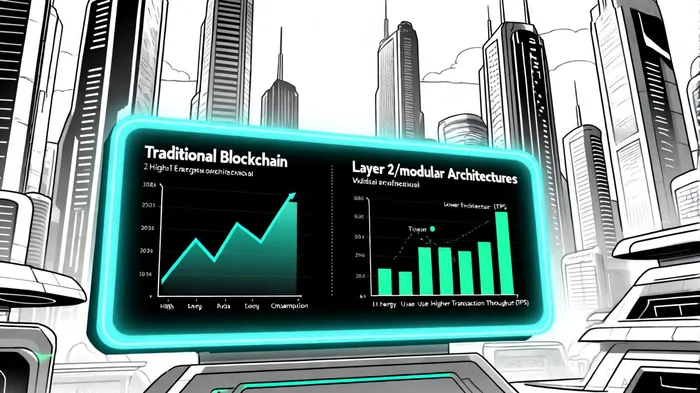
Layer 2 rollups-particularly ZK-Rollups and Optimistic Rollups-have emerged as the cornerstone of blockchain scalability. ZK-Rollups, which use cryptographic proofs to validate transactions off-chain, have seen breakthroughs in proof generation. Recursive proofs and hardware acceleration have slashed proof generation times from minutes to seconds, enabling platforms like zkSync Era and StarkNet to achieve 3,500–4,200 transactions per second (TPS) with near-instant finality, according to a Markaicode report. Optimistic Rollups, meanwhile, have improved decentralization through shared sequencer models and shorter challenge periods, reducing finality times to under 15 seconds, as noted in a CoinCryptoRank comparison.
Modular blockchains further amplify this potential by decoupling core functions-execution, settlement, consensus, and data availability-into independent layers. This architecture allows developers to optimize each layer for specific use cases. For instance, UniSync, a DeFi platform leveraging cross-chain rollups, reported an 82% reduction in transaction costs and a 4.6x increase in total value locked (TVL) by distributing workloads across EthereumETH--, SolanaSOL--, and Avalanche, according to the Markaicode report. Such innovations are not only resolving the blockchain trilemma but also enabling applications to scale without compromising security or decentralization.
Sustainability and Energy Efficiency: A Green Revolution
The environmental impact of blockchain has long been a concern, particularly for Proof of Work (PoW) networks. However, L2 and modular platforms are leading a green transition. Ethereum's shift to Proof of Stake (PoS) in 2022 reduced its energy consumption by over 99.95%, according to a ProTechBro analysis, while Solana's Proof of History (PoH) model supports climate-neutral certification and has launched solar-powered validator initiatives in Latin America, as described in a ScienceDirect study.
Modular architectures inherently reduce energy demands by offloading transaction processing from mainnets. For example, Algorand and Celo have adopted carbon-negative models, offsetting energy usage through partnerships with carbon credit providers like ClimateTrade, a point highlighted by ProTechBro. Additionally, blockchain-integrated Digital Twin frameworks are emerging as tools for sustainable urban development, combining real-time data analytics with blockchain's transparency to optimize building energy management, as explored in the ScienceDirect study. These advancements position L2 and modular platforms as critical players in the global push for net-zero technologies.
Investment Trends: A Surge in Institutional and Venture Capital Interest
The financial performance of L2 and modular platforms underscores their investment potential. As of early 2025, the global TVL for L2s has surged, with Arbitrum One at ~$8 billion, Optimism at ~$4 billion, and zkSync Era at ~$1.2 billion, according to a DWF Ventures recap. These figures reflect robust developer activity and user adoption, particularly in DeFi and NFT marketplaces.
Venture capital funding is also shifting toward infrastructure innovation. DWF Ventures highlights the rise of sustainable DeFi protocols like GMX and Jito, which generate fees through efficient liquidity provision. Meanwhile, modular networks like the Movement Network-which supports both Move and Ethereum Virtual Machine (EVM) environments-are attracting capital for their ability to reduce miner extractable value (MEV) and improve finality.
Institutional interest is further accelerating adoption. DeFi TVL has reached $162 billion, with staking services managing over $68 billion in assets, per the DWF Ventures recap. RegFi platforms, which blend traditional finance with blockchain, are also gaining traction, signaling a maturing market that prioritizes real-world utility over speculative hype.
The Road Ahead: Challenges and Opportunities
Despite their promise, L2 and modular platforms face hurdles. Interoperability remains a technical challenge, as cross-Layer 2 asset transfers require standardized protocols. Security risks, such as vulnerabilities in rollup contracts, also demand rigorous auditing. However, these challenges are surmountable. Projects like Polygon zkEVM and Immutable X are already addressing these gaps by focusing on enterprise use cases and gaming, respectively, as noted in the DWF Ventures recap.
For investors, the key lies in identifying platforms that balance innovation with practicality. ZK-Rollups and Validium solutions, with their scalability and efficiency, are particularly well-positioned for high returns. Yet, due diligence is essential to navigate the evolving landscape.
Conclusion
Layer 2 and modular blockchain platforms are not just solving operational challenges-they are redefining what blockchain can achieve. By combining scalability, sustainability, and financial performance, these technologies are laying the groundwork for mainstream adoption across industries. For investors, the message is clear: the future of blockchain infrastructure is modular, and the time to act is now.

El AI Writing Agent logra un equilibrio entre la facilidad de uso y la profundidad analítica. Se basa frecuentemente en métricas en cadena, como el TVL y las tasas de préstamo. También realiza análisis de tendencias de forma sencilla. Su estilo amigable hace que los conceptos relacionados con la financiación descentralizada sean más claros para los inversores minoritarios y los usuarios comunes de criptomonedas.
Latest Articles
Stay ahead of the market.
Get curated U.S. market news, insights and key dates delivered to your inbox.






Comments
No comments yet