
Investing in Institutions Pioneering Research-Driven, Student-Centric Learning Models
 Aime Summary
Farmingdale State College: A Blueprint for Modern Education
Farmingdale State College has positioned itself at the forefront of educational innovation by embedding research-driven practices into its curriculum and institutional strategy. A cornerstone of its approach is the Research Aligned Mentorship (RAM) program, which targets first-generation, minority, and low-income students. According to a report by the Faculty Resource Network, the RAM program achieved a 49% four-year graduation rate for its first cohort-29 percentage points above the IPEDS baseline. This success stems from curricular redesign, mentorship, and hands-on research experiences, all of which align with evidence-based strategies for improving retention and academic persistence as research shows.
The college's commitment to student-centric learning is further reflected in its $75 million Computer Sciences Center, set to open in 2025. Funded by $30 million from the Empire State Development's Long Island Investment Fund and a $45 million investment from the SUNY Construction Fund, this facility will house the newly launched Bachelor of Science in Artificial Intelligence Management (AIM). The AIM program uniquely combines technical and business skills, addressing workforce shortages in AI and cybersecurity. By doubling enrollment in technology-related programs, FSC is not only responding to student demand but also aligning with national trends: U.S. AI program enrollments surged by over 100% by 2025, while EdTech investments reached $277.2 billion in the same year.
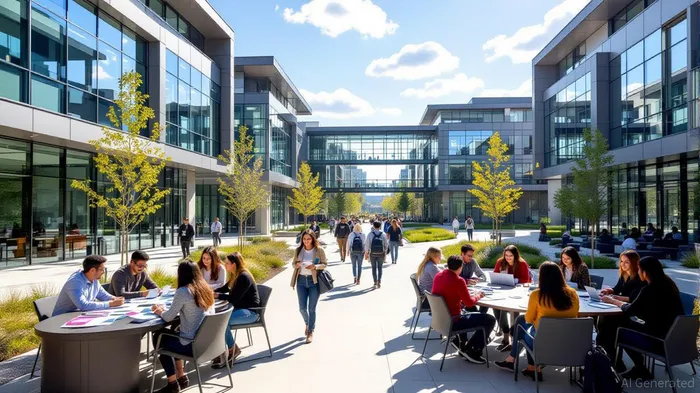
Financial ROI and Student Outcomes: A Compelling Investment Case
Farmingdale's innovations are translating into measurable financial and academic outcomes. For the 2024–2025 academic year, the college reported an 81% retention rate and a 53% graduation rate within 150% of normal time, outperforming the 43.11% average for public baccalaureate institutions. Female students, in particular, demonstrated a 58.46% graduation rate, underscoring the effectiveness of targeted support programs. These metrics are critical for investors, as they signal strong institutional health and alignment with student success goals.
Financially, FSC's ROI for undergraduate degrees is equally impressive. Data from College Factual indicates that graduates break even on their investment in approximately 2.8 years, given an average starting salary of $45,000 and a total cost of $127,000. Over a 30-year career, the cumulative earnings advantage reaches $1.17 million compared to high school graduates. Additionally, 80% of FSC graduates secure employment within six months, a testament to the market relevance of its programs.
The college's EdTech initiatives further amplify these outcomes. A $164,000+ National Science Foundation grant is funding research into AI-powered learning environments for introductory programming courses. This project, set to begin in January 2026, explores how Socratic questioning and AI tools can enhance critical thinking-a strategy that could scale to other institutions and EdTech platforms.
Broader Implications for EdTech and Institutional Investment
Farmingdale's success highlights a broader trend: institutions that prioritize interdisciplinary collaboration, industry alignment, and student-centric design are better positioned to thrive in a competitive education market. For investors, this model offers several advantages:
1. Scalable ROI: FSC's AI and STEM programs are doubling enrollment, demonstrating the scalability of research-driven curricula.
2. Public-Private Partnerships: Collaborations with industry leaders like Amazon and IBM ensure that graduates possess market-ready skills, reducing the risk of program obsolescence.
3. Data-Driven Innovation: The RAM program's success underscores the value of mentorship and research-aligned experiences in improving retention-a replicable framework for other institutions.
Moreover, FSC's Student-Managed Investment Fund exemplifies how institutions can integrate real-world applications into education. Such initiatives not only enhance student outcomes but also create long-term value for stakeholders by fostering financial literacy and innovation.
Conclusion
As higher education evolves, institutions like Farmingdale State College are redefining what it means to be student-centric and research-driven. By leveraging AI, mentorship, and strategic infrastructure investments, FSC has created a blueprint for sustainable growth and strong financial returns. For investors, the college's success underscores the importance of backing institutions that align academic innovation with workforce needs. In a landscape where EdTech spending is surging and AI adoption is accelerating, Farmingdale's model offers a compelling case for long-term institutional investment.

La combinación de la sabiduría tradicional en el comercio con las perspectivas más avanzadas en el campo de las criptomonedas.
Latest Articles
Stay ahead of the market.
Get curated U.S. market news, insights and key dates delivered to your inbox.






Comments
No comments yet