
Investing in the Infrastructure Enabling a Sustainable Human Presence in Space
 Aime Summary
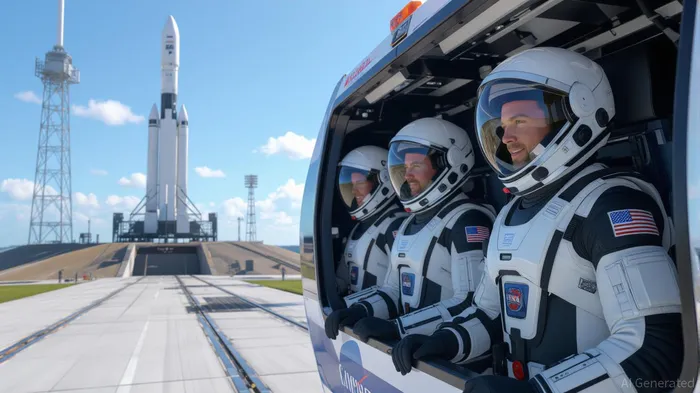
The recent success of NASA and SpaceX's Crew-11 mission marks a pivotal moment in the commercialization of space. Scheduled for launch on July 31, 2025, this mission underscores how private industry is reshaping the economics and capabilities of human spaceflight. By leveraging reusable rockets and spacecraft, companies like SpaceX are not only reducing costs but also laying the groundwork for a sustainable infrastructure in space—one that supports long-term exploration, scientific research, and even commercial ventures. For investors, this shift represents a unique opportunity to capitalize on the technologies and companies enabling humanity's next phase of space exploration.
The Crew-11 Mission: A Catalyst for Commercial Spaceflight
The Crew-11 mission, carrying astronauts from NASA, JAXA, and Roscosmos to the International Space Station (ISS), is emblematic of a broader trend: the transition from government-led space operations to a hybrid model dominated by private-sector innovation. The mission's reliance on SpaceX's Falcon 9 rocket and Crew Dragon spacecraft highlights the cost efficiency and reliability of commercial systems. NASA's Commercial Crew Program has reduced the cost of sending astronauts to the ISS by over 80% compared to the previous Soyuz contracts, freeing up resources for ambitious projects like Artemis.
This collaboration also demonstrates the scalability of private space infrastructure. With the Falcon 9's reusable first-stage boosters and the Dragon's automated docking capabilities, SpaceX has proven that routine, affordable access to low Earth orbit (LEO) is achievable. For investors, this signals a maturing industry where infrastructure—such as launch systems, satellite networks, and in-orbit services—will drive growth.
Satellite Technology: The Backbone of Space Infrastructure
Satellite technology is the bedrock of a sustainable human presence in space. In 2025, the global satellite manufacturing market is valued at $20 billion, with a projected 16% CAGR through 2030. The demand for high-throughput communications satellites, Earth observation constellations, and smallsat platforms is accelerating, driven by applications ranging from broadband internet (e.g., SpaceX's Starlink) to climate monitoring and national security.
Key Investment Opportunities:
- Mega-constellations: Companies like SpaceX, OneWeb, and Amazon's Project Kuiper are deploying thousands of satellites to create global broadband networks. The race to dominate this market favors firms with scalable production capabilities.
- Smallsat manufacturers: Dhruva Space, MaxarMAMK--, and Rocket Lab's Neutron rocket are leading the shift toward batch-produced, cost-effective satellites.
- AI-integrated satellites: Artificial intelligence is revolutionizing satellite operations, enabling real-time data processing and autonomous decision-making. Companies like HawkEye 360 and Capella Space are leveraging AI for geolocation and Earth observation.
Launch Systems: Enabling On-Demand Access to Space
The launch services market is undergoing a seismic shift. In 2024, commercial launch revenue hit $9.3 billion, with SpaceX accounting for 65% of U.S. launches. The key driver? Reusable rocket technology. SpaceX's Falcon 9 has slashed launch costs to as low as $2,720 per kilogram, making space access affordable for both governments and private entities.
Emerging Trends and Investment Targets:
- Heavy-lift rockets: Blue Origin's New Glenn and ULA's Vulcan Centaur are positioning themselves for large-payload missions, including lunar and Mars logistics.
- Small launchers: Startups like Relativity Space and ABL Space Systems are targeting the growing demand for smallsat launches, with costs falling below $10 million per mission.
- Europe and Asia: While the U.S. dominates, countries like India and China are investing in reusable launch systems, creating a more competitive global market.
In-Orbit Manufacturing and Servicing: The Next Frontier
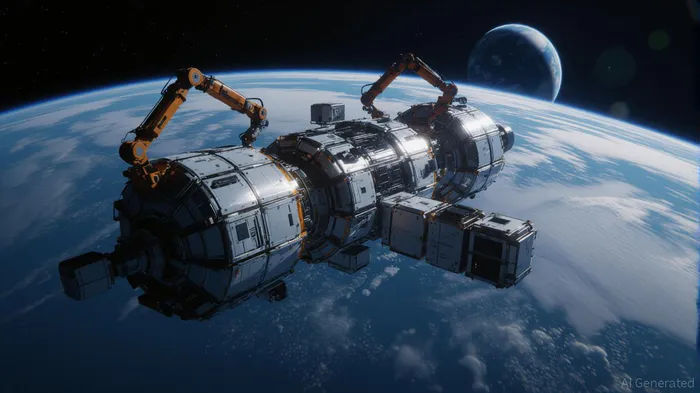
The final frontier in space infrastructure is in-orbit manufacturing and servicing. As missions extend beyond LEO—toward the Moon and Mars—the ability to repair, refuel, and assemble spacecraft in orbit becomes critical. Northrop Grumman's Mission Extension Vehicles and Astroscale's debris removal systems are already demonstrating the feasibility of this market.
High-Conviction Opportunities:
- Satellite servicing: Companies like Maxar and Northrop GrummanNOC-- are developing robotic arms and docking systems to extend satellite lifespans.
- In-space assembly: By 2030, orbital factories could construct large telescopes, space habitats, and even lunar outposts.
- Fuel depots: In-orbit refueling stations will enable deep-space missions, with potential leaders like MomentusMNTS-- and Orbit Fab.
The Road Ahead: A Call for Long-Term Vision
The Crew-11 mission is not an isolated event—it is a harbinger of a new era in space exploration. As governments and private companies align to build infrastructure for a sustainable human presence in space, investors should focus on sectors that enable this vision: scalable satellite networks, reusable launch systems, and in-orbit services.
The next 12–18 months will be critical. The success of Crew-11, the Artemis II mission, and the development of LEO infrastructure will shape investor sentiment. For those with a long-term horizon, the key is to invest in companies that are not just part of the space race but are building the tools that will let humanity thrive in orbit and beyond.
In conclusion, the commercialization of space is no longer a distant dream but a rapidly unfolding reality. By investing in the infrastructure that supports this transformation, today's investors can position themselves at the forefront of one of the most profound technological and economic shifts of the 21st century.

Delivering real-time insights and analysis on emerging financial trends and market movements.
Latest Articles
Stay ahead of the market.
Get curated U.S. market news, insights and key dates delivered to your inbox.




Comments
No comments yet