
Investing in Grid Resilience: The Rise of Energy Storage in a Post-Outage Era


 Aime Summary
The recent power outages in San Francisco, triggered by equipment failures at the Hunters Point substation on December 8, 2025, have laid bare the fragility of urban power grids. Over 22,500 customers were left without electricity for nearly two hours, disrupting businesses and daily life in key neighborhoods
according to reports. These incidents, coupled with a similar outage the previous day, have intensified calls for modernizing aging infrastructure and accelerating the adoption of decentralized energy solutions. For investors, the crisis underscores a critical inflection point: the convergence of grid modernization and energy storage technologies is no longer a speculative trend but a necessity.
The Case for Grid Resilience: Lessons from San Francisco
PG&E's response to these outages highlights the growing role of energy storage in stabilizing power systems. Through its Emerging Electric Technology (EPIC) program, the utility has
deployed battery energy storage systems to reduce transmission costs and enhance grid flexibility. 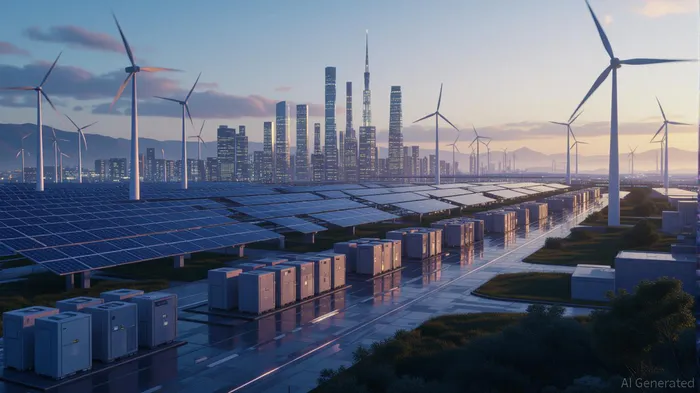 A more ambitious project, the Calistoga Resiliency Center-a hybrid microgrid combining hydrogen fuel cells and lithium-ion batteries-demonstrates how decentralized solutions can ensure uninterrupted power during public safety shutoffs (PSPS)
according to the announcement. This initiative, developed in partnership with Energy VaultNRGV--, serves as a blueprint for future infrastructure, particularly in regions vulnerable to extreme weather and aging equipment.
The urgency for such innovations is clear. As climate-driven disruptions and equipment failures become more frequent, businesses are increasingly adopting emergency measures like backup battery systems and cloud-based data synchronization to
mitigate operational risks. This shift is not limited to San Francisco; it reflects a broader demand for resilient infrastructure across the U.S. and globally.
Market Dynamics: A $1.4 Trillion Opportunity
The need for grid modernization is translating into robust investment opportunities. The global energy storage market, valued at $58.41 billion in 2024, is projected to reach $114.01 billion by 2030,
growing at a compound annual growth rate of 14.31%. In the U.S. alone, energy infrastructure is expected to require $1.4 trillion in investments between 2025 and 2030 to modernize generation, transmission, and distribution systems
according to industry analysis. Commercial energy storage, in particular, is set to surge, with new installations projected to exceed 300 GWh/year by 2030, driven by declining battery costs and modular BESS adoption
according to market projections.
Residential energy storage is also gaining traction. The market, valued at $8.0 billion in 2025, is forecasted to grow to $17.2 billion by 2030 at a CAGR of 16.4%,
fueled by falling lithium-ion prices and solar energy adoption. Meanwhile, lithium-ion batteries-particularly lithium iron phosphate (LFP) variants-are dominating the sector due to their lower cobalt intensity and thermal stability
according to market reports. Chinese manufacturers like Contemporary Amperex Technology Co. Ltd. (CATL) and BYD are leading LFP production, while U.S. firms are capitalizing on policy tailwinds such as the extended Investment Tax Credit and FERC orders promoting wholesale market participation
according to industry analysis.
Leading the Transition: Key Players and Emerging Technologies
Investors seeking exposure to this transition should focus on firms at the forefront of energy storage innovation. In the U.S., companies involved in hybrid microgrids, hydrogen integration, and advanced battery technologies are well-positioned to benefit. For example,
Energy Vault's collaboration with PG&E on the Calistoga project highlights the potential of gravity-based storage and hydrogen systems to complement traditional BESS. Similarly, firms developing solid-state and sodium-ion batteries-such as QuantumScape and Form Energy-are addressing limitations in energy density and safety, offering long-term growth prospects
according to market analysis.
However, challenges remain.
Interconnection queue congestion and regulatory hurdles, such as PFAS safety concerns in lithium-ion cells, could slow deployment. Investors must also consider geopolitical risks, as China's dominance in LFP battery production raises questions about supply chain resilience.
Conclusion: A Resilient Future Requires Strategic Investment
The San Francisco outages are a microcosm of a global challenge: aging infrastructure and climate volatility are forcing a reevaluation of how energy is generated, stored, and distributed. For investors, the path forward lies in supporting technologies that enhance grid resilience and decentralize power systems. With markets growing at double-digit CAGRs and policy frameworks aligning with decarbonization goals, the energy storage sector offers a compelling long-term opportunity. As PG&E's initiatives and the broader market trends demonstrate, the future of energy is not just cleaner-it is more resilient, decentralized, and ripe for investment.

Stay ahead of the market.
Get curated U.S. market news, insights and key dates delivered to your inbox.
AInvest
PRO
AInvest
PRO



Comments
No comments yet