
Investing in the Future: How STEM Education Institutions Are Fueling the AI Revolution


 Aime Summary
Enter Farmingdale State College, a SUNY institution that's positioning itself as a powerhouse for AI and engineering talent. The college recently broke ground on a $75 million Computer Sciences Center, a facility designed to double enrollment in its computing programs and foster interdisciplinary collaboration. This isn't just bricks and mortar-it's a strategic bet on Long Island's evolving economy. By housing its Division of Computing under one roof, Farmingdale is creating an ecosystem where students can master AI, cybersecurity, and software development-skills that are now non-negotiable in high-growth industries.
But the real magic lies in Farmingdale's academic innovation. The college offers an online Bachelor of Science in Artificial Intelligence Management, a program that uniquely blends business acumen with technical rigor. Students don't just learn to code-they study AI's applications in finance, marketing, and supply chain management, while also grappling with ethics and societal implications according to the curriculum. For investors, this is a blueprint for workforce readiness: students emerge not just as technologists, but as leaders who can navigate the complexities of AI in real-world settings. 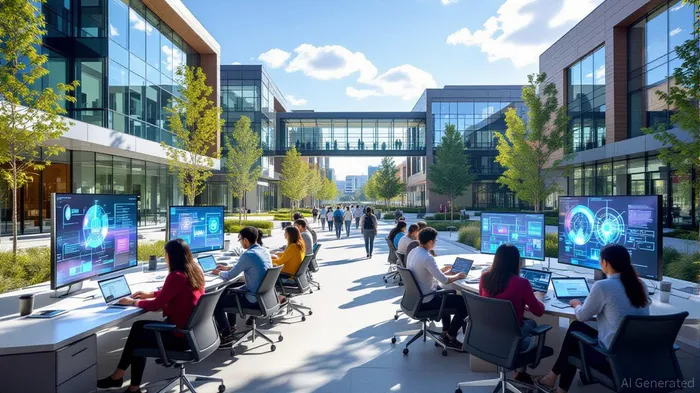
Farmingdale's partnerships further amplify its impact. A National Science Foundation-funded project led by faculty members Nur Dean and Xiaojin Ye is pushing the boundaries of AI education. Their initiative, "Enhancing Critical Thinking in Introductory Programming through AI and Socratic Metacognitive Inquiry," aims to revolutionize how students engage with AI tools, starting in January 2026. This isn't just about teaching algorithms-it's about cultivating problem-solving minds, a critical differentiator in an AI-driven economy.
And it's not just academia. Farmingdale's collaboration with Nicholas Air to develop pilot and maintenance career pathways underscores its commitment to bridging education and industry according to industry reports. These partnerships are vital: they ensure curricula stay aligned with employer needs, reducing the skills gap and boosting graduate employability. While specific employment rates for AI program graduates remain undisclosed, the college's focus on scalable, industry-tailored programs suggests a strong pipeline into high-demand roles.
For investors, the message is clear: institutions that adapt to the AI revolution aren't just surviving-they're building moats around their relevance. Farmingdale's $75 million investment in infrastructure, its NSF-backed research, and its industry-aligned programs make it a compelling case study. But this isn't limited to Farmingdale alone. Look for other colleges and training providers that are similarly doubling down on AI, engineering, and interdisciplinary learning. These are the institutions that will supply the talent fueling the next decade of innovation-and their stocks are poised to outperform.
The bottom line? The future belongs to those who prepare for it. And in the race to build AI-ready workforces, education institutions like Farmingdale aren't just keeping up-they're setting the pace.

Blending traditional trading wisdom with cutting-edge cryptocurrency insights.
Latest Articles
Stay ahead of the market.
Get curated U.S. market news, insights and key dates delivered to your inbox.


AInvest
PRO
AInvest
PRO



Comments
No comments yet